The Saadian Dynasty: Sugar, Gold, and the Marrakech Tombs They Built and Then Someone Sealed Shut
The Saadians: What They Built, What They Conquered, and Why Someone Sealed Their Tombs
The Saadian Tombs in Marrakech are sealed from outside in a way that is not obvious when you visit them now, because the entrance has been reopened and the interior restored for visitor access. But for approximately 250 years — from the early 18th century to 1917 — the tombs were completely sealed: the doors walled up, the entrances blocked, the interior inaccessible. The sealing was ordered by Moulay Ismail, the Alaouite sultan who destroyed much of the Saadian building legacy elsewhere in Morocco, but who apparently could not bring himself to demolish the tombs — a act of sacrilege against the dead that even Moulay Ismail’s political ruthlessness would not extend to — and instead sealed them, hoping that what was inaccessible would be forgotten.
It was not forgotten. The French discovered the sealed tomb complex in 1917 through aerial photography, which revealed the outline of a large enclosed structure adjacent to the Kasbah mosque in a part of Marrakech that ground-level movement had not thoroughly mapped. When the sealing was removed and the interior entered for the first time in two and a half centuries, the tombs were found to be substantially intact — the carved plaster, the zellige, the cedar ceilings undamaged — preserved by the sealed enclosure that Moulay Ismail had intended as a final obscurity.
Who Were the Saadians and How Did They Come to Power?
The Saadian dynasty was a Sharif family from the Draa Valley — sharifs claiming prophetic descent, as always in the Moroccan legitimacy framework — who rose to power in the early 16th century by positioning themselves as leaders of resistance to the Portuguese presence on Morocco’s Atlantic coast. The Portuguese had established fortified trading posts at Safi, Azemmour, and Agadir, and the Saadian presentation of their military campaigns against these posts as jihad gave them religious-political legitimacy beyond their tribal base.
By 1554, the Saadians had unified Morocco, expelled or neutralized the Portuguese presence on the coast, and established Marrakech as their capital. Their rule over Morocco lasted from this consolidation until 1659, when the Alaouite dynasty replaced them.
The dynasty’s most significant military achievement — and one of the most remarkable military events in Moroccan history — was the 1591 invasion of the Songhai Empire. Sultan Ahmad al-Mansur sent an army of approximately 4,000 soldiers (including a significant number of Spanish and Portuguese renegados — European converts to Islam serving as firearms specialists) across the Sahara to attack and destroy the Songhai Empire centered in Timbuktu and Gao. The adventure across the Sahara alone — in desert conditions, in summer — was an achievement of military logistics that contemporaries found astonishing. The Songhai army, vastly larger, was defeated at the Battle of Tondibi primarily because the Moroccan force had firearms and the Songhai did not.
The conquest of the Songhai territories gave Ahmad al-Mansur access to the gold and salt revenues of the Western Sudan, which funded the building program that produced the Saadian Tombs and the contemporaneous al-Badi palace in Marrakech.
What Are the Saadian Tombs and What Should You Look At?
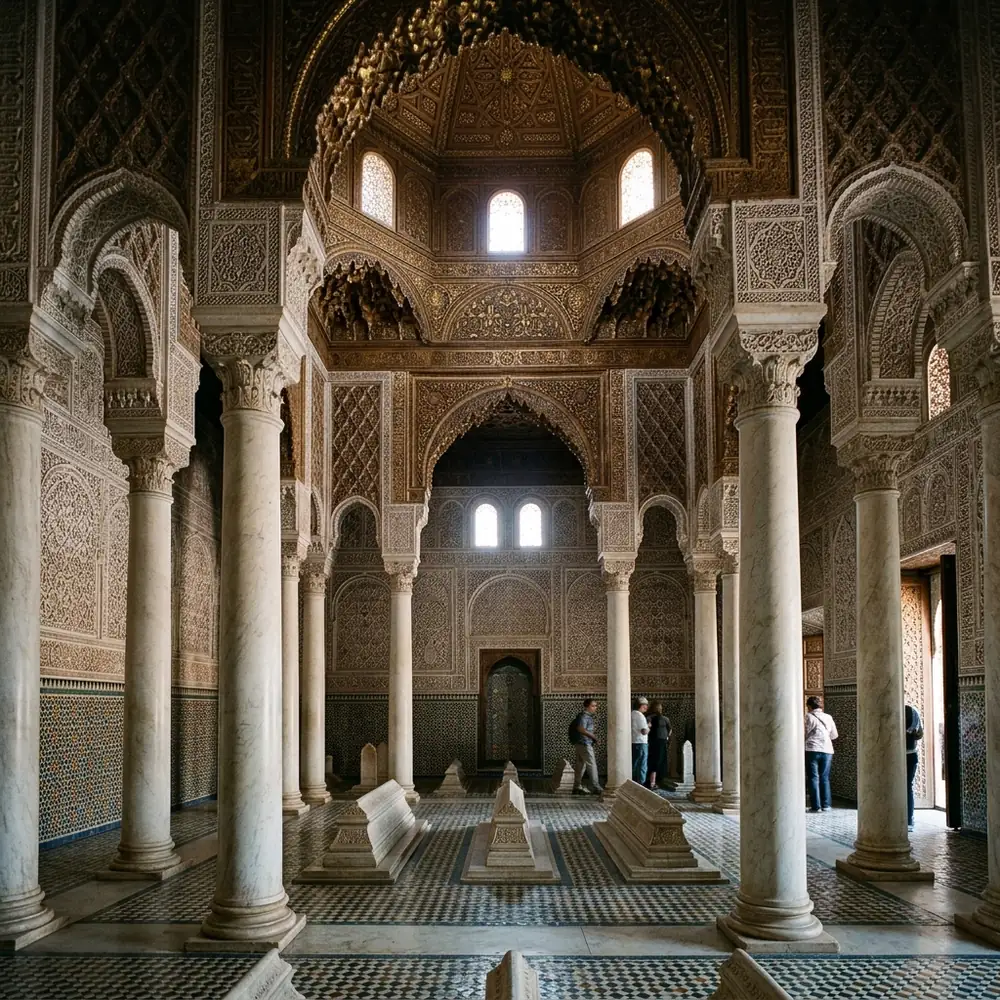
The tomb complex, which served as the royal necropolis of the Saadian dynasty, consists of two principal mausoleum chambers and a courtyard with external graves.
The main chamber — the Hall of the Twelve Columns — contains the tomb of Ahmad al-Mansur himself and the tombs of his successors, organized around a central space defined by twelve columns of Italian Carrara marble supporting a carved cedar ceiling of extraordinary quality. The ceiling — stalactite-form muqarnas carved from cedar and painted with the original polychrome decoration substantially intact — is the primary architectural achievement of the chamber and is the element that makes the Saadian Tombs’ interior genuinely remarkable rather than simply important.
The zellige, the carved plaster, the marble columns — all are fine work, better than most comparable Moroccan funerary architecture. But the cedar muqarnas ceiling is extraordinary in a different way: it produces a specific quality of overhead space, the stalactite forms creating an irregular, cave-like ceiling that is simultaneously complex and organic, quite different from the flat-panel cedar ceilings of the madrasa tradition. It is one of the finest pieces of wood carving in Morocco and one of the finest pieces of Islamic architectural decoration in the world.
Why Did Moulay Ismail Seal the Tombs but Not Destroy Them?
The answer is in the Islamic prohibition on desecrating burial sites. Moulay Ismail was ruthless in stripping the Saadian building legacy — the al-Badi palace, which had been described by contemporaries as one of the most magnificent buildings in the Islamic world, was systematically demolished and its materials (including the Carrara marble) transported to Meknès for the building program. But the tombs were different: they contained the bodies of the Saadian dead, and demolishing them would have been an act of desecration that would have been politically and religiously costly even for a ruler of Moulay Ismail’s authority.
The sealing was the compromise: the tombs were made inaccessible — effectively erased from the accessible landscape of Marrakech — without the sacrilege of disturbing the dead. It was a solution that was both politically intelligent and ultimately futile, since what is architecturally extraordinary does not stay invisible, even for 250 years.
The Invisible Invitation
Arrive at the Saadian Tombs as early as the site opens — the visitor numbers at peak hours make the interior chambers uncomfortably crowded and the experience of the architecture substantially reduced. In the Hall of the Twelve Columns, position yourself at the center of the space and look directly up at the muqarnas ceiling. The stalactite forms radiate from the central apex, each form carved from cedar in the same basic shape but differing in detail, the painted zouak decoration visible in the lower sections where restoration has been most thorough. Follow one stalactite form from its smallest tip at the top to its widest point at the bottom where it meets the wall. Count the carving stages. Then look at the overall ceiling again as a complete composition. The form that was individual becomes the module. The module repeated becomes the ceiling. The ceiling becomes the space. This is the logic of the muqarnas, which is the logic of all Islamic ornament: the local generates the global, and the global is incomprehensible without the local. You have time to understand this. The ceiling has been waiting 400 years.
SEO Meta Description: Who were the Saadian dynasty? The Songhai Empire conquest, Ahmad al-Mansur, the Saadian Tombs Hall of Twelve Columns muqarnas ceiling, and why Moulay Ismail sealed rather than demolished the tombs.
Experience the true heart of Moroccan heritage through its culinary traditions. Join us in preserving and honoring these ancestral recipes.
What People Are Saying
No comments yet. Be the first — we'd love to hear from you.
Omar Idrissi
Culturally Verified & Fact-CheckedThe Moroccan Food editorial team brings together native culinary researchers, heritage preservationists, and experienced home cooks across Marrakech, Fes, and Casablanca. Every recipe and cultural guide is reviewed against ancestral oral traditions and authentic regional practices.