Sahara Camel Trek Guide: Merzouga vs Erg Chigaga, Overnight Camps, and Responsible Desert Tourism
Sahara Camel Trek Guide: Merzouga vs Erg Chigaga, Overnight Camps, and Responsible Desert Tourism
There’s a particular moment that happens to almost everyone on their first night in the Moroccan Sahara. You’re lying on a mat outside the tent, having tried and failed to sleep because the silence is so complete it feels like a physical presence. The stars are closer than they have any right to be. The sand still holds warmth from the day. You hear a camel shift its weight somewhere nearby. And then, slowly, a feeling settles over you that’s difficult to name — something between deep peace and the vertiginous awareness of your own smallness.
I’ve experienced that moment dozens of times, in different erg fields and different seasons. It still works. The Sahara still does that. And the question that matters for you, planning your trip, is: how do you create the conditions for that moment to happen, rather than spending the night in a glorified holiday camp with Wi-Fi?
Morocco’s Two Great Desert Destinations: Understanding the Difference
When people say ‘the Moroccan Sahara,’ they most often mean one of two places: Erg Chebbi near Merzouga, or Erg Chigaga near M’Hamid. Both are genuine Saharan erg fields — vast areas of sand dunes, some towering over 150 meters. But they are very different experiences.
Merzouga and Erg Chebbi
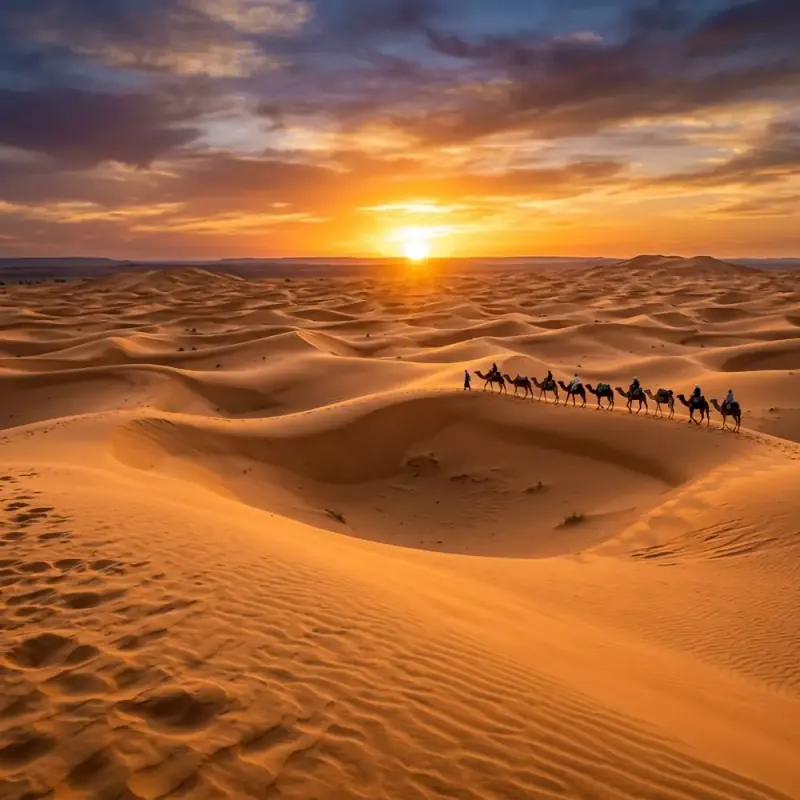
Erg Chebbi is the more famous, the more accessible, and the more photographed. The orange-red dunes rise directly behind the small town of Merzouga, about 50 kilometers south of Erfoud in the Tafilalet region. You can be sitting in a Marrakech café for breakfast and watching the sunset from a sand dune that evening — it’s that accessible.
This accessibility is both its greatest strength and its main compromise. The tourism infrastructure around Erg Chebbi has grown enormously in the past fifteen years. There are now dozens of desert camps, ranging from extremely basic to startlingly luxurious, and in peak season (especially around the December–January new year period and in spring) the dunes closest to Merzouga can feel busy.
But Erg Chebbi is also genuinely beautiful. The scale of the dunes — you can walk for forty minutes in any direction and feel entirely alone — is real. The colors at sunset and sunrise are real. And if you choose your camp carefully and time your ride to the quiet hours (before 7am or after 5pm when the day-trippers have retreated), the magic is absolutely available.
M’Hamid and Erg Chigaga
Erg Chigaga sits about 60 kilometers beyond M’Hamid, which is itself 100 kilometers south of Zagora, which is already deep in the Draa Valley. To reach Erg Chigaga, you need either a 4WD vehicle or a two-day camel trek from M’Hamid. Most visitors arrive by 4WD in two to four hours depending on route.
This additional distance is Erg Chigaga’s defining feature. Because it’s harder to reach, it receives fewer visitors, and the camps that exist here — there are perhaps a dozen, compared to hundreds near Merzouga — are more spaced out, more isolated, and more likely to offer something approaching genuine silence.
Erg Chigaga is also notably wilder. The dunes are large but the field is smaller than Erg Chebbi. What surrounds it — plains of hammada (flat rocky desert), ancient salt flats, occasional acacia trees — gives it a different character. Less postcard-perfect, more genuinely Saharan.
I’ve always been fascinated by how different the light is here compared to Erg Chebbi. The colors are warmer and more complex, influenced by the mineral content of the surrounding desert floor.
The Camel Trek: What It’s Actually Like
Let me be honest about camels, because the gap between expectation and reality is significant.
Camels are magnificent animals and completely indifferent to your enjoyment. They are strong, enduring, and occasionally possessed of a personality that suggests they’ve assessed you and found you mildly disappointing. The gait of a walking camel is deeply uncomfortable for the first thirty to forty-five minutes, until your body finds its rhythm.
After that — and this is the part nobody warns you about — it becomes genuinely wonderful. You’re at a height that gives you a different perspective on the desert. The sound of the camel’s feet in the sand is rhythmic and soft. The pace is exactly right for looking around rather than watching your feet.
Standard camel treks into the dunes take between sixty and ninety minutes each way. Longer treks (two or three days) are available from M’Hamid specifically, following the traditional caravan route to Erg Chigaga, camping in the open desert rather than at established camps. This is the more adventurous option and genuinely extraordinary for those with the time.
What to wear: loose, light clothing. Avoid shorts — you’ll be grateful for long trousers on the camel saddle. A scarf or keffiyeh for your face during windy periods. Sun protection everywhere.
Choosing Your Desert Camp: The Most Important Decision
The desert camp you choose determines your experience more than almost any other factor. Here’s how to think about it honestly.
What to avoid
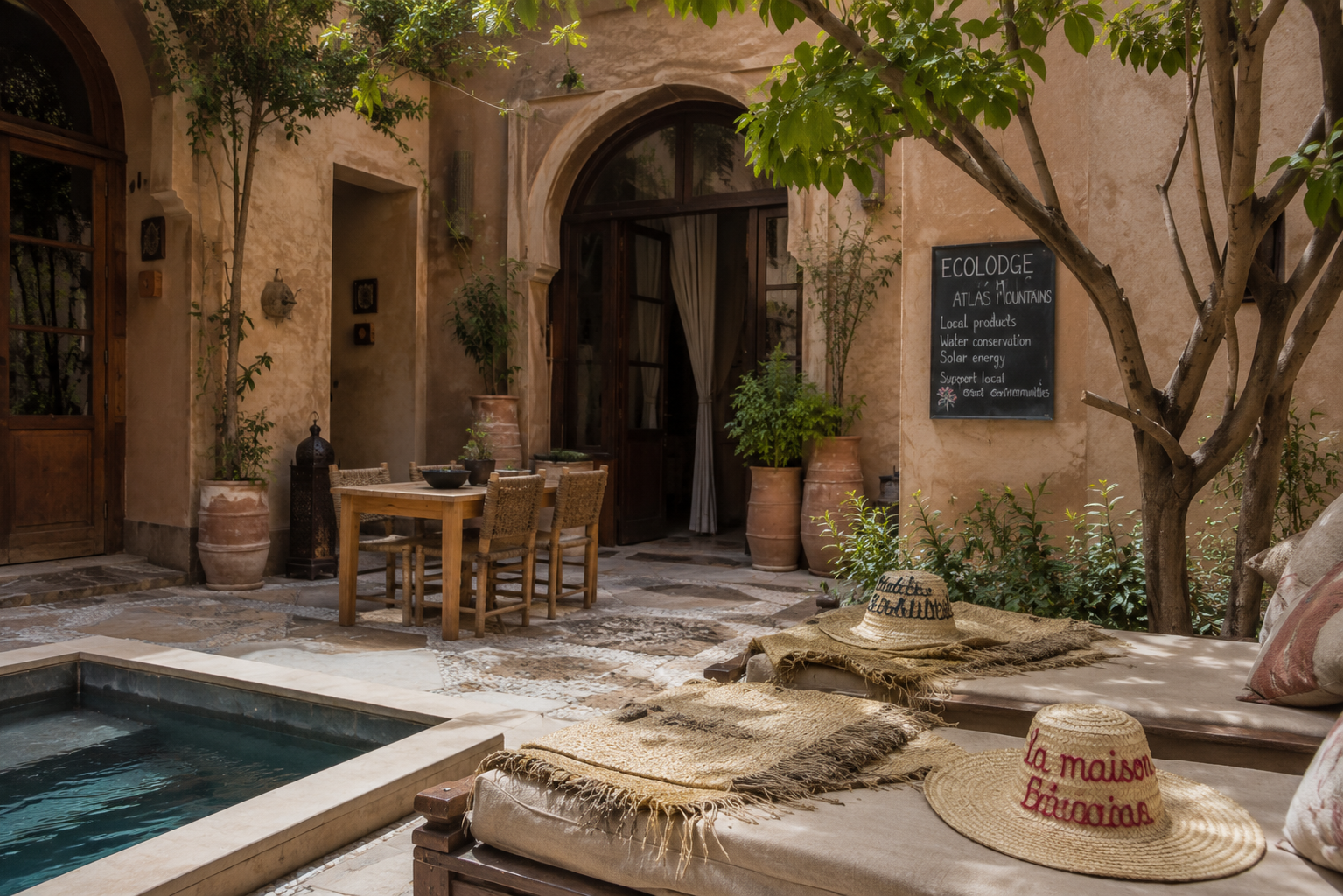
Camps that advertise private en-suite bathrooms with hot showers, multiple restaurant options, and entertainment programs are not really a desert experience — they’re a hotel that happens to be made of canvas. They’re fine if that’s what you want. But they have nothing to do with the silence and the stars and the feeling I described at the beginning of this piece.
Also avoid the very cheapest options that include ‘camel ride + night in camp’ as a package for under 300 dirhams. The economics of this don’t work in a way that benefits anyone — the camp, the camel handlers, or you.
What to look for
Small camps with a maximum of 10–15 guests. The fewer tents, the more honest the silence. Camps where the meals are cooked on site, over a fire, rather than brought from a central kitchen. Guides and handlers who are local Amazigh people, ideally from the nomadic communities that have lived in this desert for generations. No generators running all night. And no Wi-Fi — or at least, Wi-Fi that you can genuinely ignore.
Price range
Expect to pay 600–1,500 dirhams per person for a night in a good camp including dinner, breakfast, and the camel ride. The higher end of this range in reputable mid-sized camps near Merzouga, or for well-organized 4WD-and-camp programs at Erg Chigaga.
Responsible Desert Tourism: The Part That Matters
The Moroccan Sahara is under real environmental pressure from tourism. The accumulation of plastic waste, the degradation of dunes from vehicle tracks, the overextraction of water in desert towns — these are real issues.
How to be a responsible desert visitor:
Choose camps that have explicit waste management practices. Ask the question directly. If they haven’t thought about it, that tells you something.
Don’t use the 4WD vehicles for ‘dune bashing’ — the practice of driving over the dunes for sport. It destroys the dune structure and disturbs the fragile ecosystem of organisms that live in Saharan sand.
Support locally owned camps and guides rather than operations owned by investors from Marrakech or abroad. The nomadic Amazigh communities of the Tafilalet and the Draa Valley have rights to this land and deserve to benefit from its tourism.
Carry out all your waste. Everything. The desert is not a place where anything disappears.
The Practical Logistics
Getting to Merzouga: Comfortable overnight CTM buses run from Marrakech (10–11 hours). Private shared taxis from Rissani (the nearest town with regular transport). Or fly to Ouarzazate and hire a car — the drive through the Draa Valley is magnificent and adds context to the landscape.
Getting to Erg Chigaga: From Marrakech via car over the Tichka Pass and through Ouarzazate and Zagora is the standard route — a long but beautiful day’s drive, better done over two days with a night in Zagora.
Best months: October–November and February–April are the classic desert seasons. Avoid July–August when midday temperatures exceed 45°C and the experience becomes survival rather than pleasure. December is magical weather-wise but very busy. January can be cold at night (genuinely cold — bring a proper sleeping bag).
The Night in the Desert
After dinner, when the fire has burned low and the guides have retreated to their own tent, go outside and lie on the warm sand and look up.
There’s no good way to describe what happens next. I’ve tried many times and failed every time. It’s something about the scale of the sky when there’s no light pollution within 200 kilometers. Something about the silence that’s not silence but the absence of human noise. Something about lying on sand that was wind-carved three hundred million years ago.
That’s why you’re going. And it’s worth it.
Experience the true heart of Moroccan heritage through its culinary traditions. Join us in preserving and honoring these ancestral recipes.
What People Are Saying
No comments yet. Be the first — we'd love to hear from you.
Rachid Bouarfa
Culturally Verified & Fact-CheckedThe Moroccan Food editorial team brings together native culinary researchers, heritage preservationists, and experienced home cooks across Marrakech, Fes, and Casablanca. Every recipe and cultural guide is reviewed against ancestral oral traditions and authentic regional practices.