Sfenj vs. Churros: The Shared Andalusian History of Deep-Fried Dough
Sfenj and Churros: The Mediterranean Brotherhood of Fried Dough
Across the Mediterranean, human beings share a fundamental, unifying weakness: we love dough fried in hot oil and covered in sugar.
In Spain, this weakness manifests as the churro — a long, fluted, star-shaped stick of dough, fried until rigid and served alongside a cup of thick, pudding-like hot chocolate. In Morocco, the weakness takes the form of sfenj — a rustic, uneven ring of highly hydrated dough, fried until golden and chewy, and strung onto a piece of palm frond to be carried home.
To the casual observer, the churro and the sfenj look unrelated. One is a precise, extruded stick; the other is a chaotic, bubbly ring. But if you look at the culinary history of the Iberian Peninsula and North Africa, you realize they are culinary siblings, born from the same kitchen: the Islamic courts of Al-Andalus.
The Arabic Root: Isfanj
The word sfenj comes from the Arabic word isfanj, meaning “sponge.” This is the perfect description of the Moroccan doughnut.
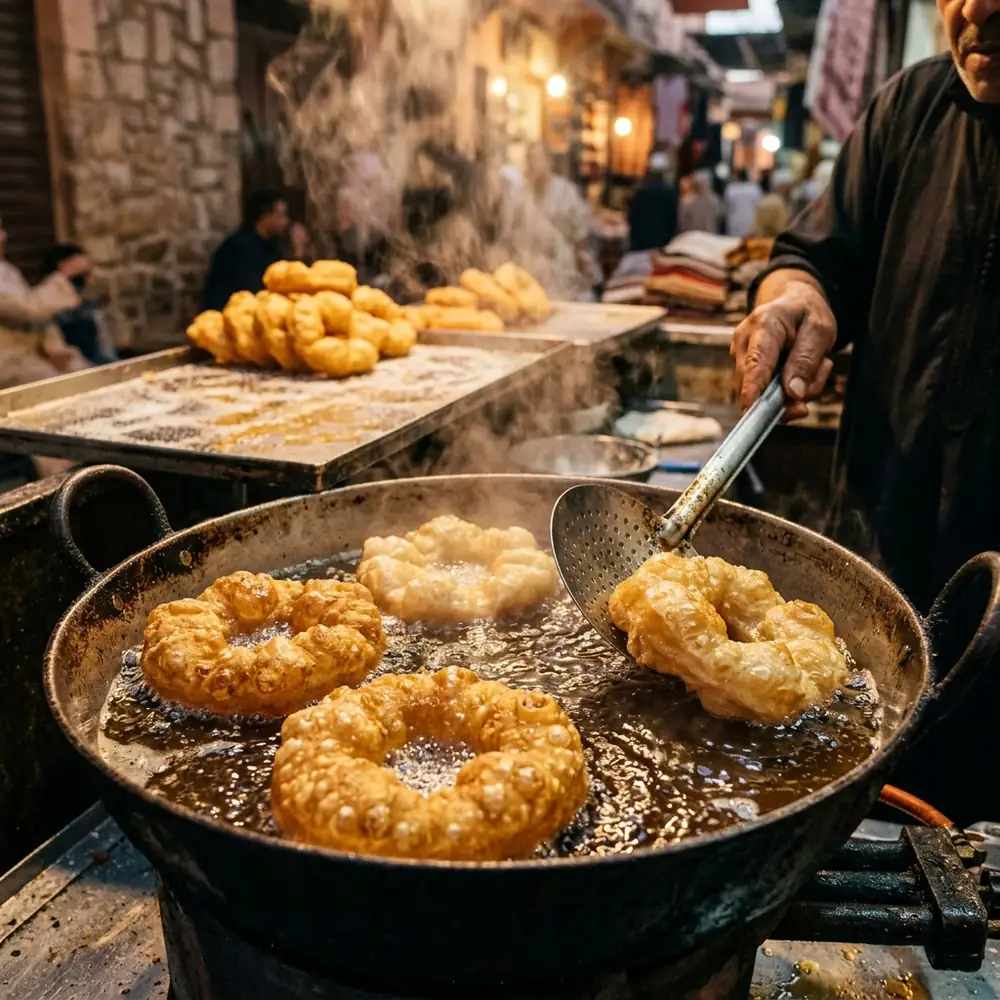
The dough for sfenj is incredibly wet. It is not rolled out or cut with a mold. It is a sloppy, sticky, highly hydrated mixture of flour, water, yeast, and a little salt. The sfenjiy (the man who makes the sfenj) works with a bowl of water next to him to prevent the dough from sticking to his hands. He grabs a handful of the wet dough, punches a hole through the center with his thumbs, and tosses the ring directly into a vat of boiling oil.
Because the dough is so wet, the heat of the oil causes the water inside to turn to steam instantly. This steam creates massive, uneven bubbles inside the dough, resulting in a texture that is shatteringly crisp on the outside and airy, chewy, and “spongy” on the inside.
The Al-Andalus Connection
Before the Christian Reconquista, much of Spain was ruled by Islamic caliphates for nearly 800 years. During this period, Arab and Amazigh (Berber) culinary traditions fused with local Iberian ingredients to create the cuisine of Al-Andalus.
Fritters made of wet dough (zalabiya or sfinge) were a staple of Andalusian cooking, often soaked in honey or syrup. When the Muslims and Sephardic Jews were expelled from Spain in the 15th and 16th centuries, they fled to North Africa, taking these recipes with them, where they evolved into the Moroccan sfenj we know today.
Meanwhile, the people who remained in Spain adapted the recipe. The Spanish added a crucial piece of technology: the churrera, a star-shaped nozzle. By forcing a thicker dough through this nozzle, they increased the surface area, making the pastry much crispier and removing the large, spongy bubbles of the Arabic original. The churro was born.
The Ritual of Consumption
Despite their physical differences, the ritual surrounding sfenj and churros remains strikingly similar, pointing to their shared DNA.
Neither is meant to be eaten cold, and neither is meant to be stored. They are ultimate street foods, designed to be consumed within minutes of leaving the fryer.
In Madrid, you eat churros at a chocolatería after a long night out, or for breakfast, dunking the crisp stick into hot chocolate to soften it.
In Marrakech, Fes, or Casablanca, the sfenjiy operates from a small, hole-in-the-wall shop, usually open early in the morning and again in the late afternoon. You do not make sfenj at home; you buy it from the master. The sfenjiy strings a half-dozen hot doughnuts onto a thin strip of palm leaf or a piece of twine so you can carry them without burning your hands. You walk home, the oil seeping into the paper wrapping, and you eat them immediately with a pot of heavily sweetened mint tea.
The Invisible Invitation
It is 5:00 PM in the medina of Meknès. You hear the furious, spitting hiss of boiling oil before you see the shop. The sfenjiy is working with mesmerizing speed, his hands constantly moving between the bowl of water, the vat of wet dough, and the deep fryer. He throws five rings into the oil; they sink for a second, then violently bob to the surface, swelling to twice their size. Order two. He will ask if you want them plain or with sugar. Choose sugar. He will toss the hot rings in granulated sugar and hand them to you on a piece of brown paper. Bite into it. The outside is hot and crunches loudly; the inside is steamy, chewy, and full of air pockets. It is the cheapest, most magnificent luxury in the city, an unbroken culinary lineage stretching back a thousand years to the palaces of Cordoba.
SEO Meta Description: Discover the shared history between Spanish churros and Moroccan sfenj. Learn how both deep-fried dough recipes trace their origins back to the Islamic golden age of Al-Andalus.
Experience the true heart of Moroccan heritage through its culinary traditions. Join us in preserving and honoring these ancestral recipes.
What People Are Saying
No comments yet. Be the first — we'd love to hear from you.
Fatima-Zahra Benali
Culturally Verified & Fact-CheckedThe Moroccan Food editorial team brings together native culinary researchers, heritage preservationists, and experienced home cooks across Marrakech, Fes, and Casablanca. Every recipe and cultural guide is reviewed against ancestral oral traditions and authentic regional practices.