The Souss Plain: Morocco's Agricultural Engine and the Water Crisis Nobody Talks About Enough
The Souss Plain: Where the Tomatoes for European Supermarkets Come From and What They Are Costing
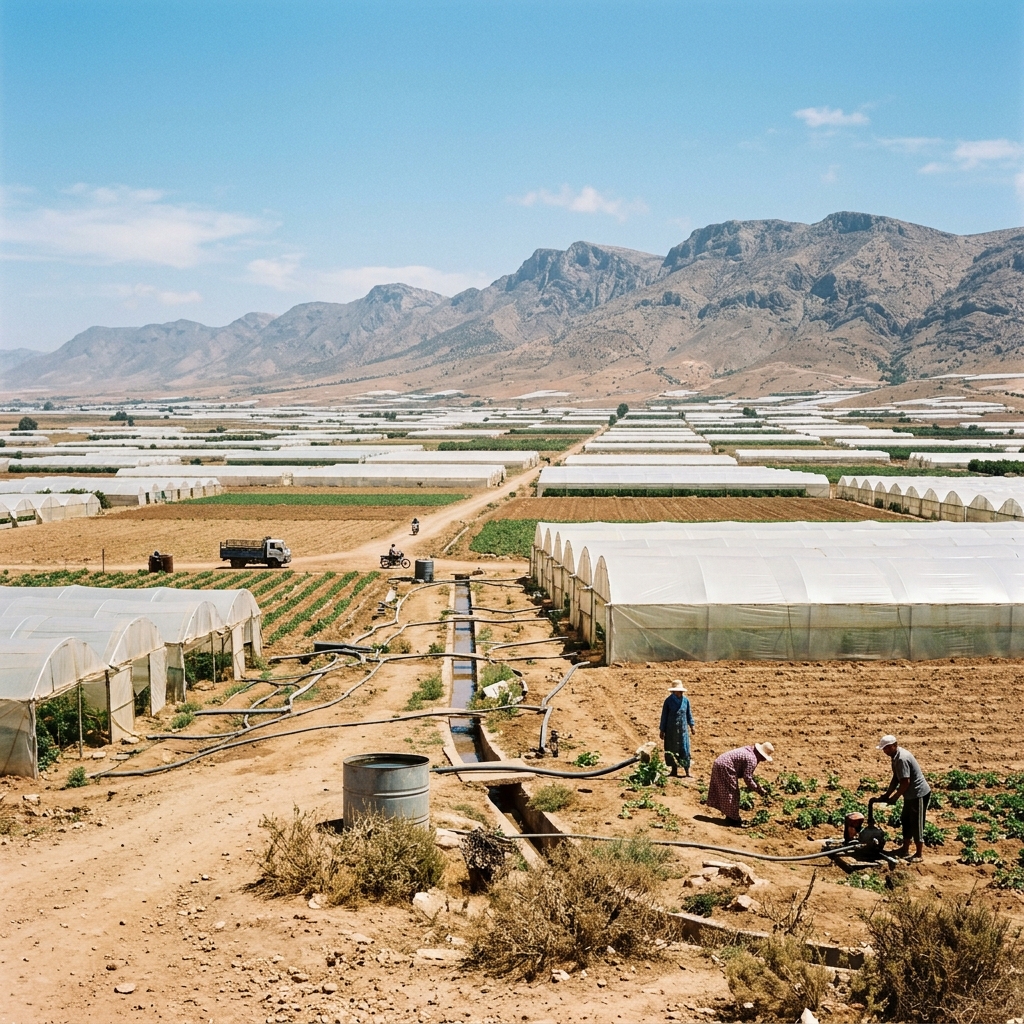
In December and January, when the tomatoes and peppers in European supermarkets have traveled from Morocco rather than from the Netherlands or Spain — because the Moroccan sun in winter provides what the European sun cannot — a significant proportion of them have grown in the Souss plain between Agadir and the Anti-Atlas foothills. The polytunnel agriculture of the Souss is one of the most productive agricultural landscapes in Africa: dense rows of plastic-covered greenhouse structures stretching across the plain, growing tomatoes and peppers and strawberries and courgettes for the French and German and British markets that were the target of the export agriculture program that transformed this region from the 1970s onward.
The success of the Souss agricultural transformation is real and should be credited as such. The region has become one of Morocco's primary export earners, has created substantial employment in processing and packaging and logistics, has supported the growth of Agadir from a modest city to a genuinely significant regional capital, and has demonstrated that Morocco can compete in demanding European markets requiring certified quality standards. These are real achievements produced by real investment and real agricultural skill.
The cost of the transformation is also real, and it runs primarily through the same resource that made the transformation possible: water.
Where Does the Souss Plain's Water Come From and What Is Happening to It?
The Souss plain sits above an underground aquifer — the Souss-Massa aquifer system — that has been the primary water source for both agricultural and domestic use in the region since before the export agriculture era. The aquifer is recharged by rainfall and by infiltration from the Oued Souss and its tributaries descending from the High and Anti-Atlas mountains.
In the pre-industrial agriculture era, extraction from the aquifer was balanced by recharge — the traditional khettara irrigation system (underground channels tapping the water table) and the shallow wells of subsistence farming drew at rates compatible with natural replenishment. The intensification of export agriculture from the 1970s onward dramatically increased extraction, primarily through deep borehole pumping that accesses water below the natural replenishment level.
The result is aquifer depletion at rates that multiple hydrological surveys have documented as unsustainable. The water table in parts of the Souss plain has dropped by tens of meters over the past fifty years. The salinity of aquifer water in coastal sections has increased as seawater intrusion fills the space vacated by freshwater extraction. Agricultural boreholes in some areas have had to be deepened repeatedly as the water table drops below the previous depth.
This is not a secret. The Moroccan government's own water resource assessments have noted the Souss-Massa aquifer's depletion and the need for demand management. International organizations have funded studies and proposed solutions. The agricultural lobby that depends on the water has sufficient political weight that implemented restrictions have consistently been more modest than the depletion rate requires.
What Is Morocco Doing About the Water Problem?
Several interventions are underway with varying degrees of implementation:
Desalination: a large-scale seawater desalination plant near Agadir, partially operational, is intended to provide municipal and eventually agricultural water from the Atlantic. Desalination at industrial scale is energy-intensive and produces a brine discharge that has its own environmental implications, but it does provide water that is not drawn from the depleting aquifer.
Drip irrigation expansion: government programs subsidizing the transition from flood irrigation to drip systems have increased water use efficiency across the region. Drip irrigation uses significantly less water per unit of crop than flood methods and has been adopted widely in the export agriculture sector, though the efficiency gains have been partially offset by the expansion of irrigated area.
Crop adjustment: some growers have transitioned from water-intensive crops (citrus, avocado) toward less water-intensive alternatives, partly in response to market demand and partly in recognition of the water constraint. The avocado expansion in particular — driven by European and North American demand — is a significant concern because avocados are extremely water-intensive in a region with water scarcity.
None of these interventions is sufficient individually, and the rate of aquifer depletion has not reversed. The trajectory of the Souss water situation — absent more significant demand management or technology breakthrough — is toward a constraint that will eventually limit the agriculture that has sustained the region's economic development.
What Is the Experience of Living in the Souss Plain?
Outside the export agriculture context, the Souss is an extraordinary landscape: the flat plain bounded by the Anti-Atlas to the east and the Atlantic to the west, the argan forest that covers the Anti-Atlas foothills in its specific, scrubby, beautiful way, the mountain light in the early morning before the heat builds. Agadir — rebuilt after the 1960 earthquake that killed 15,000 people and destroyed the original city — is a modern beach resort with specific charms distinct from the historical Moroccan cities: beaches that are genuinely good for swimming, a corniche that functions, a fish market (souk el-had) that is among the best in Morocco for the quality and variety of Atlantic seafood.
The traditional Amazigh culture of the Souss — the Tachelhit language, the specific musical tradition of rwais (traveling poet-musicians who have been the region's cultural memory-keepers for centuries), the architectural tradition of the agadir (collective fortified granary, specific to the Souss region) — exists alongside and sometimes in tension with the modernity that agricultural prosperity and beach tourism have brought.
The Invisible Invitation
Drive the road from Agadir toward Tiznit in the early morning, before seven, when the polytunnel agriculture is visible in the sideways light as a continuous field of silver — the plastic sheeting catching the first sun before the plain behind it has fully lit. Then take any track toward the Anti-Atlas foothills where the argan trees begin. Park where the argan forest starts. Walk in for twenty minutes. The argan trees — gnarled, old, with the specific quality of trees that have survived in difficult conditions for centuries — are unchanged by the agricultural transformation of the plain below them. The silence in an argan forest in the early morning, with the plain visible between the trees and the mountains above you, is the specific silence of a landscape that has been itself for a very long time and that the current era has not yet fully reached. Be in it for a while. Then go back to the plain, which is what is feeding Europe, and which is also what is drinking the water. Both things need to be understood together.
SEO Meta Description: What is the Souss plain of Morocco? The export agriculture success, aquifer depletion crisis, desalination response, and what Amazigh culture and argan forests exist alongside the polytunnel landscape.
Experience the true heart of Moroccan heritage through its culinary traditions. Join us in preserving and honoring these ancestral recipes.
What People Are Saying
No comments yet. Be the first — we'd love to hear from you.
Youssef Amazigh
Culturally Verified & Fact-CheckedThe Moroccan Food editorial team brings together native culinary researchers, heritage preservationists, and experienced home cooks across Marrakech, Fes, and Casablanca. Every recipe and cultural guide is reviewed against ancestral oral traditions and authentic regional practices.