Majhoul Dates of Tafilalet: King of Dates, Millennium Khettara Irrigation & Oasis Rebirth
Majhoul Dates of Tafilalet: King of Dates, Millennium Khettara Irrigation & Oasis Rebirth
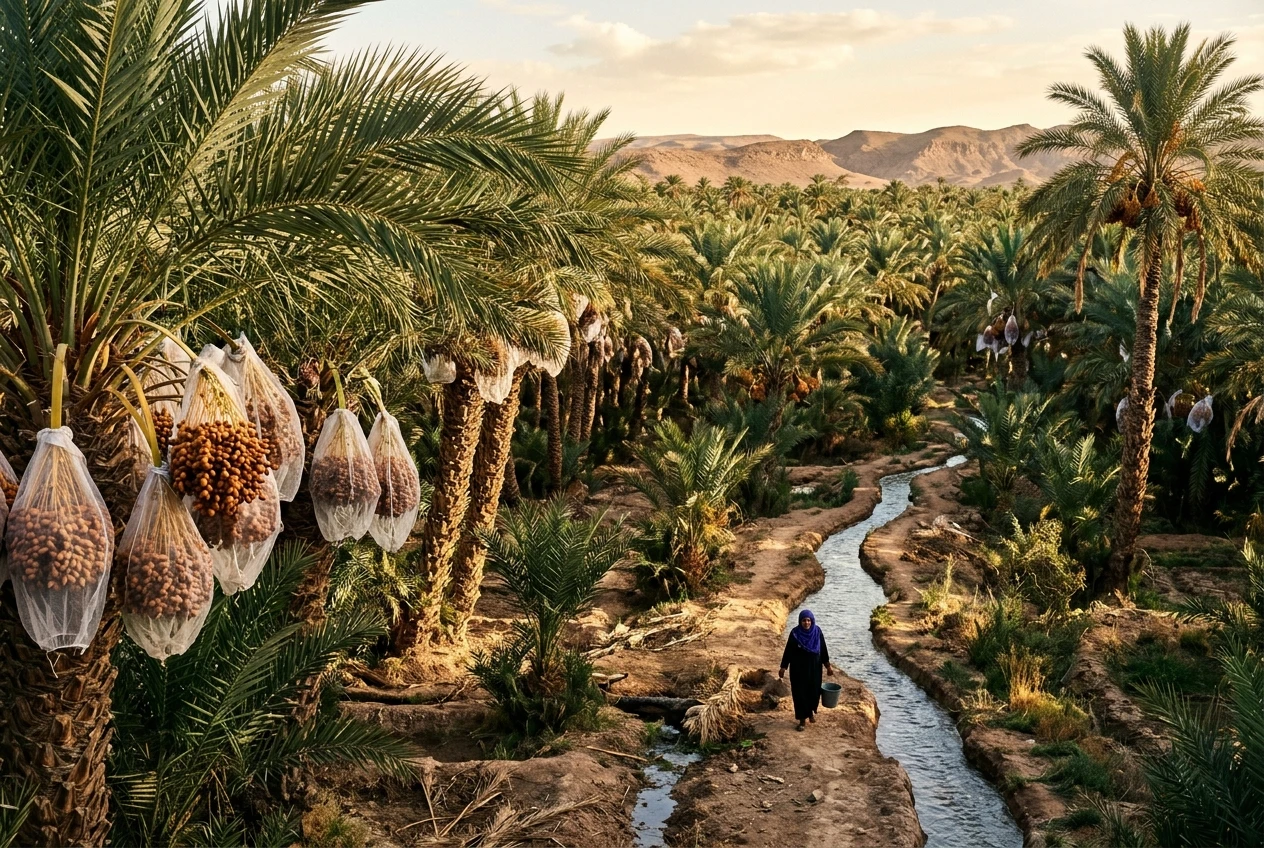
In the vast sun-drenched river basins of the Ziz and Gheris, where the eastern High Atlas mountains yield to the ochre sea of the Saharan dunes, stands the ancient oasis of Tafilalet. Centered around the historic royal desert capitals of Sijilmassa, Erfoud, and Rissani, this sprawling palm grove is not merely one of the world’s most enduring agricultural sanctuaries; it is the authentic evolutionary birthplace of the undisputed monarch of all dates: the Majhoul of Tafilalet (Phoenix dactylifera cv. Majhoul).
Known across global gourmet markets as the “King of Dates” or “Medjool,” this regal fruit nearly vanished in the early 20th century due to the devastating Bayoud vascular fungus. Today, through state-of-the-art agronomic research, the national planting of over 5 million palm trees, and the official awarding of the Protected Geographical Indication (IGP Dattes Majhoul de Tafilalet), Morocco has reclaimed its rightful crown as the global spiritual home of the authentic desert Majhoul.
This deep agricultural and economic dossier explores the hydro-engineering marvels of the oasis, official production and export statistics, the rigorous physical caliber standards of the Majhoul, and the sacred role of dates in Moroccan cultural and culinary diplomacy.
The Oasis Ecosystem: Khettara Engineering & Three-Tier Agroecology
The Tafilalet oasis is a masterwork of human ecological ingenuity, sustained for more than a thousand years through the traditional Khettara underground gravity irrigation network:
- The Khettara Water Channels: Ancestral Amazigh and Arab engineers dug gently sloping subterranean aqueducts extending for kilometers beneath the desert floor. Tapping groundwater at the foot of mountain aquifers, the Khettaras transported pure snowmelt water straight to palm roots with zero evaporative loss, despite searing surface temperatures exceeding +45°C.
- The Three-Tier Oasis Canopy: The oasis functions as a self-regulating vertical microclimate:
- Upper Canopy (15 to 25 meters): Towering date palms create a dense, protective umbrella of fronds that filters harsh solar radiation and drastically reduces ground-level wind erosion.
- Middle Tier (2 to 5 meters): In the dappled shade of the palms, fruit trees thrive, including pomegranates, figs, quinces, and apricots.
- Ground Tier (0 to 1 meter): On the cool, humid ground level, farmers cultivate alfalfa (Fizza), wheat, barley, mint, and heirloom coriander, fertilized naturally by livestock manure.
Without the protective shade and microclimate generated by the date palm, agriculture in the pre-Saharan desert would be biologically impossible.
Official Harvest Statistics & Strategic Metrics (ANDZOA & ORMVA/TF)
The revitalization of Morocco’s date palm heritage is coordinated by the National Agency for the Development of Oasis Zones and the Argan Tree (ANDZOA) alongside the Regional Office of Agricultural Development of Tafilalet (ORMVA/TF).
The following data reflects verified multi-year audits from the Ministry of Agriculture, Maritime Fisheries, Rural Development, Water and Forests (MAPMDREF) and the SIDATTES international date exhibition registry:
| Key Strategic Sector Metric | Official Quantitative Value | Regulatory & Institutional Source |
|---|---|---|
| National Date Palm Population | 6.9 Million Date Palms (Surpassing 5M Tree Target) | ANDZOA National Phoenix Survey |
| Tafilalet Regional Palm Share | 2.65 Million Active Palms (40% National Total) | ORMVA Tafilalet Agricultural Census |
| Annual National Date Production | 145,000 to 162,000 Metric Tons | MAPMDREF Directorate of Agricultural Statistics |
| Majhoul Production Volume | 38,000 to 45,000 Metric Tons (Rapidly Expanding) | Moroccan Date Interprofessional Federation (FIMADATTES) |
| Official Geographical Label | IGP Dattes Majhoul de Tafilalet (Awarded 2011) | Official Bulletin of the Kingdom of Morocco |
| Annual International Trade Platform | Salon International des Dattes au Maroc (SIDATTES) | Association of the International Date Fair (Erfoud) |
| Modern Packing & Storage Units | 52 Industrial Cold-Storage Stations (>40,000 MT capacity) | Regional Investment Center (CRI Drâa-Tafilalet) |
These figures demonstrate how Morocco transformed a sector threatened by desertification into a high-technology export pillar that anchors rural populations to their ancestral desert lands.
Physical Chemistry of the Royal Majhoul: Calibers & Sugar Profile
What elevates the Tafilalet Majhoul above common varieties (such as Boufeggous, Bouskri, or Jihel) is its majestic size, translucent amber skin, and melting, caramel-like flesh:
Caliber Classification Standards (Norme Marocaine NM 08.5.115)
- Super Jumbo: Fruit weight exceeding 26 to 32 grams per single date. Length greater than 50 mm. A true rarity reserved for royal ceremonies and luxury diplomatic gifts.
- Jumbo: Fruit weight between 22 and 26 grams.
- Large: Fruit weight between 18 and 22 grams.
- Medium: Fruit weight between 14 and 18 grams.
Moisture & Sugar Dynamics
Unlike dry dates (like Deglet Noor or Zahidi) which become hard and leathery, the authentic Tafilalet Majhoul is classified as a semi-soft date:
- Optimal Moisture Window: Regulated between 21 and 26 percent. This exact moisture equilibrium creates a velvety, melt-in-the-mouth texture reminiscent of brown butter and vanilla fudge.
- Natural Invert Sugars: Dominantly comprised of natural fructose and glucose (~65-70% dry matter), which are absorbed readily by human cells for instant, clean metabolic energy without causing severe glycemic spikes associated with refined sucrose.
- Fiber and Mineral Abundance: Rich in bioavailable potassium (650 mg/100g, 40% higher than bananas), magnesium, iron, and protective polyphenols that inhibit intestinal lipid oxidation.
The Agricultural Ritual: Pollination to Breathable Mesh Bagging
Cultivating world-class Majhoul dates is an artisan art requiring year-round physical bravery:
- Manual Spring Pollination (Dokkar): In March, male flower spathes are gathered. Elite palm climbers (Nakhlaouis) scale 20-meter palm trunks without harnesses, tucking three to five male flower sprigs into each female inflorescence and binding them with palm fibers.
- Strand Thinning (Khaff): In May, farmers cut away up to 40 percent of the developing green fruitlets on each cluster. This sacrifice allows the remaining dates to receive maximum nutrients, achieving their celebrated Super Jumbo caliber.
- Breathable Net Bagging: In July, massive cascading date bunches (each weighing 10 to 15 kg) are wrapped in white, breathable micro-mesh bags. This shields the ripening fruit from desert dust storms, protects against foraging wasps, and catches any early-ripening dates that detach naturally.
Cultural Diplomacy & The Moroccan Culinary Throne
In Moroccan civilization, the date palm is a sacred emblem of blessing (Baraka), hospitality, and eternal life:
- The Imperial Welcome (L’Accueil Royal): For over a millennium, no honored guest, foreign ambassador, or wedding party has ever entered a Moroccan home without being offered a silver tray bearing plump Tafilalet Majhoul dates and a bowl of chilled fresh buttermilk (Lben) or orange-blossom scented milk.
- The Art of Stuffed Festive Dates (Dattes Farcies): For bridal celebrations and Eid feasts, Majhoul dates are slit lengthwise, pitted, and stuffed with velvety almond paste tinted with saffron or beet juice, delicately scored in herringbone patterns and crowned with roasted walnut halves, toasted pistachios, or silver leaf.
- The Soul of Ramadan Iftar: When the sunset cannon roars across Moroccan cities announcing the end of the fast, tradition dictates breaking the fast with an odd number of Majhoul dates alongside a steaming bowl of rich, spiced Harira. The natural sugars instantly restore blood glucose levels while the alkaline minerals soothe the empty stomach.
- Tagine de Veau aux Dattes et Amandes: Tender veal shanks slow-simmered with onions, ginger, and saffron broth. In the final twenty minutes of cooking, whole pitted Majhoul dates are added directly to the tagine, softening in the savory braising juices and creating an exquisite sweet-savory glaze.
Frequently Asked Questions (FAQ)
Did California Medjool dates actually originate in Morocco’s Tafilalet?
Yes! In 1927, when the Bayoud fungal disease was devastating the Tafilalet palm groves, American botanist Dr. Walter Swingle visited Morocco and collected eleven healthy, disease-free Majhoul offshoots from the Boudenib area. These offshoots were transported to the desert of southern California (Coachella Valley), where they survived and propagated. All commercial Medjool date trees grown in North America, Israel, and the Middle East trace their genetic lineage directly back to these eleven Moroccan palms!
How should fresh Majhoul dates be stored at home?
Because Majhoul dates are semi-soft and contain natural moisture, they should be stored in an airtight container in the refrigerator (at 2°C to 4°C) for up to 6 months, or in the freezer (-18°C) for up to two years. They do not freeze rock-hard due to their high natural sugar content, and can be eaten straight from the cold.
How can I identify genuine IGP Tafilalet Majhoul dates?
Authentic Tafilalet dates carry the official IGP Dattes Majhoul de Tafilalet certification badge on the box, along with the ONSSA sanitary registration number. The skin should be deep translucent amber, thin, lightly wrinkled, and naturally adhered to the dense, succulent flesh without separating into papery air blisters.
Experience the true heart of Moroccan heritage through its culinary traditions. Join us in preserving and honoring these ancestral recipes.
What People Are Saying
No comments yet. Be the first — we'd love to hear from you.
Houssam Elmrabet
Culturally Verified & Fact-CheckedHoussam Elmrabet is a Moroccan researcher in territorial marketing and cultural heritage preservation. His work documents regional gastronomic identities, local agricultural heritage, and how ancestral culinary traditions define authentic territorial branding across the Kingdom.