The Beldi Almond of Tafraout: Pink Granite Terroir, Mountain Agro-Forestry & Authentic Amlou Craft
The Beldi Almond of Tafraout: Pink Granite Terroir, Mountain Agro-Forestry & Authentic Amlou Craft
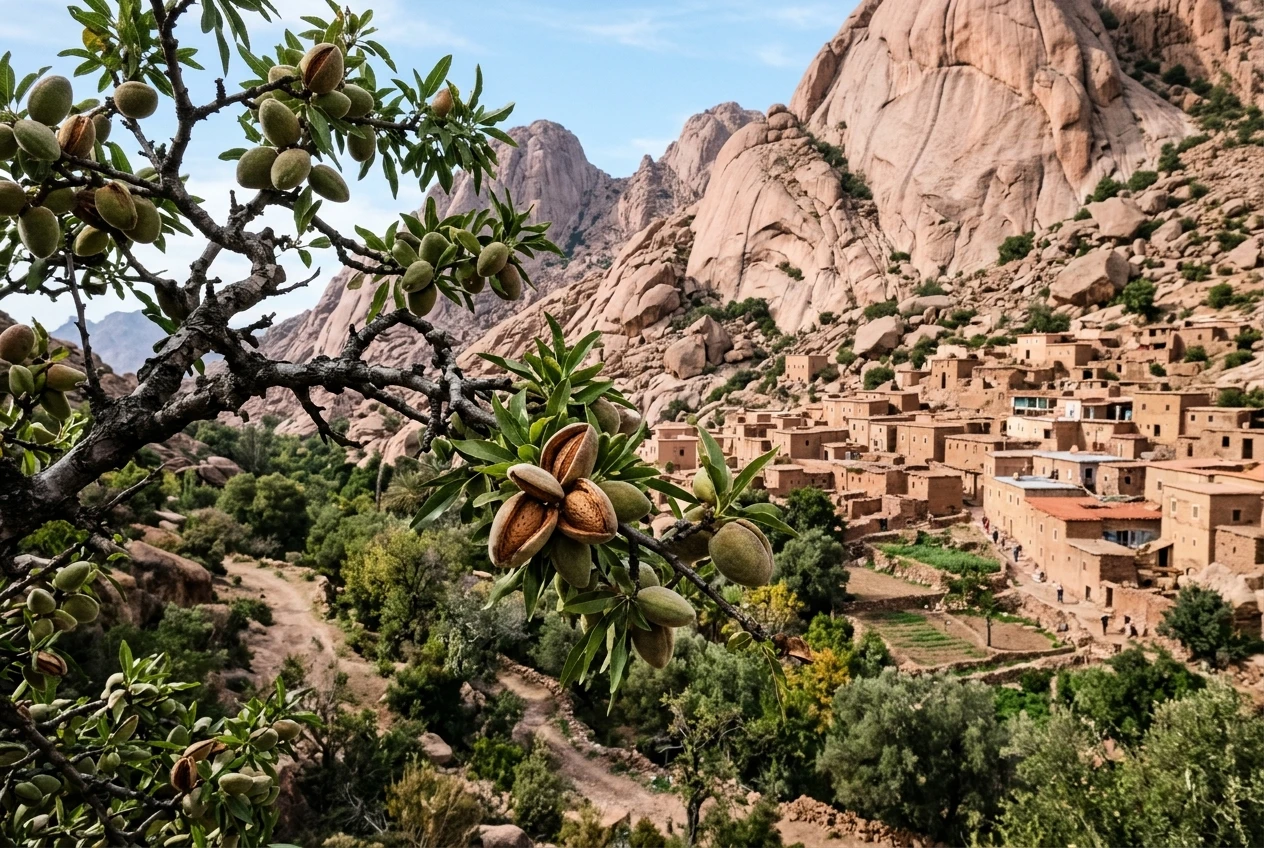
Nestled within a dramatic amphitheater of colossal, weather-sculpted pink granite boulders in the southern Anti-Atlas mountains lies the Ammeln Valley of Tafraout. Each February, this austere, sun-blasted mountain basin transforms into an ethereal sea of soft white and pale pink blossoms, announcing the awakening of one of Morocco’s most venerable tree crops: the Beldi Almond (Prunus dulcis var. Beldi).
While industrial California and Spanish almond orchards prioritize uniform size, paper-thin shells, and excessive irrigation, the traditional mountain terraces of Tafraout cultivate a wild, drought-hardened, non-irrigated heirloom variety. Small, dense, and packed with aromatic essential oils, the Tafraout Beldi almond is revered throughout the Maghreb as the unrivaled aristocrat of nuts, providing the indispensable foundation for authentic Moroccan pastry craft and artisanal Amlou.
This comprehensive agricultural and gastronomic report explores the unique granite terroir of Tafraout, official harvest and economic statistics, the ancestral agro-forestry systems of the Amazigh people, and the scientific lipid chemistry that makes Beldi almonds a nutritional powerhouse.
Geological Terroir: The Pink Granite & Mountain Drainage
The geographical character of Tafraout’s almond groves is indivisible from the unique geology of the Anti-Atlas mountain chain. Formed during the Precambrian era, the region’s colossal monoliths of rose-colored granite (Granite Rose de Tafraout) create a distinct agricultural micro-terroir:
- High-Permeability Sandy-Silt Soils: As the granite exfoliates over millennia through physical weathering and thermal expansion, it decomposes into coarse, quartz-rich sandy loam (Arènes granitiques). This soil offers zero water retention at the surface, forcing almond taproots to drill deep into subterranean rocky faults to access permanent mineralized groundwater.
- Thermal Regulation of Granite: The gigantic pink granite boulders act as natural thermal batteries. Absorbing blistering solar radiation during the day, the stones radiate gentle heat back onto surrounding terraced orchards throughout the cold mountain night, buffering tender almond blossoms against sudden late winter frosts.
- Dry Alpine Microclimate: Situated at altitudes between 1,000 and 1,400 meters, rainfall rarely exceeds 180 to 220 millimeters annually. The relative air humidity remains exceptionally low, naturally inhibiting fungal blights (such as Monilinia brown rot) without requiring synthetic chemical fungicides.
- Ancient Terraced Agro-Forestry (Tawenza): For centuries, local Amazigh tribes constructed drystone retaining walls along steep mountain ravines to trap seasonal flash-flood sediments, creating miniature micro-oasis terraces irrigated solely through seasonal mountain runoff.
Official Harvest Statistics & Cooperative Economics (ORMVA Souss-Massa)
The almond sector in the Anti-Atlas mountains is monitored by the Regional Office of Agricultural Development of Souss-Massa (ORMVA/SM) and the Ministry of Agriculture, Maritime Fisheries, Rural Development, Water and Forests (MAPMDREF).
The table below compiles official structural indicators from agricultural censuses and regional cooperative federations:
| Sector Parameter | Official Statistical Value | Data & Institutional Source |
|---|---|---|
| Almond Orchard Surface Area | 28,400 Hectares (Anti-Atlas Foothills) | ORMVA Souss-Massa Provincial Cadastre |
| Average Annual In-Shell Harvest | 11,500 to 13,200 Metric Tons | MAPMDREF National Fruit Tree Directorate |
| Average Yield per Hectare | 400 to 520 kg (Rainfed Non-Irrigated Mountain Orchards) | National Agricultural Research Institute (INRA) |
| Local Processing Cooperatives | 42 Certified Cooperatives (78% Female-Operated) | Regional Chamber of Agriculture |
| Economic Value Generation | Over 540 Million MAD ($54M+ USD) | Regional Investment Center (CRI Souss-Massa) |
| Annual Cultural Event | Tafraout Almond Blossom Festival (Moussem des Amandiers) | Municipality of Tafraout & Ministry of Culture |
| Water Requirement | Zero Industrial Irrigation (100% Traditional Rainfed/Spate) | Water Basin Agency of Souss-Massa (ABHSM) |
These figures demonstrate that Tafraout’s almond sector represents a sustainable, low-carbon agro-ecological model capable of producing high-value food without draining scarce regional aquifers.
Biochemical Profile: Why Beldi Outperforms Industrial Almonds
Commercial supermarket almonds are often grown with intensive flood irrigation, swelling the nuts with water but diluting their essential oil and sugar concentrations. In contrast, the stress-hardened Beldi almond of Tafraout concentrates its nutrient density:
Lipid & Nutrient Density (Laboratory Analysis per 100g raw kernel)
- Total Healthy Lipids: 54 to 58 grams, dominated by heart-healthy monounsaturated oleic acid (Omega-9, ~68%) and polyunsaturated linoleic acid (Omega-6, ~22%).
- Natural Alpha-Tocopherol (Vitamin E): 26.2 mg (over 170% of recommended daily intake), representing one of the highest natural concentrations measured in tree nuts globally.
- Dietary Plant Protein: 21.8 grams, rich in essential amino acids, particularly arginine and leucine.
- Fiber & Low Moisture: Moisture content remains strictly below 4.5 percent, compared to 6.5 to 8 percent in commercial imported nuts, ensuring exceptional crunch and preventing mold formation during storage.
The Aromatic Volatiles (Benzaldehyde & Amygdalin)
The Beldi almond possesses a thick, hard outer shell (Coque dure) that protects the inner kernel from oxidation and insect pests. Within the seed, minute trace amounts of naturally occurring amygdalin break down upon stone grinding, releasing trace amounts of natural benzaldehyde, the chemical compound responsible for the unmistakable, sweet, marzipan-like fragrance that perfumes traditional Moroccan bakeries.
The Sacred Craft of Amlou: The Moroccan Superfood
In Amazigh households throughout the Anti-Atlas, the greatest sign of honor bestowed upon a guest is a freshly prepared bowl of Amlou, often described by international nutritionists as the world’s most luxurious nut spread.
Authentic Tafraout Amlou is defined by the strict harmony of three noble terroir ingredients:
- Gently Toasted Beldi Almonds: Whole almonds are slowly roasted over a low wood fire or in a clay oven until the skins turn deep mahogany. Burning the skin destroys the delicate monounsaturated fats; under-roasting leaves the spread flat and grassy.
- Cold-Pressed Culinary Argan Oil: Pure oil pressed from gently roasted argan kernels harvested from nearby Souss groves.
- Raw Mountain Wildflower Honey: Unfiltered honey harvested by mountain beekeepers from wild thyme (Za’atar), lavender, or euphorbia flowers.
The Grinding Ritual on the Azrg
In artisanal cooperatives across the Ammeln Valley, women continue to grind Amlou using the ancestral rotary stone mill, known in Tamazight as the Azrg.
Carved from dense volcanic basalt, the heavy upper stone is rotated rhythmically by hand while roasted almonds are slowly fed into the central eye. Unlike modern high-speed stainless steel blenders that heat and oxidize delicate fats at 15,000 RPM, the heavy stone quern crushes the almonds at cold ambient temperatures. As the almonds release their natural oils, the miller slowly drizzles culinary argan oil and raw honey into the friction zone.
The resulting elixir flows down the stone runnel as a warm, silky, liquid amber cream with a lightly textured, grain-to-velvet consistency that cannot be replicated by factory machinery.
The Pillar of Moroccan Imperial Pastry
Beyond Amlou, the Tafraout Beldi almond is the undisputed king of Moroccan festive confectionery:
- Kaab el Ghazal (Gazelle Horns): The legendary crescent pastries of Fes and Rabat demand blanched Beldi almonds ground into a velvety paste with pure mastic (Meska Horra), clarified butter, and distilled orange blossom water. The natural oils of the Beldi nut prevent the pastry filling from drying into a chalky lump during baking, keeping it moist and supple for weeks.
- Briouates aux Amandes: Triangular parcels of razor-thin Warqa pastry wrapped around spiced almond paste, fried to golden perfection and soaked immediately in bubbling warm mountain honey.
- Sellou (Sfouf): The restorative energy powder prepared for Ramadan and postpartum recovery, where roasted Beldi almonds are combined with browned flour, toasted sesame seeds, aniseed, and cinnamon.
Frequently Asked Questions (FAQ)
What is the visual difference between Beldi almonds and California almonds?
Tafraout Beldi almonds are noticeably smaller, slightly flatter, teardrop-shaped, and possess a darker, rougher brown skin with deeper ridges. Imported California almonds are significantly larger, uniformly oval, have pale tan skins, and taste mild and watery compared to the intense nutty crunch of Beldi.
Does real Amlou separate into layers over time?
Yes. Authentic artisanal Amlou contains zero hydrogenated palm oils, chemical emulsifiers, or stabilizers. Over several weeks of standing, the lighter argan oil naturally rises to the top while the heavier stone-ground almond solids settle to the bottom. Simply stir the jar thoroughly with a spoon before serving.
Why do Beldi almond trees flower in February when it is still cold?
Almond trees are among the earliest deciduous trees to break winter dormancy. In the Anti-Atlas, February temperatures begin rising above 12°C during sunny afternoons, triggering flowering weeks before leaves emerge. Local farmers celebrate this phenomenon during the annual Moussem des Amandiers as a sacred herald of spring.
Experience the true heart of Moroccan heritage through its culinary traditions. Join us in preserving and honoring these ancestral recipes.
What People Are Saying
No comments yet. Be the first — we'd love to hear from you.
Houssam Elmrabet
Culturally Verified & Fact-CheckedHoussam Elmrabet is a Moroccan researcher in territorial marketing and cultural heritage preservation. His work documents regional gastronomic identities, local agricultural heritage, and how ancestral culinary traditions define authentic territorial branding across the Kingdom.