Tafraoute and the Blue Rocks: Southern Morocco's Granite Desert That Almost Nobody Visits
Tafraoute and the Blue Rocks: Southern Morocco’s Granite Desert That Almost Nobody Visits
Here is a geographical curiosity worth considering. The Anti-Atlas Mountains run across southern Morocco like a geological afterthought — older, drier, and less dramatic than the High Atlas to the north. Most travellers skip them entirely. They drive through on the way to the Sahara and see a blur of brown rock out the window.
This is a significant miscalculation.
Tafraoute sits in the middle of the Anti-Atlas at 1,200m altitude, cradled in a valley of pink granite boulders that look, at sunrise and sunset, like something from a different planet. The town itself is small, Amazigh, and almost entirely overlooked by international tourism. This is either a problem or the entire appeal, depending on your perspective.
The Geological Story: Why This Place Looks the Way It Does
The Anti-Atlas is one of the oldest mountain ranges in Africa — Precambrian basement rock exposed by hundreds of millions of years of erosion. While the High Atlas is still actively rising (it is a relatively young mountain range), the Anti-Atlas has been slowly worn down for geological ages.
What you see around Tafraoute is the result: massive rounded boulders of pink-orange granite, smoothed by millennia of wind and flash floods. They pile on each other in improbable configurations. Some look balanced. Some look like they should have fallen centuries ago.
At sunrise and sunset, the light turns these rocks from brown to amber to deep red. At midday, they are almost blinding. It is a landscape that rewards patience.
The Belgian Artist and the Blue Rocks
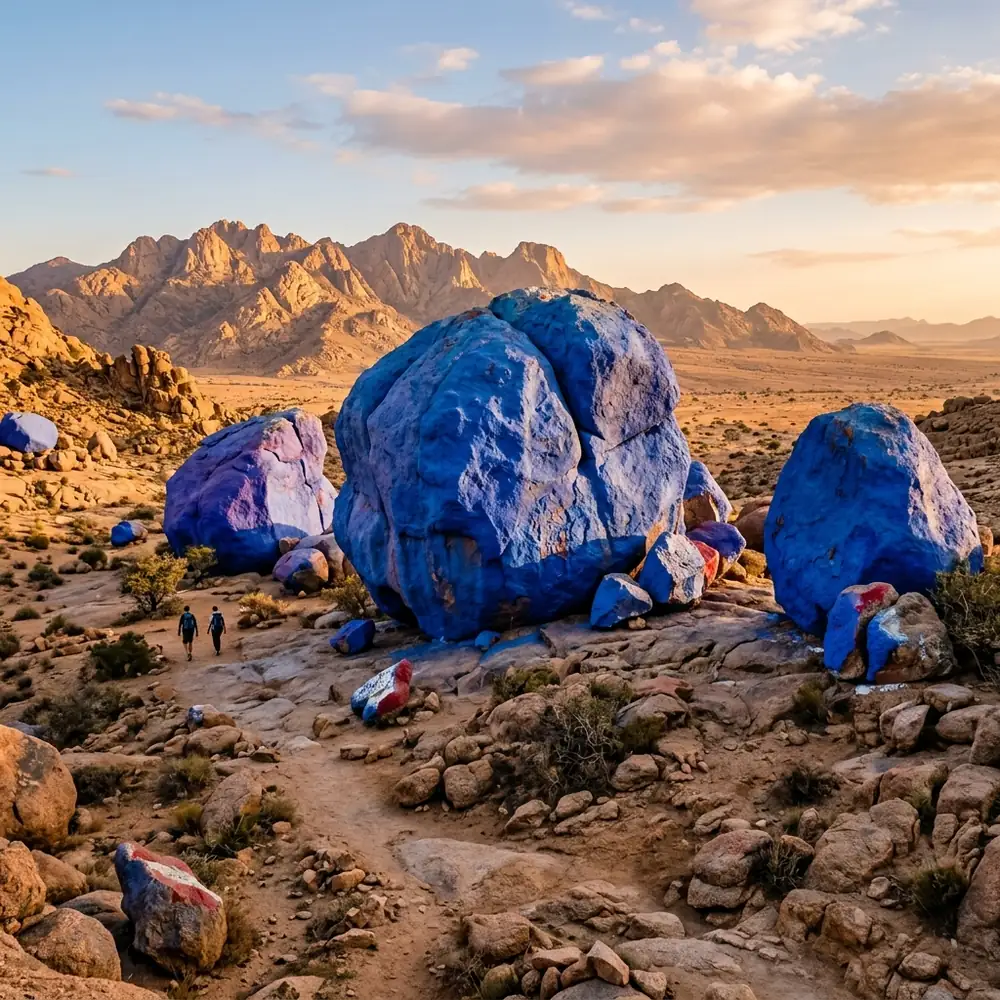
In 1984, Belgian land artist Jean Vérame persuaded the Moroccan authorities to let him paint. Not a canvas. Not a wall. Approximately 20 tonnes of rock.
Using blue, violet, white, and red industrial paint, Vérame and a team of workers spent months covering a section of the granite boulders south of Tafraoute. The “Painted Rocks” or “Blue Rocks” (Roches Bleues) became one of Morocco’s stranger tourist attractions.
Opinions about them divide neatly:
Some people: “This is a fascinating piece of land art that transforms the relationship between human creativity and natural landscape.”
Other people: “Someone painted rocks blue in the desert and now we are calling it art.”
Both positions are defensible. What is undeniable is that the rocks are still there, four decades later, the paint slowly weathering back into the granite. They are approximately 3km south of Tafraoute, an easy walk or a short drive.
Whatever you think of them artistically, they are genuinely worth seeing in the context of the wider granite landscape — a piece of deliberate colour dropped into an otherwise monochrome world.
The Town of Tafraoute: What to Do and See
The Almond Groves
Tafraoute is in the Ameln Valley, famous throughout Morocco for its almond trees. In late January and February, the valley erupts in white and pink almond blossom — one of Morocco’s most beautiful natural spectacles and almost entirely off the standard tourist calendar. If you can time a visit for the blossom period, it is extraordinary.
The Almond Festival (Moussem des Amandes) usually runs in February — check local dates. It is a genuine celebration, not a tourist-oriented event.
The Women’s Argan and Almond Cooperatives
The valleys around Tafraoute are Amazigh territory, and women’s cooperatives produce amlou (the Moroccan almond, argan oil, and honey spread), argan oil, and almond products for local sale and export.
Visiting a cooperative is genuinely educational and not a tourist performance. Women work there. You can buy directly from producers.
The Tiznit Road (N12)
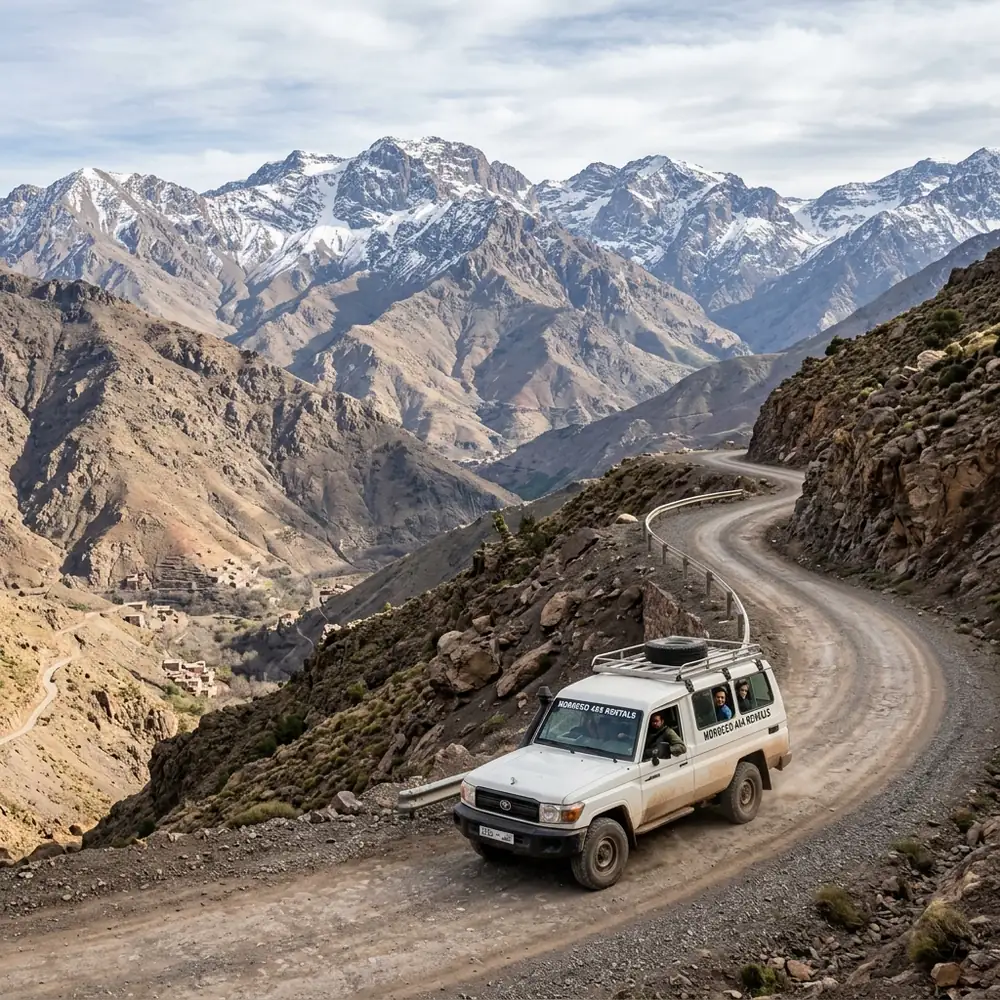
The drive between Tafraoute and Tiznit on the N12 is one of the most spectacular road trips in southern Morocco. The road descends through the Tizi Mighert pass in a series of dramatic switchbacks, with views across the Souss plain all the way to the Atlantic on clear days.
If you have a rental car, this drive alone justifies coming to Tafraoute.
Rock Climbing
The Anti-Atlas granite is excellent for climbing. Routes around Tafraoute are well-documented in climbing guides and are visited by serious climbers from France and Germany throughout the cooler months. If you climb, bring your equipment — there is no rental available locally.
Practical Information for Getting to Tafraoute
By car: The most practical option. Tafraoute is 180km from Agadir via Tiznit (2.5–3 hours) or 200km via Taroudant (3 hours). Both routes are tarmacked and offer beautiful driving.
By CTM bus: Daily services connect Agadir and Tiznit to Tafraoute. The Agadir–Tafraoute adventure takes approximately 4 hours. Check current timetables at the CTM station in Agadir.
By grand taxi: Shared taxis run from Tiznit to Tafraoute (about 1 hour). This is the most economical shared transport option.
Where to Stay and Eat
Tafraoute has a modest but functional selection of accommodation — mostly small guesthouses and maisons d’hôtes run by local families. Prices are significantly lower than Marrakech or Fes equivalents.
A private room with breakfast: 200–400 MAD (18–36 EUR).
For meals: the small restaurants around the main square serve honest Moroccan food — tagines, couscous, harira. Nobody is performing for tourists here. The mechoui (slow-roasted lamb) sold from roadside stalls on market days is some of the best in southern Morocco.
Market day: Tuesday in Tafraoute. Worth timing your visit around.
Frequently Asked Questions
When is the best time to visit Tafraoute? February for almond blossom (magical but cold at altitude). October through April in general for pleasant temperatures. Avoid July and August — temperatures regularly exceed 38°C and there is little shade in the valley.
How far is Tafraoute from Marrakech? Approximately 320km (4–5 hours by car via the N10 through Taroudant). It is a genuinely rewarding drive.
Can I visit the Blue Rocks without a guide? Yes. The Blue Rocks are clearly signposted from the southern edge of Tafraoute, about 3km on an unpaved track. Any local can point you in the right direction, and the rocks are impossible to miss once you are near.
Is there ATM access in Tafraoute? There is a bank branch in the town centre with an ATM. Bring sufficient cash as backup — rural Moroccan ATMs can be unreliable.
Experience the true heart of Moroccan heritage through its culinary traditions. Join us in preserving and honoring these ancestral recipes.
What People Are Saying
No comments yet. Be the first — we'd love to hear from you.
The Moroccan Editorial Team
Culturally Verified & Fact-CheckedThe Moroccan Food editorial team brings together native culinary researchers, heritage preservationists, and experienced home cooks across Marrakech, Fes, and Casablanca. Every recipe and cultural guide is reviewed against ancestral oral traditions and authentic regional practices.