The Tagine Cone: A great piece of Pre-Industrial Hydrology
The Tagine Cone: A great piece of Pre-Industrial Hydrology
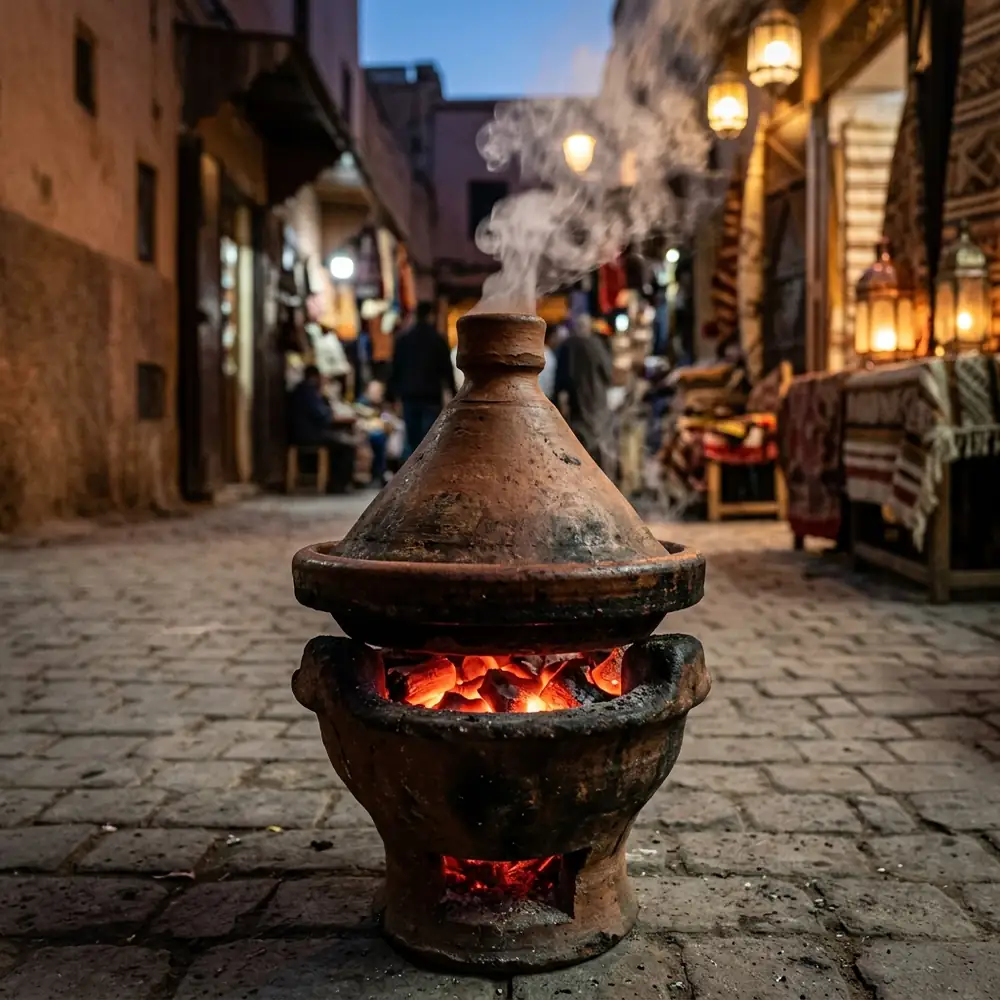
It is arguably the most famous piece of cookware in the world. The Moroccan Tajine—a wide, shallow clay base topped with a towering, conical lid—is immediately recognizable.
Tourists often buy them simply because they look beautiful on a kitchen shelf. But to the nomadic Berber (Amazigh) tribes who invented them thousands of years ago, the Tajine was not a decorative object. It was a highly advanced piece of pre-industrial technology designed to solve a massive problem: how do you cook a stew in the desert where water is scarce?
The Architecture of Condensation
In a standard Western stew pot with a flat lid, water boils, turns to steam, hits the hot flat lid, and escapes through the edges. To prevent the stew from burning, the cook must constantly add more water or broth.In the arid landscapes of North Africa, water is too precious to boil away into the wind.
This is where the cone comes in. When you cook meat and vegetables in the base of a Tajine, the moisture naturally evaporates. However, because the conical lid is so tall, the very top of the cone remains significantly cooler than the base sitting on the fire.
When the hot steam rises and hits the cooler walls of the tall cone, it immediately condenses back into water droplets. Those droplets run down the steep, angled sides of the lid and fall right back into the stew.
The Closed Loop System
The Tajine operates as a completely closed-loop hydrological system. The meat and vegetables are essentially cooking in their own trapped juices. You can simmer a tough cut of camel or goat for three hours over a charcoal brazier, and you will almost never need to add a single drop of extra water.The conical shape ensures that the stew never dries out, the meat becomes impossibly tender through slow braising, and the precious water is preserved. It is a brilliant, beautiful example of design dictated entirely by the harshness of the environment.
Experience the true heart of Moroccan heritage through its traditions. Join us in preserving these ancestral rituals.
What People Are Saying
No comments yet. Be the first — we'd love to hear from you.
Ghina Mrabet
A Moroccan cultural writer dedicated to documenting the authentic voice, history, and heritage of the Kingdom. Writing from within — to share what truly makes Morocco extraordinary.
Our Mission →