The Red Gold of Taliouine: Inside Morocco's AOP Saffron Terroir, Alpine Cooperatives & Global Market
The Red Gold of Taliouine: Inside Morocco’s AOP Saffron Terroir, Alpine Cooperatives & Global Market
High in the rugged volcanic folds of the Anti-Atlas mountains, perched between the snow-capped summits of the High Atlas and the arid plains of the Moroccan Sahara, lies the ancient mountain plateau of Taliouine. Here, at elevations exceeding 1,800 meters, thrives Morocco’s most prized agricultural treasure: Crocus sativus, the delicate purple iris whose slender crimson stigmas yield pure saffron, universally known across the Maghreb as Zaafrane Beldi.
While cheap synthetic powders and adulterated safflower flood global supermarkets, Taliouine stands as an uncompromising fortress of botanical authenticity. Awarded Morocco’s prestigious Appellation d’Origine Protégée (AOP Safran de Taliouine) by ministerial decree, this high-altitude terroir produces some of the most chemically potent, aromatic, and intensely pigmented saffron on Earth.
This deep investigation explores the geological origin of Taliouine saffron, the rigorous chemical metrics of ISO 3632 certification, the economic empowerment of female Amazigh cooperatives, and the authentic culinary traditions that make this spice the golden soul of Moroccan royal dining.
Geological Terroir: The Volcanic Secret of Jbel Sirwa
The excellence of Taliouine saffron is rooted in its extraordinary geological and climatic environment. The cultivation zone is centered around Mount Siroua (Jbel Sirwa), an extinct stratovolcano rising to 3,305 meters between Taroudant and Ouarzazate.
Unlike the humid lowlands or clay-heavy river valleys, this high alpine plateau offers four critical microclimatic requirements for the Crocus sativus corm:
- Volcanic Igneous Soil: The earth is rich in weathered volcanic basalts, potassium, phosphorus, and trace minerals, providing impeccable natural drainage. Saffron corms rot instantly in waterlogged soil; Siroua’s porous volcanic gravel allows winter snowmelt to hydrate the roots while shedding excess moisture immediately.
- Thermal Shock & Dormancy: The plateau experiences drastic seasonal temperature extremes, plunging to -7°C in deep winter and soaring to +38°C in July. This stark thermal contrast is essential to awaken the vegetative dormancy of the underground bulbs.
- Intense High-Altitude Solar Radiation: At 2,000 meters elevation, ultraviolet radiation is remarkably concentrated. In response to intense sunlight, the plant synthesizes elevated concentrations of protective secondary metabolites, specifically crocin (the deep ruby-red water-soluble carotenoid pigment) and picrocrocin (the bitter glucoside).
- Pure Mountain Springs: Irrigation is conducted exclusively using ancestral gravity-fed mountain channels (séguias) carrying pristine glacial and snowmelt spring water straight from the volcanic peaks.
Official Production Statistics & Institutional Data
The cultivation, harvest, and certification of saffron in Taliouine are regulated by the Ministry of Agriculture, Maritime Fisheries, Rural Development, Water and Forests (MAPMDREF) alongside the Federation of Saffron Producers (FIMASAFRAN) and the National Food Safety Office (ONSSA).
The quantitative data in the table below represents official sector audits compiled from agricultural censuses and cooperative reports:
| Key Sector Indicator | Official Metric | Regulatory & Statistical Source |
|---|---|---|
| National Cultivated Area | 3,850 Hectares (85% concentrated in Taliouine/Taznakht) | MAPMDREF Rural Directorate Census |
| Annual Harvest Volume | 6.8 Metric Tons of Dried Pure Stigmas | Maison du Safran de Taliouine Annual Report |
| Flowers Required per 1 kg Saffron | 145,000 to 160,000 Fresh Crocus sativus Blossoms | FIMASAFRAN Agronomic Standard |
| Labor Hours per 1 kg Saffron | 380 to 420 Manual Labor Hours (Harvesting + Pruning) | Regional Chamber of Agriculture (Souss-Massa) |
| Active Agricultural Cooperatives | 56 Certified Cooperatives (72% Women-Led) | Office for the Development of Cooperation (ODCO) |
| International Quality Standard | ISO 3632 Category I (Highest Global Grade) | Moroccan Quality Certification Institute (IMANOR) |
| Economic Beneficiaries | Over 6,200 Smallholder Family Farms | Taliouine Agricultural Development Center |
These figures demonstrate the extraordinary human effort and biological density required to yield a single jar of pure red gold.
ISO 3632 Standard: The Chemistry of Pure Saffron
In global commerce, saffron is frequently adulterated with corn silk, dyed horsehair, shredded beet fibers, or yellow safflower (Carthamus tinctorius). Real Taliouine saffron is verified through spectrophotometric laboratory analysis governed by the international standard ISO 3632-1/2.
To qualify for Category I (Top Grade), saffron must satisfy strict chemical thresholds across three distinct volatile and aromatic compounds:
- Crocin (Coloring Strength): Measured at an absorbance wavelength of 440 nanometers ($E_{1cm}^{1%} \lambda_{440}$). While the minimum threshold for Category I is 200, laboratory tests conducted by ONSSA on prime Taliouine harvests routinely score between 235 and 265, demonstrating superior coloring power.
- Picrocrocin (Bitterness Index): Measured at 257 nanometers ($E_{1cm}^{1%} \lambda_{257}$). Category I requires a minimum reading of 70. Taliouine samples consistently register between 82 and 94, providing the distinctive bittersweet backbone characteristic of authentic wild alpine harvest.
- Safranal (Aroma & Volatile Terpene): Measured at 330 nanometers ($E_{1cm}^{1%} \lambda_{330}$). Grade I limits require values between 20 and 50. Taliouine saffron hits the optimal window of 32 to 42, releasing aromas of dried honey, warm hay, and subtle leather without acrid undertones.
Moreover, moisture content must remain below 12 percent through gentle solar drying or controlled indirect-heat dehydrators, ensuring natural preservation for several years without synthetic preservatives.
The Dawn Ritual: Ancestral Harvest & Female Cooperatives
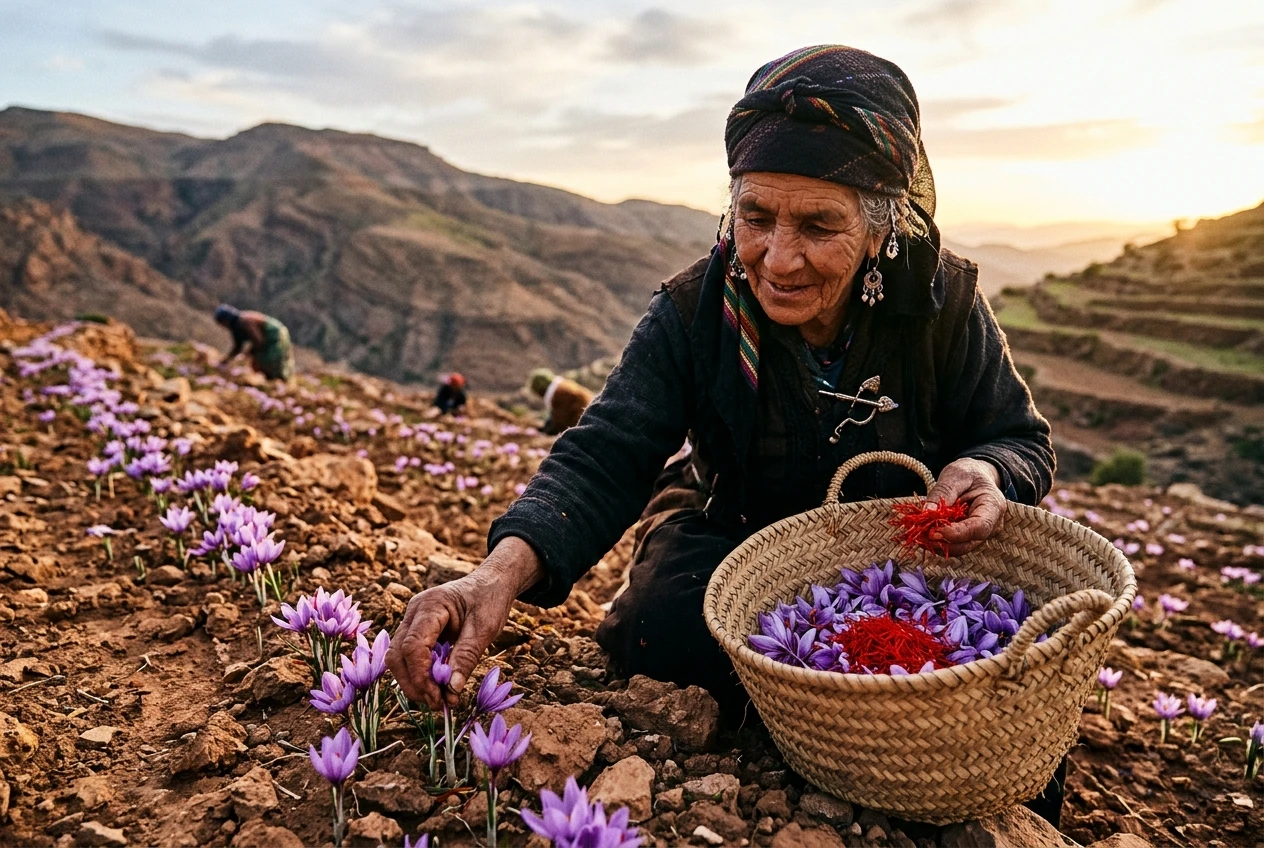
The saffron harvest in Taliouine occurs during a fleeting four-week window between mid-October and mid-November. The work is intensely demanding and begins long before the first rays of sunlight crest the Atlas peaks.
- The Pre-Dawn Plucking: Women from local Amazigh villages walk to the terraced fields at 4:30 AM in the freezing alpine air. The flowers must be hand-plucked while still closed in tight lavender cones (al-barâ’im). If the flower opens under the midday sun, solar ultraviolet rays rapidly degrade the delicate crocin molecules, bleaching the deep crimson stigmas to pale orange.
- The Manual Stripping (Émondage): Once harvested in woven palm-leaf baskets, the blossoms are brought indoors. Sitting in clean communal cooperative halls, women carefully open each petal and sever the three crimson stigmas with their fingernails, discarding the yellow style (pollen tube) and purple petals.
- Controlled Dehydration: The fresh moist stigmas lose approximately 80 percent of their weight during drying. In Taliouine’s modern cooperative drying rooms, stigmas are placed on fine silk screens and dried at 40°C for 35 minutes, instantly locking in safranal and converting picrocrocin into stable aromatic precursors.
Through institutions like the Maison du Safran in Taliouine, fair-trade premiums return directly to the female harvesters. Cooperative membership provides rural women with autonomous bank accounts, micro-credit access, adult literacy classes, and healthcare funds, cementing saffron as the primary driver of rural social progress in the Anti-Atlas.
Gastronomic Chemistry in the Moroccan Kitchen
Authentic Taliouine saffron is never thrown whole into boiling oil, which burns the fragile essential oils and turns the spice bitter. Moroccan culinary tradition approaches saffron with pharmaceutical precision:
The Secret of Cold Blooming (Al-Takhmeer)
Traditional Dadas (master female court cooks) always toast saffron threads gently on an overturned, warm tagine lid for 10 seconds until brittle. The threads are then crushed between palm leaves and steeped in lukewarm water, warm orange blossom water, or light meat broth for at least 30 minutes before cooking. This hydraulic infusion hydrolyzes the crocin molecules, releasing an astonishing golden-amber hue and distributing aroma evenly throughout the entire dish.
Iconic Traditional Pairings
- Mrouzia Sultania: The legendary honey and almond lamb confit slow-cooked during Eid al-Adha. Saffron cuts through the richness of the rendered sheep tail fat and caramelized shallots, balancing the deep warmth of Ras el Hanout.
- Pastilla Fassi: The royal pigeon and almond pie where shredded poultry is braised in an intensely saffron-rich onion gravy (daghmira) thickened with farm-fresh eggs.
- Atay b’Zaafrane: The noble hospitality tea of the Anti-Atlas, where a small pinch of whole Taliouine stigmas is dropped into hot gunpowder green tea infused with wild mountain mint and orange zest.
Frequently Asked Questions (FAQ)
How can I spot fake saffron compared to real Taliouine saffron?
Real saffron stigmas are trumpet-shaped (flared at the top and narrow at the base), deep dark crimson, and dry to the touch. Place a few threads in a glass of cold water: genuine Taliouine saffron slowly colors the water a brilliant, clear golden-yellow over 15 to 20 minutes while the threads retain their deep red color. Fake dyed saffron instantly turns the water murky red or dark orange while the fake threads turn white.
Why is Taliouine saffron more expensive than cooking spices?
Because each flower produces only three tiny stigmas. It requires up to 160,000 hand-picked blossoms and over 400 hours of delicate human handwork to produce a single kilogram of dried pure saffron. There is zero mechanized harvesting possible on steep mountain terraces.
How should I store Taliouine saffron at home?
Keep whole stigmas in an airtight dark glass jar away from direct sunlight, humidity, and heat. Under proper storage, high-grade Taliouine saffron retains its full coloring power and aromatic potency for over three to four years.
Experience the true heart of Moroccan heritage through its culinary traditions. Join us in preserving and honoring these ancestral recipes.
What People Are Saying
No comments yet. Be the first — we'd love to hear from you.
Houssam Elmrabet
Culturally Verified & Fact-CheckedHoussam Elmrabet is a Moroccan researcher in territorial marketing and cultural heritage preservation. His work documents regional gastronomic identities, local agricultural heritage, and how ancestral culinary traditions define authentic territorial branding across the Kingdom.