Tangier Food Guide: Eating at the Crossroads of Two Continents
Tangier Food Guide: Eating at the Crossroads of Two Continents
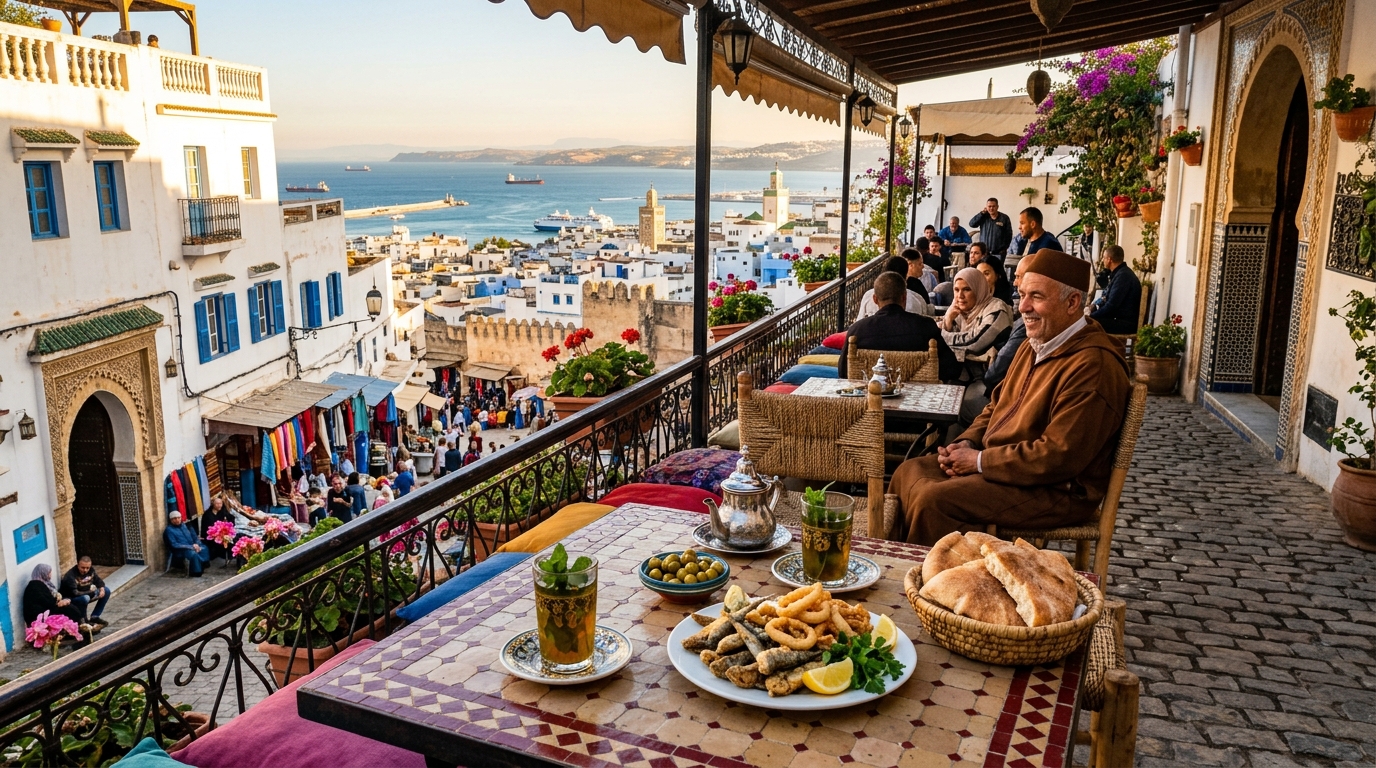
Standing on the terrace of Café Hafa on a clear day, you can see Spain. Not in a metaphorical sense — you can literally see the white buildings of Tarifa across the Strait of Gibraltar, 14 kilometers of water separating two continents that have been feeding each other for a thousand years. Tangier is where that exchange happened — where Andalusian spice blends met Moroccan preserved lemons, where Spanish churro culture became the Moroccan sfenj, where a city learned to speak several culinary languages simultaneously and did so entirely without pretension.
The result is one of the most genuinely distinctive food cities in Morocco. Not famous for food the way Fes is, not glamorized the way Marrakech has been, but quietly, confidently its own thing. Tangier rewards the visitor who ignores the obvious and follows the smell of fish frying and bread baking through the medina’s switchback streets.
The Tanjawi Kitchen: A Cuisine Born from History
The unique culinary character of Tangier — what locals call the Tanjawi style — is a direct product of the city’s history as a crossroads. For centuries, Tangier hosted Andalusian Muslim refugees expelled from Spain, Portuguese traders, Spanish merchants, Jewish merchants, British diplomats, and French colonists. Each group left something in the pot.
The Andalusian influence is the most fundamental. When Muslim and Jewish families were expelled from Spain in 1492, many settled in Tangier and brought with them a sophisticated cooking tradition: the use of almonds in savory dishes, the combination of meat and dried fruit, the refined pastilla, the preference for saffron and cinnamon in places other Moroccan cities reserve for cumin and paprika. Five hundred years later, you can still taste it.
Spanish influence came later and differently — through the years of the International Zone (1923–1956) when Tangier was governed jointly by multiple European powers and Spanish became a second language of the street. The bocadillo sandwich culture, the café con leche habit, the small fried pastries eaten with sugar: all of this embedded itself into the Tanjawi daily routine and never entirely left.
Café Hafa: The View, the Tea, the Silence
Built into the hillside above the Marshan neighborhood in 1921, Café Hafa is the oldest and most atmospheric café in Tangier, and possibly in all of Morocco. It descends in a series of terraced levels, each with low tables and wooden chairs, looking out over the Strait of Gibraltar. In the afternoon, the light on the water is extraordinary.
The café serves mint tea, coffee, and very little food — maybe a few simple cookies or a piece of ghoriba (a crumbly almond shortbread). That is fine. This is not a place for eating; it is a place for sitting. Paul Bowles came here regularly for decades. The Rolling Stones sat here in 1967. A few dozen Tanjawis will be here today doing what they have always done: drinking tea slowly and looking at the sea.
Go in the late afternoon. Order the tea. Add two sugars. Do not rush. This is the most important meal of your Tangier day even if no food is involved.
The Medina Breakfast: Bisara, Khobz, and the Morning Ritual
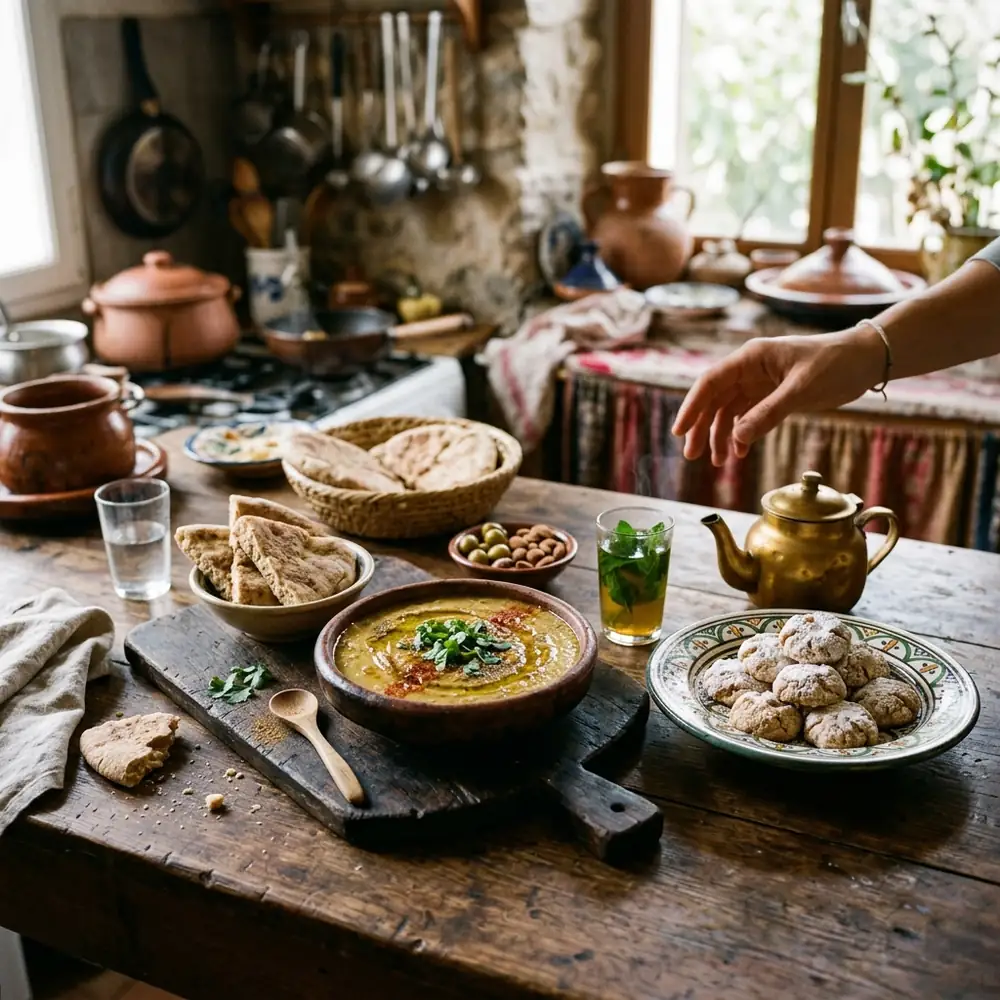
A proper Tanjawi morning starts early and cheaply. The dish to know is bisara — a thick, warm soup of fava beans, blended until smooth, poured into a bowl, and finished with a drizzle of olive oil, ground cumin, and sometimes a pinch of hot paprika. It is thick enough to eat with bread, which you do: tearing off pieces of warm khobz (round Moroccan flatbread) and dragging it through the bowl.
Bisara stalls open before sunrise in the medina and near the Grand Socco. They sell until they run out, which is usually by 9am. A bowl costs 5 to 10 dirhams. The olive oil used in Tangier is from the northern Moroccan olive belt and tends to be more intensely flavored and more peppery than the oils from the south. This matters.
Add to your morning: a small clay pot of argan oil with bread for dipping (less common here than in the south, but available), fresh-squeezed orange juice, and a glass of sweet café noir (strong black coffee served in a small glass). This entire breakfast will cost you 20 to 30 dirhams in the medina. In a café near the port facing European cruise ship tourists, multiply that by four.
The Atlantic Seafood: Better Than People Think
Tangier sits at the convergence of the Atlantic Ocean and the Mediterranean Sea, and the waters nearby are some of the most productive fishing grounds in the world. The cold Canary Current from the Atlantic meets warmer Mediterranean waters just off Cap Spartel, creating ideal conditions for sardines, mackerel, sea bream, sea bass, cuttlefish, and a rotating cast of other species.
The port area — particularly the stretch of restaurants and grill stalls near the old fishing harbor — serves this catch in the most direct way possible: buy it, grill it, eat it with bread and harissa. This is not complicated. It is not supposed to be. The sardines here are as good as anything you will find in Essaouira or Agadir, and they cost less.
For a slightly more sit-down experience, the small restaurants on the streets immediately inland from the port — around Avenue d’Espagne — offer fish cooked Tanjawi-style, which often means a sauce involving preserved lemon, olives, and fresh tomato baked around a whole fish in a clay dish. Ask what came in today. If they hesitate, leave.
The Spanish Crossover: Sfenj, Bocadillos, and Café Culture
Sfenj are Morocco’s answer to churros — loops of unsweetened fried dough, pulled from a vat of hot oil by a vendor who shapes them by hand in a single continuous motion that is genuinely impressive to watch. They are sprinkled with sugar, sometimes dipped in honey, and eaten hot, immediately, standing up. The best sfenj vendors in Tangier are near the Grand Socco and in the Beni Makada neighborhood. Morning only.
The bocadillo influence is more subtle but real. In the neighborhoods that had large Spanish populations during the International Zone era, sandwich culture developed in a way it did not in Marrakech or Fes. A Tanjawi bocadillo is a baguette-style bread filled with grilled kefta, sliced tomato, harissa, and a few green olives — equal parts Moroccan and Iberian, and entirely its own thing.
Tangier Pastilla: A Refined Northern Tradition
Pastilla — the extraordinary layered pastry filled with pigeon (or in modern versions, chicken) meat, almonds, cinnamon, and sugar, wrapped in wafer-thin warka pastry — has its most refined expression in the northern cities that were most directly shaped by Andalusian culinary culture. Fes is famous for it. But Tangier’s version is worth knowing separately.
The Tanjawi pastilla tends to be smaller and more delicate than the Fes versions, and some of the older family recipes use a richer filling that includes saffron-soaked raisins and a higher almond-to-meat ratio. A few restaurants in the kasbah area still make it the old way. Ask ahead whether they make it fresh — pastilla made the day before is not pastilla worth eating.
The Grand Socco and Kasbah: Eating by Neighborhood
The Grand Socco — officially Place du 9 Avril 1947 — is the main market square at the entrance to the medina and the best place to buy local produce, dried fruits, and street food. The weekly market held here is particularly good for herbs, olives sold from enormous barrels, and local cheeses from the Rif foothills.
The kasbah neighborhood, higher up in the medina, hides a few excellent small restaurants that require some navigation to find. The streets are narrow and the signage is minimal, but the reward is a quieter, more residential eating experience. Look for places with hand-written menus on chalkboards and tables that do not face the street. These are the ones feeding locals.
The Café Literati Legacy
Tangier’s café culture was shaped by the decades when the city attracted writers, painters, and intellectuals — Paul Bowles, William S. Burroughs, Tennessee Williams, Juan Goytisolo — who lived here partly for the freedom the International Zone afforded and partly because the café terraces were cheap and the light was good. The legacy of that era is a café culture that takes sitting seriously. A good Tanjawi café is a place where nobody rushes you. Order what you want, read what you brought, and stay as long as you like.
FAQ
Is Tangier food more expensive than other Moroccan cities? In the medina and local neighborhoods, prices are similar to or slightly lower than Marrakech. The tourist-facing port area and the cafés near the ferry terminal charge significantly more. Stay in the medina for meals and you will eat well cheaply.
What is the best neighborhood to eat in Tangier? The medina and the Ancien Quartier near the kasbah for local food. The Grand Socco area for street food and produce. Avoid the Ville Nouvelle (new town) restaurants unless you have a specific recommendation; most are aimed at office workers and offer uninspiring fixed-price lunches.
Can I eat well in Tangier on a budget of 100 dirhams per day for food? Easily. A bisara breakfast, a bocadillo or sfenj mid-morning, a grilled fish plate at the port for lunch, and a harira soup with khobz for dinner adds up to well under 100 dirhams and covers all the essential Tanjawi food experiences.
Is Café Hafa worth visiting if I do not drink mint tea? Yes. The view and the atmosphere are the point, not the menu. Order a coffee or even just a bottle of water. Nobody will rush you, and watching the strait change color as the sun moves is its own reward.
Experience the true heart of Moroccan heritage through its traditions. Join us in preserving these ancestral rituals.
What People Are Saying
No comments yet. Be the first — we'd love to hear from you.
The Moroccan Food
A Moroccan cultural writer dedicated to documenting the authentic voice, history, and heritage of the Kingdom. Writing from within — to share what truly makes Morocco extraordinary.
Our Mission →