The Gnaoua World Music Festival of Essaouira: Sacred Trance and Global Harmonies
archived: false
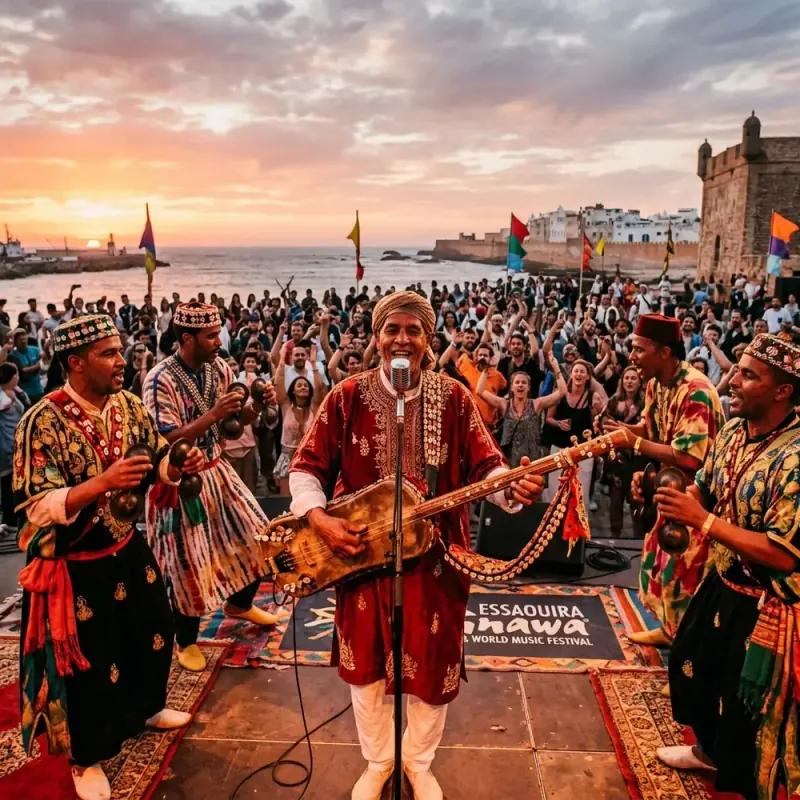
Every year in late June, the historic Atlantic fortress city of Essaouira (historically Mogador) undergoes an astonishing cultural transformation. As trade winds blow across the stone ramparts and waves crash against the eighteenth-century sea wall, over four hundred thousand music lovers, spiritual seekers, and international artists from across the globe descend upon the town for the Gnaoua and World Music Festival (Festival Gnaoua et Musiques du Monde).
Inscribed by UNESCO on the Representative List of the Intangible Cultural Heritage of Humanity in 2019, this monumental gathering is not merely a summer music concert; it is a sacred cultural crossroads where centuries-old African spiritual healing trance rituals (Lila) meet modern international jazz, blues, rock, and flamenco.
The Sacred Roots: The Diaspora of the Gnaoua
To understand the emotional power of the festival, one must understand the history of the Gnaoua people:
- The Sub-Saharan Journey: The ancestors of the Gnaoua were enslaved sub-Saharan Africans brought across the Sahara desert to Morocco between the eleventh and sixteenth centuries from ancient empires in the Sahel (modern-day Mali, Senegal, Guinea, and Niger).
- The Spiritual Syncretism: In Morocco, these communities preserved their ancestral animist spirit beliefs, polyrhythmic drumming, and healing rituals, synthesizing them with Sufi Islamic mysticism and devotion to the Prophet Muhammad and Muslim saints (Awliya).
- The Sacred Trance Night (Lila): In traditional Gnaoua practice, music is an active therapy. Led by a master musician (Maâlem), the all-night ceremony (Lila) uses repetitive, hypnotic polyrhythms, incense smudging, and symbolic color stages (white, black, blue, red, green, yellow) to enter states of spiritual trance (Jazba), healing trauma and restoring psychological harmony.
The Instruments of the Maâlem
The acoustic power of Gnaoua music relies on three foundational handcrafted instruments:
- The Guembri (or Hajhouj): The spiritual soul of the performance. A three-stringed, bass lute carved from a single solid log of walnut or mahogany, its soundboard covered with stretched dried camel neck skin. Strung with heavy goat intestines, the Guembri produces deep, resonant, percussive bass notes that resonate directly in the listener’s chest.
- The Qraqeb (Iron Castanets): Heavy, hand-forged dual-disc iron castanets played in pairs. The master musicians strike the iron plates together with rapid, syncopated wrist snaps, producing a driving, metallic, galloping rhythm that mimics the sound of horses’ hooves and breaking slave chains.
- The Tbel (Large Bass Drum): A double-headed cowhide drum beaten with curved wooden sticks to summon the community to the ritual circle.
The Festival Alchemy: Sacred Tradition Meets Global Fusion
Founded in 1998, the Essaouira festival achieved something revolutionary: it took music that had been marginalized for centuries and placed the veteran Moroccan Maâlems on monumental outdoor stages as musical equals alongside the world’s greatest instrumentalists.
The festival operates on two complementary levels:
1. The Monumental Open-Air Fusion Stages
Set against the ocean ramparts at Place Moulay Hassan and the beach, massive evening concerts feature legendary cross-cultural jam sessions:
- Maâlems trading lightning-fast improvisations with Grammy-winning American jazz bassists, West African kora masters, Andalusian flamenco guitarists, and Cuban salsa ensembles.
- Music historians have long noted that African-American delta blues and jazz share direct pentatonic scales, call-and-response structures, and spiritual sorrow with Gnaoua music, a profound reunion of separated African diasporic traditions.
2. The Intimate Acoustic Zaouias
Away from the giant festival amplifiers, intimate midnight acoustic sessions take place inside historic medina sanctuaries (Zaouia Gnaoua) and stone riad courtyards:
- Lit only by candles, the Maâlem sits on carpets surrounded by his chorus, singing raw spiritual suites (Oulad Bambara) well until dawn, allowing visitors to experience the profound meditative power of unamplified Gnaoua music.
Practical Advice for Attending the Festival
Attending the Gnaoua Festival requires advance logistical preparation:
- Book Accommodation Months in Advance: Essaouira’s hotels, riads, and rental apartments fill completely for festival weekend. Reserve your accommodation at least three to four months before late June.
- Embrace the Crowds and Dress for Atlantic Wind: Festival nights are cool and breezy due to the strong Atlantic trade wind (Alize). Pack warm layers, a windbreaker, and comfortable footwear for walking between medina stages.
- Free Admission: The vast majority of the major open-air concerts on the main squares and beach are completely free and open to the general public.
Frequently Asked Questions
When does the Essaouira Gnaoua Festival take place?
The festival is held annually over three or four days in late June. Exact dates are officially announced several months in advance by the festival association (Association Yerma Gnaoua).
What does the title “Maâlem” signify in Gnaoua culture?
Maâlem translates from Moroccan Arabic as “Master Craftsman” or “Teacher.” In Gnaoua tradition, achieving the rank of Maâlem requires decades of rigorous apprenticeship, mastering hundreds of sacred vocal suites, memorizing complex polyrhythms, and possessing the spiritual maturity to guide audiences through trance.
How did Jimi Hendrix connect to Essaouira?
Legend holds that rock guitarist Jimi Hendrix visited Essaouira in the summer of 1969, allegedly inspired by the town’s atmosphere and the rhythmic pulse of Gnaoua music. While local myths claim he wrote “Castles Made of Sand” here (the song was actually recorded two years earlier), his historic visit helped establish Essaouira as a global counterculture sanctuary for musicians.
Can non-Moroccan travelers understand the music?
Yes! The driving, hypnotic, polyrhythmic groove of the Guembri and Qraqeb transcends spoken language. Audiences from every continent find themselves naturally swept up in the joyful, uplifting momentum of the music.
Experience the true heart of Moroccan heritage through its culinary traditions. Join us in preserving and honoring these ancestral recipes.
What People Are Saying
No comments yet. Be the first — we'd love to hear from you.
Houssam Elmrabet
Culturally Verified & Fact-CheckedHoussam Elmrabet is a Moroccan researcher in territorial marketing and cultural heritage preservation. His work documents regional gastronomic identities, local agricultural heritage, and how ancestral culinary traditions define authentic territorial branding across the Kingdom.