The History of Moroccan Calligraphy and Manuscripts
The History of Moroccan Calligraphy and Manuscripts
Published: January 12, 2026
Why does the Arabic calligraphy found in Morocco look completely different from the sweeping, angular scripts of the Middle East? The Maghrebi script is a unique, deeply rounded, and fiercely sweeping style of calligraphy born in North Africa and Andalusia. Discover the obsessively illuminated manuscripts and the golden ink that define Morocco’s special texts.
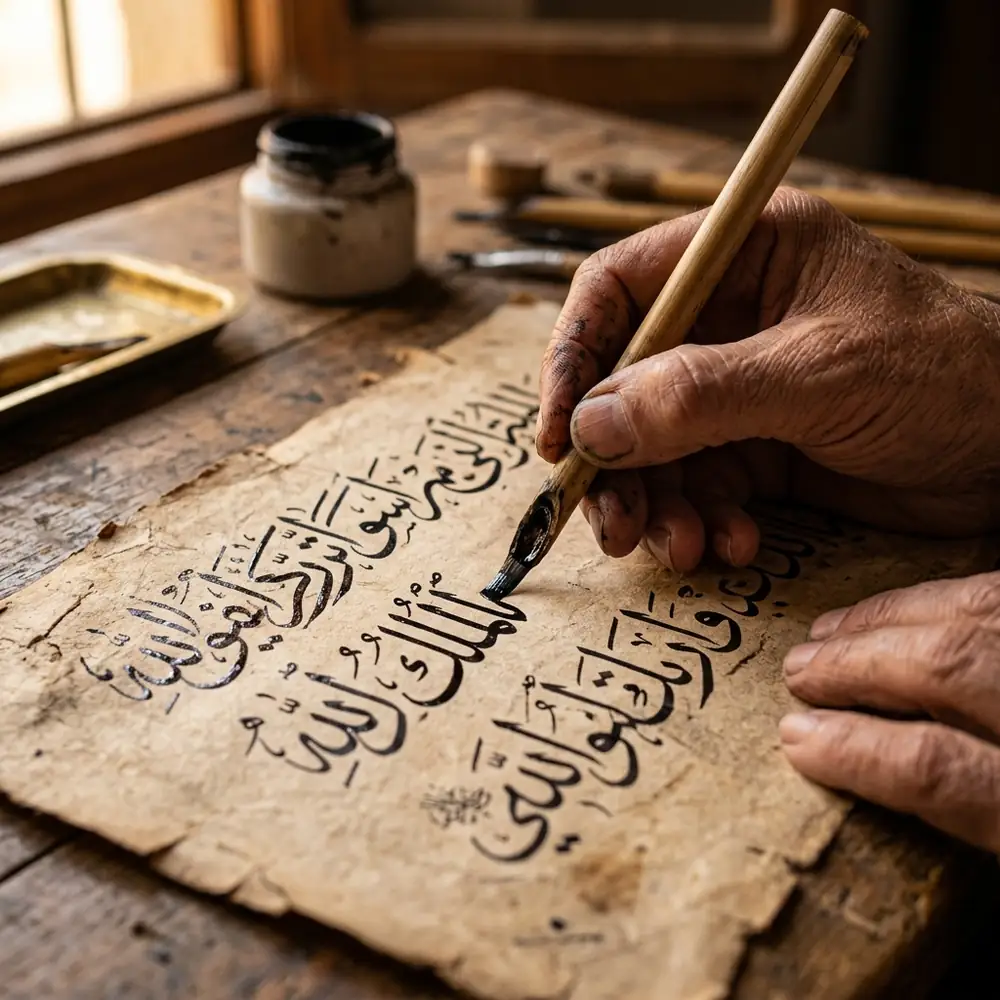
In our Kingdom, writing the word of God is an act of supreme physical devotion. When the classical Islamic scripts arrived in North Africa centuries ago, our scholars did not simply copy them. Our ancestors passed down a method of rounding the sharp edges of the letters, creating a fluid, cascading script that perfectly mirrors the endless, rolling dunes of our deserts. Today, I invite you to open an ancient book. The ink is dark, and the curves are a great piece of breath and patience.
What makes the Maghrebi script so visually distinct?
The Moroccan style deliberately breaks the rigid mathematical rules of Eastern calligraphy, favoring a highly fluid, organic flow.
- The sweeping swoops: The letters feature massive, exaggerated, and deeply dropping sub-linear curves, resembling the sweeping bowls of brass spoons.
- The uniform thickness: Unlike Eastern scripts that rely heavily on varying the pressure of the reed pen, Maghrebi script is written with a uniform, blunt thickness, making it heavily legible and bold.
- The golden illumination: special texts are often written on thick parchment, heavily illuminated with geometric, Andalusian-style medallions painted in pure gold leaf and lapis lazuli blue.
How was the knowledge passed down?
The creation of these manuscripts was an incredibly laborious, deeply respected guild profession in ancient Fes and Marrakech.
- The Zawiya scribes: Monastic scribes spent decades locked in small, cedar-lined rooms within the Madrasas, painstakingly copying massive volumes of law and theology by the light o <truncated 62892 bytes> petitive tasks, spending years simply hammering rough edges or sanding wood until the motion becomes a flawless, unthinking muscle memory.
- The unwritten exam: There is no graduation ceremony. The apprentice only becomes a Maâlem when the older masters in his guild collectively nod their heads and finally trust him to execute a complex, geometric design entirely on his own.
Why do they never use blueprints or sketches?
The most terrifying aspect of a Moroccan master craftsman is his absolute, unwavering reliance on spatial memory and oral mathematics.
- The mental library: A Maâlem in Zellige (mosaic) or Geps (carved stucco) holds hundreds of incredibly complex, infinite geometric star patterns entirely in his head, completely incapable of forgetting them.
- The compass and string: When designing a massive, towering palace wall, he does not use a computer or a paper grid. He uses only a piece of charcoal, a basic compass, and a stretched piece of string to snap flawless, perfectly symmetrical guidelines directly onto the blank plaster.
- The divine geometry: The master believes that drawing these endless, intersecting sixteen-point stars is a deeply spiritual act, a physical meditation that reflects the infinite, flawless perfection of God.
Imagine standing in a dusty, dimly lit workshop smelling heavily of wet clay and cedarwood. A man with deeply calloused, scarred hands sits on the floor, holding a heavy iron hammer. Without pausing to think or measure, he rapidly strikes a glazed tile three times, dropping a flawless, razor-sharp blue star into a basket. He has done this a million times before. Our hands are scarred, and our math is divine; come watch the master work.
Meta Description: Explore the grueling path to becoming a Maâlem (Master Craftsman) in Morocco. Learn how these artisans carve complex cedar and zellige mosaics entirely from memory.
Experience the true heart of Moroccan heritage through its culinary traditions. Join us in preserving and honoring these ancestral recipes.
What People Are Saying
No comments yet. Be the first — we'd love to hear from you.
Diafa Editor
Culturally Verified & Fact-CheckedThe Moroccan Food editorial team brings together native culinary researchers, heritage preservationists, and experienced home cooks across Marrakech, Fes, and Casablanca. Every recipe and cultural guide is reviewed against ancestral oral traditions and authentic regional practices.