The Soul of the Moroccan Ftour: Harira, Chebakia, and Ramadan Traditions at Our Table
The Soul of the Moroccan Ftour: Harira, Chebakia, and Ramadan Traditions at Our Table
Marhaba, welcome to my table. If you were to walk through the ancient, labyrinthine alleyways of the medina of Fes, the lively souks of Marrakech, or even my own quiet neighborhood in Casablanca just before sunset during the holy month of Ramadan, the air itself would tell you a story. It’s a profound, almost intoxicating mix of scents that weaves through the streets: the earthy perfume of heavily toasted sesame seeds, the bright citrusy tang of fresh cilantro and celery being chopped on wooden boards, and the heavy, sweet, floral scent of warm honey infused with pure orange blossom water.
In Morocco, Ramadan is not merely a month of fasting from dawn until dusk; it is a time of deep spiritual reflection, communal charity, and, equally, a period of extraordinary, meticulous culinary devotion. The Ftour (our Moroccan term for Iftar, the meal that breaks the daily fast) is not just a dinner to refuel the body; it is an institution. It is a daily celebration of family, unshakeable faith, and generations of culinary heritage preserved by the hands of our mothers and grandmothers.
Let me take you by the hand, pull out a chair for you, and show you exactly what Ramadan looks, smells, and tastes like in a traditional Moroccan home, focusing on the undisputed royalty of our Ftour table: the majestic Harira soup and the sticky, sweet jewel known as Chebakia.
The Prelude to Ramadan: The Scents and Sounds of Chaaban
The Moroccan Ramadan experience actually begins weeks before the new crescent moon is officially sighted, during the preceding lunar month of Chaaban. If you walk into any Moroccan home during this anticipatory period, you’ll find the women of the family—and increasingly the men—gathered in a flurry of purposeful, joyous activity. The preparations are a monumental undertaking.
I clearly remember my mother and aunts sitting on plush floor cushions around a large, gleaming silver tray, meticulously sorting through mountains of golden sesame seeds, picking out microscopic stones or impurities with the practiced speed of artisans. The oven would be running non-stop from morning until late afternoon, roasting whole almonds until they released their deep, nutty oils and their skins grew dark and fragrant.
This communal preparation is absolutely essential because the sweets of Ramadan—particularly Chebakia and the energy-dense Sellou—are incredibly labor-intensive. We don't buy these out of boxes from supermarkets if we can help it; we make them with our own hands, folding our love, anticipation, and prayers for a blessed month into every single batch. The scent of these Chaaban preparations permanently lingers in the house, a sensory countdown to the holy month.
Harira: The Beating Heart of the Ftour Table
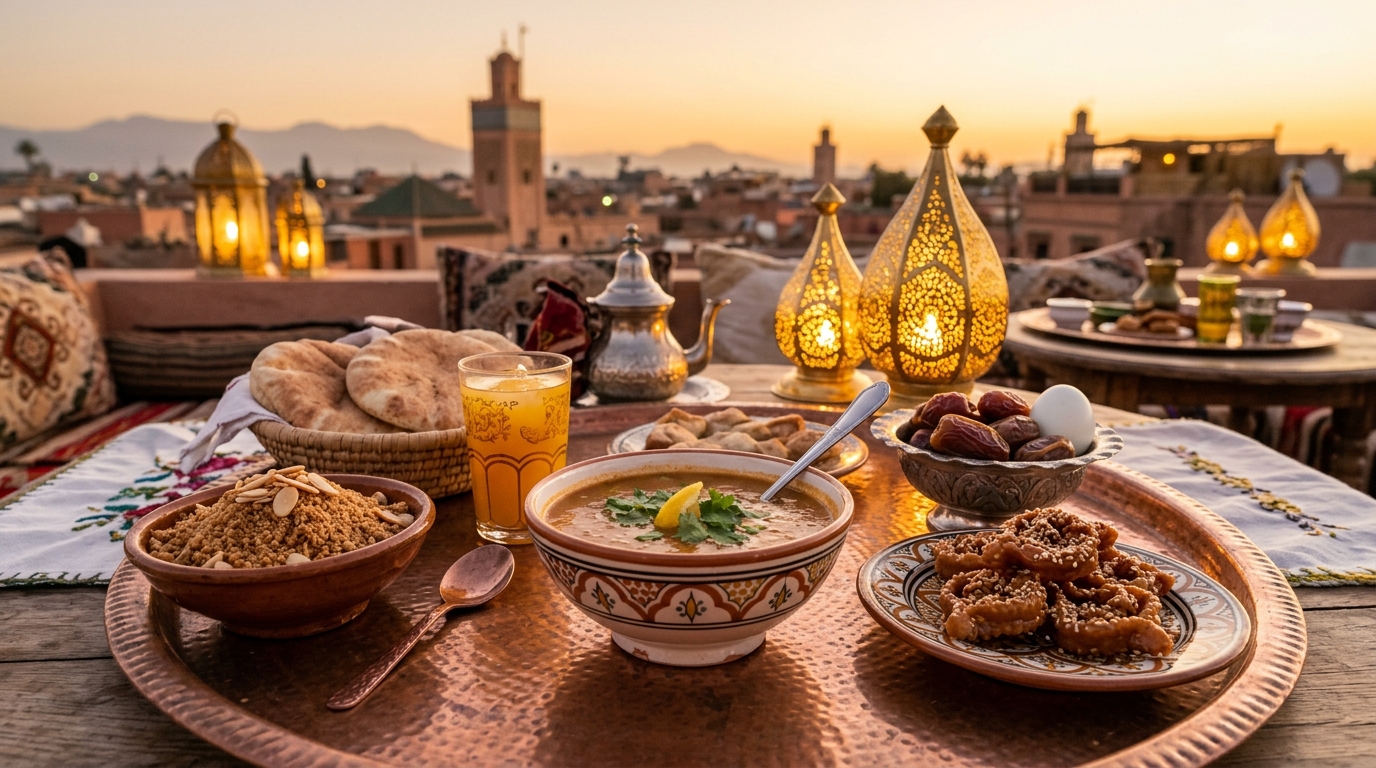
When the muezzin finally calls the Maghrib prayer from the minaret of the local mosque, signaling the end of the long day's fast, a profound silence falls over the dining room. A brief prayer is murmured. Then, the first thing that graces our lips—usually following the Prophetic tradition of a sweet Medjool date and a small sip of room-temperature water or milk—is Harira.
To call Harira a simple "tomato, lentil, and chickpea soup" is to do it a grave culinary disservice. Harira is the undisputed core of the Moroccan Ftour. It is a thick, velvety, deeply complex, and restorative masterpiece that warms the fasting body and comforts the soul.
The Anatomy of a Perfect Harira
Every family has its secret nuances—a pinch of this, a dash of that—but the fundamental soul of Harira remains the same across the kingdom. It begins with a base of freshly grated, ripe tomatoes, finely chopped celery stalks and leaves, and a frankly astonishing volume of fresh, fragrant cilantro and parsley.
To this vibrant herbaceous base, we add plump chickpeas (which must be soaked overnight and meticulously peeled by hand, a tedious but necessary task I was often assigned as an impatient child), earthy brown lentils, and tender, bite-sized morsels of beef or lamb on the bone to enrich the broth.
The magic, however, lies in two crucial elements: the spice blend and the tedouira. We season our Harira with warming ginger, vibrant yellow turmeric, a generous hit of black pepper, and sometimes a tiny pinch of cinnamon. Many families add a spoonful of smen—a fermented, intensely flavored clarified butter that adds an umami depth you simply cannot replicate with regular butter.
The tedouira is the thickening agent. It is a slurry made of flour and water (and sometimes a bit of yeast, left to ferment slightly for a sourdough-like tang) that is whisked into the boiling soup at the very end, along with a handful of broken vermicelli noodles or rice. This tedouira gives Harira its signature heavy, silky texture that coats the back of a wooden spoon.
When you serve Harira, it must be steaming hot, ladled generously into a zlafa (a traditional, deeply patterned ceramic bowl), and always, always accompanied by a wedge of fresh lemon. Squeezing that bright, acidic lemon juice into the rich, earthy, velvety soup wakes up every single flavor profile. It is a taste that, to any Moroccan anywhere in the world, is instantly synonymous with coming home.
Chebakia: The Sticky, Sweet Crown Jewel
Now, we must talk about the perfect, non-negotiable companion to Harira. You cannot truly understand the Moroccan Ftour without understanding the glorious, sticky, architectural paradox that is Chebakia (also called Mkharqa in certain regions of Morocco).
Chebakia is a mesmerizing, intricately folded, flower-shaped cookie. But calling it a cookie feels inadequate. It is made from a rich, highly spiced dough that contains finely ground toasted sesame seeds, anise, fennel, cinnamon, saffron threads steeped in water, and a splash of vinegar to tenderize the gluten.
The dough is kneaded until smooth, rolled out paper-thin, and then cut into small rectangles with a fluted pastry wheel, making several parallel slits in the center of each piece. Then comes the folding. My grandmother’s hands moved with such practiced, fluid speed when folding Chebakia that it looked like a magic trick—weaving the delicate strips of dough over and under each other, turning them inside out to create a beautiful, interlocking rose or braid shape that holds together during the violent frying process.
The Alchemy of Frying and Soaking
Once folded, the dough flowers are deep-fried in hot oil until they achieve a perfect, deep golden-brown hue. Then comes the alchemy: immediately upon being scooped from the fryer—while still bubbling hot—the pastries are plunged directly into a large pot of warm, premium honey that has been heavily scented with pure, distilled orange blossom water.
The hot, crispy pastry violently drinks in the fragrant honey. It becomes incredibly sticky and glossy on the outside, yet retains a slightly crisp, deeply spiced, and crumbly texture on the inside. Finally, as they are fished out of the honey bath to drain, they are showered generously with toasted whole sesame seeds.
The Harira and Chebakia Pairing: A Culinary Revelation
If you are not Moroccan, the idea of eating an intensely sweet, honey-soaked, fragrant cookie alongside a savory, meaty, acidic soup might sound bizarre, perhaps even unappealing. But trust me on this: it works.
Taking a sip of warm, tangy, rich Harira and immediately following it with a bite of sweet, chewy, sesame-laden Chebakia is one of the greatest, most unexpected culinary marriages on earth. The intense sweetness of the honey cuts through the savory, meaty depth of the soup; the rich spices of the Chebakia harmonize with the ginger and turmeric of the Harira; the acidic lemon in the soup cleanses the palate of the heavy sugar. It is a masterful balancing act of extreme flavors that instantly replenishes a fasting person's depleted energy and makes you close your eyes in pure, unadulterated bliss.
Beyond Harira: The Full Moroccan Ftour Spread
While Harira, Chebakia, and dates form the sacred trinity of the table, the Moroccan Ftour is a sprawling, abundant canvas of textures, colors, and flavors. We eat with our eyes first, and the table is always covered edge-to-edge in colorful small plates and tiered stands.
Sweet and Savory Breads
Carbohydrates are essential for rapidly restoring energy after a 14-hour fast, and we deliver them beautifully:
- Msemmen & Meloui: These are incredibly flaky, laminated flatbreads, stretched thin with oil and butter, folded into squares or coils, and cooked on a screaming hot cast-iron griddle. We tear them apart by hand and dip them in a warm mixture of melted butter and honey, or we stuff them prior to cooking with a savory, spicy mixture of minced meat, onions, bell peppers, and suet.
- Baghrir: Often lovingly referred to as "thousand-hole pancakes," these are spongy, delicate, semolina-based crepes that are cooked only on one side. As the batter hits the warm pan, the surface erupts in hundreds of tiny bubbles that pop and stay open, creating a honeycomb texture. This texture is absolutely crucial, as it acts as a perfect, highly absorbent sponge for the warm honey and butter syrup we pour over them.
Sellou (Sfouf): The Ultimate Energy Booster
Sitting in a prominent position alongside the Chebakia is a beautiful, dome-shaped mound of Sellou (also known as Sfouf or Zmita depending on the city). This is a highly unique preparation. It is not a baked good, but rather a powdery, incredibly rich, unbaked confection.
It is made from slowly browned flour, massive quantities of ground toasted almonds and ground toasted sesame seeds, experienced heavily with ground anise, cinnamon, and nutmeg, and finally bound together with pure honey and clarified butter until it reaches the texture of damp sand. It is intensely rich, deeply nutty, and incredibly nutrient-dense, specifically designed to provide sustained, slow-release energy for the fasting days ahead. I love taking a small spoonful of Sellou and letting it melt on my tongue alongside a piping hot glass of mint tea.
Savory Bites and Protein
To balance out the heavy presence of sweets and carbs, we feature an array of savory finger foods. Briouates—which are crispy, tightly folded triangular phyllo pastry parcels—are a staple. They are stuffed with everything from lemon-herb chicken and vermicelli to spiced minced meat, or a simple mixture of fresh goat cheese and thyme. We also commonly serve hard-boiled eggs, peeled and presented with a small communal dish of freshly ground cumin and salt for dipping.
The Rhythm of the Evening: Ftour, Taraweeh, and Shour
The true beauty of the Moroccan Ramadan lies in its unhurried, communal rhythm. The Ftour meal itself is frequently broken into two distinct stages. When the sun sets, the initial fast-breaking is relatively swift: dates, water, a comforting bowl of Harira, and some Chebakia. This quells the immediate hunger and stabilizes the blood sugar.
Then, there is a pause. The family washes and steps away from the table to pray the Maghrib prayer together.
Only after the prayer is completed do we return to the table for the rest of the feast—the sprawling assortment of breads, the pastries, the savories, and the endless conversation. It’s a time of laughter, of catching up on the day’s minor struggles, and often, of watching the special, highly anticipated Ramadan sitcoms and hidden-camera shows that air on national television during this specific hour.
Later in the evening, after families return from the long, meditative Taraweeh prayers at the local mosque, they often gather yet again in the living room for a lighter, more relaxed spread. This late-night gathering might feature fresh seasonal fruit slices, a piece of almond cake, and inevitably, more Moroccan Mint Tea (Atay), expertly poured from a great height to create the requisite frothy crown in the glass.
A Table Set with Unconditional Love
To fully experience a Moroccan Ftour is to experience the very essence, the core, of our culture. It is an expression of massive generosity, a physical manifestation of faith and patience, and a proof to the women (and men) who spend countless hours in the kitchen to ensure the table is a place of absolute joy and comfort.
If you ever find yourself with the opportunity to visit Morocco during the holy month of Ramadan, do not hesitate for a second to accept an invitation to an Iftar in a family home. Come hungry, come ready to be completely overwhelmed by the sheer scale of the hospitality, and remember—always, always squeeze a little fresh lemon into your Harira. Besseha wa raha (To your health and ultimate comfort).
Frequently Asked Questions (FAQ)
1. Can I make Harira without meat? Is it still authentic?
Absolutely! While the traditional 'grand' Harira often utilizes small pieces of beef, lamb, or chicken bones to create a richer, deeper broth, a vegetarian or vegan Harira is incredibly common, completely authentic, and just as delicious. The true, complex flavor profile of Harira comes primarily from the massive amounts of fresh herbs (cilantro, parsley, celery), the pureed tomatoes, and the specific spice blend. Simply omit the meat, perhaps add an extra handful of lentils for body, and ensure you use a robust vegetable broth or high-quality water.
2. How long does Chebakia last, and how should I properly store it?
Because Chebakia is deep-fried and then essentially preserved in a thick coating of honey (containing very little internal moisture), it boasts a wonderfully long shelf life. If stored properly in an airtight container lined with parchment paper, kept in a cool, dry place away from direct sunlight, it can easily last for two to three months. In fact, most Moroccan families make enormous batches in the weeks prior to Ramadan precisely because it keeps so well for the entire 30 days of the month!
3. What is the difference between Ftour and Iftar?
There is absolutely no difference in meaning or practice! Iftar is the standard, classical Arabic word for the meal that breaks the fast at sunset. Ftour (or sometimes spelled F'tour) is simply the Moroccan Darija (local dialect) pronunciation and terminology for that exact same meal. In Morocco, you will hear "Ftour" used almost exclusively in daily conversation.
4. How do you eat Sellou (Sfouf)? Is it a dessert?
Sellou occupies a unique space; it's a sweet treat, but it's fundamentally viewed as an energy supplement. Because it has a unique, powdery-yet-dense texture (like wet sand), it is usually served mounded beautifully on a communal plate, often decorated with intricate patterns of powdered sugar and whole fried almonds. You can eat it by delicately scooping a small amount with a spoon. Alternatively, some families prefer to firmly compress it into small, bite-sized molds or roll it into balls to be eaten easily by hand. It pairs best with a strong, hot, unsweetened glass of mint tea to balance its intense richness.
Image Prompts for the Blog Post
Subject: A close-up, top-down shot of a traditional, steaming Moroccan Harira soup in a beautifully patterned, rustic blue and white ceramic bowl (zlafa). Next to the bowl rests an intricately carved wooden spoon, a vibrant wedge of fresh lemon, and three plump, premium Medjool dates on a small brass saucer. Vibe: Warm, deeply comforting, intimate lighting emphasizing the steam gently rising from the velvety soup. Style: Editorial culinary photography, moody chiaroscuro lighting, natural textures, shallow depth of field highlighting the soup's rich texture. Format: 16:9
Subject: A stunning macro shot of Moroccan Chebakia resting on an antique, hammered copper tray. The absolute focus should be on the intricate, flower-like folded architectural shape of the pastry, glistening heavily with a thick coating of amber honey and sprinkled generously with toasted golden sesame seeds. Vibe: Rich, decadent, sticky, incredibly appetizing, highlighting artisanal craftsmanship. Style: High-end culinary photography, warm golden hour light catching and reflecting off the honey glaze, highly detailed and sharp. Format: 4:3
Subject: A lively, fully set Moroccan Ftour table at the exact moment of sunset. The table features bowls of steaming Harira, plates of flaky, layered Msemmen flatbreads, a towering plate of Chebakia, a pristine mound of Sellou dusted with powdered sugar, and a gleaming silver Moroccan tea service. Human element: an older woman's hands, adorned with faint henna, pouring mint tea from a traditional teapot high up into a small, ornately painted glass. Vibe: Abundant, familial, joyful, deeply authentic and welcoming. Style: Lifestyle food photography, slightly moody ambient lighting with a warm, inviting indoor glow, non-stock aesthetic, a slightly messy, lived-in table showing a real family meal. Format: 16:9
Subject: A cinematic, close-up shot of flour-dusted hands working with Chebakia dough on a rustic, worn wooden table. One hand is actively using a brass fluted pastry wheel to cut the thinly rolled dough into rectangles, while the other hand delicately holds a half-folded, intricate Chebakia shape, demonstrating the weaving process. Vibe: Artisanal, traditional, handmade, conveying generational knowledge and hard work. Style: Cinematic, dramatic side lighting from a nearby window highlighting the texture of the dough, the brass tool, and the fine flour dust suspended in the air. Format: 1:1
Subject: A perfect, wildly spongy Baghrir (thousand-hole pancake) resting on a rustic, unglazed clay plate. A generous, melting pat of fresh butter sits directly in the center, while a thick drizzle of rich amber honey is actively being poured over it from a wooden dipper, seeping deeply into the hundreds of honeycomb-like holes in the crepe. Vibe: Mouth-watering, breakfast-style comfort, warm, rich, emphasizing the unique texture of the food. Style: Bright, natural daylight, macro food photography, hyper-focus on the spongy texture of the Baghrir and the glossy, viscous flow of the honey. Format: 4:3
Experience the true heart of Moroccan heritage through its culinary traditions. Join us in preserving and honoring these ancestral recipes.
What People Are Saying
No comments yet. Be the first — we'd love to hear from you.
Youssef Amazigh
Culturally Verified & Fact-CheckedThe Moroccan Food editorial team brings together native culinary researchers, heritage preservationists, and experienced home cooks across Marrakech, Fes, and Casablanca. Every recipe and cultural guide is reviewed against ancestral oral traditions and authentic regional practices.