The Sacred Friday Ritual: Rolling Couscous by Hand in Moroccan Homes
archived: false
In every village, medina, and modern town across the Kingdom of Morocco, Friday bears a singular sensory identity. As the midday call to prayer (Adhan al-Juma’a) echoes across rooftop minarets, the streets quieten and an unmistakable aroma drifts from open kitchen windows: the sweet, comforting fragrance of steaming durum wheat semolina, slow-cooked beef shank, caramelized pumpkin, chickpeas, and pure saffron.
Friday in Morocco is synonymous with Couscous (Seksu in Tamazight). More than a national dish, Friday couscous is a sacred weekly communal sacrament of gratitude, family reunion, and charitable sharing (Sadaqa). While commercial pre-steamed couscous in cardboard boxes has flooded Western grocery shelves, true Moroccan couscous remains an artisanal craft of hand-rolling raw semolina grains and steaming them three times over bubbling rich broth in a traditional two-tiered steamer (Couscoussier).
The Amazigh Origins of Seksu
Archaeological excavations across the Maghreb reveal primitive terracotta couscous steamers dating back over two millennia, confirming that indigenous Amazigh tribes developed couscous long before Arab or Roman arrivals. The word Seksu derives from the Tamazight root describing well-rolled, rounded, and aerated grain.
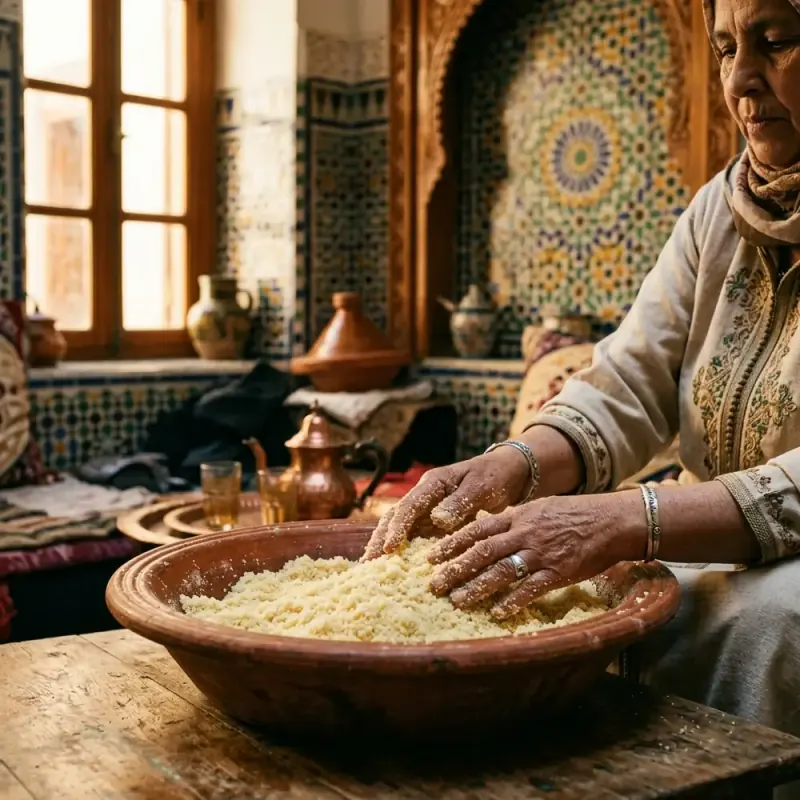
Historically, preparing couscous was a communal task performed by village women during late summer harvests. Women gathered in sunlit courtyards with massive shallow painted clay platters (Gsaa or Qas’ah) carved from walnut wood or fired terracotta. Working with coarse, medium, and fine grades of hard durum wheat semolina (Smida), clean spring water, and fine sea salt, their palms moved in rhythmic, circular motions (Kskis) to coax raw flour into microscopic, spherical golden pearls.
The Chemistry of the Triple Steam
True couscous is never boiled in water like rice or pasta. Boiling turns semolina into heavy, gelatinized glue. Authentic couscous is aerated and inflated through three gentle cycles of steam inside the perforated upper basket (Keskas) set tightly atop the lower broth pot (Borma):
The First Steam (Et-Tafwira Al-Oula)
Raw semolina is moistened with a drizzle of cold water and a tablespoon of olive oil, tossed gently between open fingers to separate the grains, and ladled into the steaming basket over simmering meat and vegetables. When white plumes of steam rise evenly through the grain bed (roughly twenty minutes), the grains are tipped out into the wide wooden platter.
The Aeration and Hydration (Et-Tahrir)
While piping hot, the cook sprinkles cold salted water across the grains, using a wooden paddle or bare palms to break apart any clustered lumps. The moist grains absorb the water and expand. The semolina rests for ten minutes, swelling and drying slightly.
The Second Steam
The aerated couscous returns to the steamer for another twenty minutes. Upon the second dumping, the grains have doubled in volume, turning remarkably light and fluffy. The cook rubs softened farm butter (Zoubda Beldia) or a teaspoon of aged fermented butter (Smen) into the steaming grains, coating each pearl in delicate savory fat.
The Third Steam
The final ten-minute steam sets the buttery aroma and warms the grains to piping perfection immediately before assembly.
The Architecture of the Friday Platter: Couscous aux Sept Légumes
The benchmark Moroccan Friday couscous features seven vegetables (Seb’a Khoudar). The number seven holds spiritual significance in Islamic and Mediterranean traditions, symbolizing completeness, luck, and cosmic order:
- Carrots: Cut lengthwise into thick quarters.
- White and Purple Turnips (Lft): Providing peppery, earthy balance to rich broth.
- Zucchini and Courgettes: Added toward the end of simmering so they remain firm.
- Red Pumpkin (Qra’a Hamra): Sweet, melting squash that dissolves lightly into the sauce.
- Cabbage (Kromp): Wedges of white cabbage that absorb meat broth deeply.
- Sweet Tomatoes and Onions: Forming the melted foundation of the golden sauce.
- Chickpeas (Hommoss): Soaked overnight, providing nutty protein richness.
Underneath the mountain of vegetables simmers choice cuts of pasture-fed beef shank, bone-in lamb neck, or free-range farm chicken, seasoned with cracked black pepper, ground ginger, turmeric, saffron threads, and a bouquet of fresh cilantro.
The Sacred Ritual of Gathering and Sharing
When the Friday prayers conclude, families assemble barefoot in the salon around the central low table.
The steamed couscous is mounded into a monumental cone inside the Gsaa. The cook hollows out a crater at the summit to cradle the tender meat. The vegetables are arranged with geometric reverence like the spokes of a wheel down the sloping sides of the grain mound. Ladles of rich, saffron-tinted broth are poured generously over the assembly until the grains glisten without turning soupy.
Diners eat communally from their designated triangle of the platter, rolling small portions of couscous, tender meat, and vegetable into compact round spheres (Kouba) using only the fingers of their right hand before tossing them neatly into the mouth without touching lips to fingers. A wooden spoon is provided for novices and elders.
In every Moroccan medina, a portion of Friday couscous is carried in covered platters to the neighborhood mosque to feed traveling strangers, students, and the destitute. This enduring practice of Sadaqa ensures that on Friday, no one in the community goes without warm, comforting food.
Frequently Asked Questions
Why does commercial boxed couscous taste so different from authentic Moroccan couscous?
Commercial boxed couscous sold in Western supermarkets is factory pre-cooked, steamed, and dehydrated. Rehydrating it with boiling water in five minutes produces dense, heavy grains. Authentic Moroccan couscous is raw durum semolina steamed three separate times over aromatic meat broth, which creates grains that are unimaginably light, fluffy, and fragrant.
Can Moroccan couscous be made vegetarian?
Yes, vegetarian couscous (Couscous Khoudar) is widely enjoyed. The broth is prepared with abundant seasonal vegetables, chickpeas, caramelized onions, raisins, and a generous teaspoon of smen or good olive oil to build rich savory body without meat.
What is the traditional drink served with Friday couscous?
Friday couscous is universally paired with tall chilled glasses of Lben, naturally fermented, churned buttermilk. The cool, tangy acidity and probiotic brightness of Lben cuts through the richness of the meat and buttery semolina, aiding digestion.
What is Tfaya couscous?
Couscous Tfaya is a celebrated sweet-and-savory festive preparation. The steamed semolina and meat are crowned with a luscious compote of sweet onions and plump golden raisins slow-caramelized with cinnamon, butter, honey, and orange blossom water, garnished with fried almonds and hard-boiled eggs.
Experience the true heart of Moroccan heritage through its culinary traditions. Join us in preserving and honoring these ancestral recipes.
What People Are Saying
No comments yet. Be the first — we'd love to hear from you.
Lalla Zineb
Culturally Verified & Fact-CheckedLalla Zineb preserves ancestral imperial recipes from the heart of the Fes medina, honoring slow-cooking methods and ceremonial feast traditions.