Tiznit: The Silver Jewelry City of the Souss and the Desert Trade Routes That Made It
Tiznit Silver: What the Jewelry Is, Where It Came From, and Why the Coral Is Not Decorative
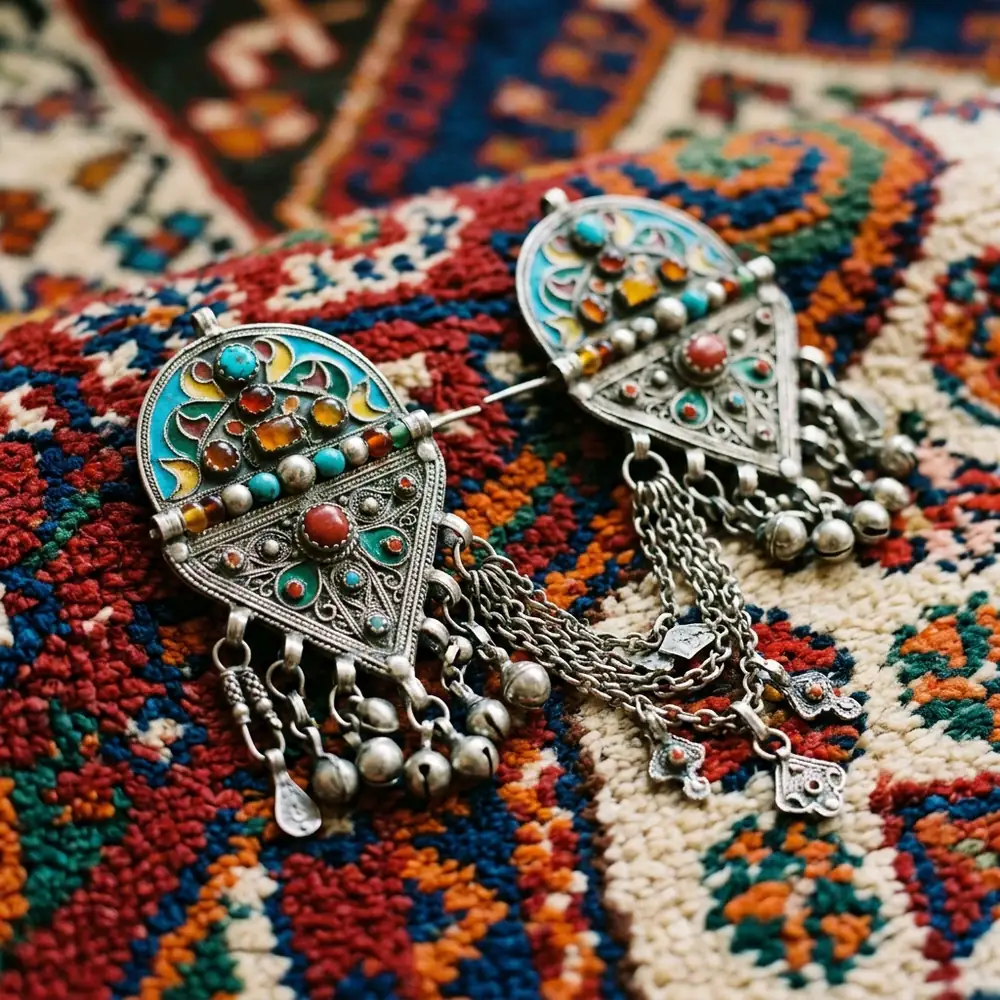
Tiznit is a walled city in the Souss region, approximately 90 kilometers south of Agadir, that has been Morocco's primary center of southern silver jewelry production for at least several centuries. The jewelry associated with Tiznit and the broader southern Moroccan-Saharan tradition is unlike the delicate filigree associated with Fes or the ornate gold-and-enamel work of the northern imperial cities — it is heavy, geometric, granulated, sometimes aggressive in its scale, made from fine silver (often recycled from old coins and objects), and decorated with a vocabulary of symbols — triangles, diamonds, eyes, spirals, crosses — that predates Islam in the region by millennia.
The craftsmen who historically made this jewelry in Tiznit were primarily Jewish — the Jewish siyagh (silversmith) communities of the southern Moroccan cities and the pre-Saharan oases were the primary producers of silver jewelry for both the Amazigh populations of the Anti-Atlas and the Saharan Tuareg and Sahrawiyyin communities who came north along the trade routes. The departure of Tiznit's Jewish community after Moroccan independence — part of the broader emigration that emptied Morocco's mellahs across the 1950s and 1960s — was a significant disruption to the craft tradition, and the contemporary Tiznit silver workshop community is composed primarily of Amazigh craftsmen who learned the craft partly from the remaining Jewish masters before the full departure and who have maintained and adapted it since.
What Is the Specific Character of Tiznit Silver and What Techniques Are Used?
The defining techniques of southern Moroccan silver jewelry are granulation and filigree in their more robust, southern form — not the delicate miniaturism of Fes goldsmithing but a heavier, more tactile expression of the same basic metalworking vocabulary.
Granulation — the application of tiny spheres of silver to a surface, fused without visible solder — produces the textured, beaded quality that characterizes much Tiznit jewelry. The spheres are made by melting tiny amounts of silver until surface tension forms them into balls, which are then applied to the cleaned silver surface and fused through a specific technique involving a mixture of copper salt and organic glue that, when heated, produces a momentary alloying at the contact point between granule and surface without melting the surrounding material. A granulated surface that is dense enough for the silver spheres to be touching each other requires very precise control of temperature and placement. Examine a well-made piece of Tiznit granulated silver under magnification and you will see each sphere as a distinct individual element, perfectly fused, with no visible join.
The symbolic vocabulary of the jewelry's decoration is the element I find most interesting and most consistently misunderstood in tourist contexts. The triangles, the hand motifs (khamsa), the eye symbol, the diamond lattice — all of these appear in Tiznit silver not as decorative choices but as a symbolic system that has protective and social meaning. The khamsa (five-pointed hand) is the most internationally recognized element, but in its southern Moroccan context it is a very specific kind of protection against the evil eye, worn by women at specific life transitions — marriage, pregnancy, recovery from illness. The eye symbol (ain) similarly. The geometric patterns carry information about the wearer's tribal affiliation, marital status, and regional origin that anyone within the community could read.
What Is the Coral and Amber and Where Did It Come From?
Southern Moroccan silver jewelry is frequently combined with red coral and amber — large, irregular beads strung with silver elements, or coral cabochons set into silver frames. The coral is Mediterranean, imported through the northern Moroccan ports from the Sicilian and Sardinian coral fisheries. The amber is sub-Saharan, arriving via the trans-Saharan trade routes from the amber deposits of West Africa (primarily from the Mauritanian and Malian regions). Both materials — expensive, imported, far-traveled — functioned as stores of value in the Saharan and pre-Saharan trade economy, worn on the body both as adornment and as portable wealth.
The presence of Mediterranean coral in jewelry produced in the Saharan trade zone tells you something specific about how far the commercial networks reached and how efficiently they connected distant resources. The coral that a Tuareg woman wore in the western Sahara in the 17th century had been fished in the Strait of Messina, traded through multiple intermediary markets, and arrived in the Sahara through a supply chain whose individual links were separated by thousands of kilometers.
The amber in contemporary Tiznit jewelry is frequently resin rather than genuine amber — the genuine sub-Saharan copal amber became increasingly rare and expensive as the 20th century progressed and the trade routes that supplied it collapsed with the end of the Saharan caravan economy. Knowing the difference: genuine copal amber is translucent to semi-transparent, slightly warm to the touch, and develops a static charge when rubbed. Resin imitations are slightly heavier, more uniformly colored, and do not develop static. Both appear in current Tiznit jewelry markets, and the genuine amber commands significantly higher prices.
The Invisible Invitation
The jewelry souk in Tiznit's medina is organized around a central square where the silversmiths have their workshops facing the market — you can watch the work being done while the finished pieces are displayed for sale. Go to a workshop that is actually making rather than simply selling. Watch the granulation process if you are lucky enough to arrive during that stage of production — the moment the granules are applied and the piece goes briefly under heat is the technically precise moment that the entire tradition's complexity is concentrated in. The smell of the flux heating is specific and unpleasant but brief. What follows it — the granule fused, permanent, part of the silver now — is a small miracle of metalworking that takes a lifetime to learn and thirty seconds to accomplish. You are watching the result of forty years of training happen in half a minute. This is the correct way to think about craft.
SEO Meta Description: What is Tiznit silver jewelry and where does it come from? Southern Morocco's granulation technique, Amazigh-Jewish craft history, coral and amber trade routes, and the protective symbolism of geometric designs.
Experience the true heart of Moroccan heritage through its culinary traditions. Join us in preserving and honoring these ancestral recipes.
What People Are Saying
No comments yet. Be the first — we'd love to hear from you.
Youssef Amazigh
Culturally Verified & Fact-CheckedThe Moroccan Food editorial team brings together native culinary researchers, heritage preservationists, and experienced home cooks across Marrakech, Fes, and Casablanca. Every recipe and cultural guide is reviewed against ancestral oral traditions and authentic regional practices.