The Moroccan Breakfast Feast: Flaky Msemen, Spongy Baghrir, Pure Honey, and Morning Rituals
The Moroccan Breakfast Feast: Flaky Msemen, Spongy Baghrir, Pure Honey, and Morning Rituals
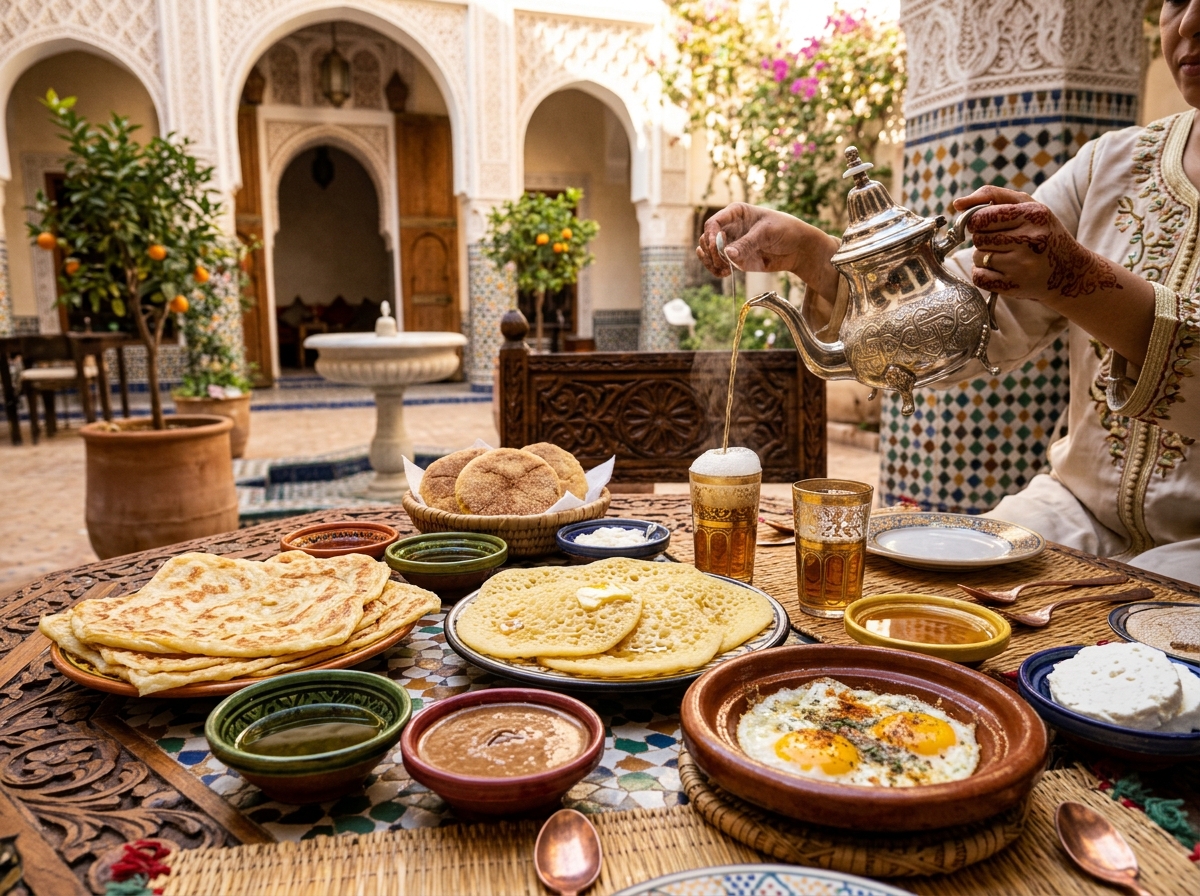
Morning in a Moroccan household begins not with an alarm clock, but with the rhythmic slap of dough against an oiled counter, the hiss of semolina meeting a smoking iron griddle, and the sweet aroma of boiling spearmint. Breakfast—known across Morocco as ftour—is never a rushed affair eaten standing up. It is a slow, communal gathering where crisp flatbreads, mountain honey, cold-pressed olive oils, and cured meats cover every inch of a round tabletop.
In Moroccan food philosophy, breakfast sets the foundation for the day. It bridges the rustic agricultural heritage of Berber mountain villages with the refined pastry traditions of imperial medinas. Whether you are seated at a low wooden table in an Atlas riad or pulling up a stool outside a neighborhood street bakery, the morning meal is generous, comforting, and deeply rooted in ancestral customs.
The Morning Bread Trifecta: Masterpieces of the Griddle
Bread is the undisputed king of the Moroccan breakfast table. Without fresh bread, a Moroccan meal does not exist. While standard round crusty loaves (khobz) are always present, morning belongs to three griddled semolina specialties:
1. Msemen: The Flaky Laminated Square
Msemen is arguably Morocco’s most beloved morning pastry. Made from fine durum semolina (smida rkika), a touch of flour, warm water, and salt, it is kneaded until smooth and elastic.
The secret lies in the lamination:
- The dough is divided into smooth balls, coated in vegetable oil, and rested.
- A baker stretches each ball across an oiled marble or metal surface until it becomes translucent, thin as paper.
- Softened butter and a light dusting of dry semolina are scattered over the stretched dough.
- The dough is folded inward in thirds like a letter, then folded again into a neat square package with dozens of microscopic layers.
- Cooked on a heavy, ungreased cast-iron griddle (farah), the msemen puffs into golden, blistering layers that tear apart with a crisp outside and tender chew inside.
A circular coiled variation known as Meloui uses a spiral rolling technique, yielding a softer, flaky crumb with concentric circles of buttery dough.
2. Baghrir: The Pancake of a Thousand Holes
Lifting a warm Baghrir from the griddle feels like holding a piece of culinary magic. Known affectionately as the “thousand-hole pancake,” Baghrir is a yeast-leavened semolina crepe whose entire surface erupts into tiny honeycomb steam tunnels as it cooks.
The batter combines fine semolina, a spoonful of flour, warm water, active dry yeast, and baking powder, blended until frothy and allowed to ferment for thirty minutes. When a ladle of batter hits a moderately hot, ungreased non-stick pan, hundreds of air bubbles rise to the surface and burst, leaving open perforations.
Crucially, Baghrir is cooked on one side only. It is never flipped. The pancake cooks through entirely from the bottom heat, preserving its tender, spongy top. While still piping hot, it is bathed in mélange—a warm mixture of melted country butter and fragrant wildflower honey. The honey and butter seep deep into the thousands of holes, making every bite melt immediately on the tongue.
3. Harcha: The Crumbly Golden Semolina Bread
For those who crave texture, Harcha (derived from the Arabic word for “rough”) provides a crumbly, sandy delight. Made from durum semolina, Harcha resembles a rustic skillet flatbread.
Coarse semolina is rubbed with softened butter, salt, a pinch of sugar, and milk until it forms a soft, sandy dough. The round is shaped into a thick disc, dusted generously with dry coarse semolina, and toasted slowly in a dry pan until a pale golden crust develops on both sides. Sliced into wedges while hot, Harcha has a crisp, granular crust and a steaming, buttery interior. It is eaten split down the center and slathered with soft cheese or dipped in wildflower honey.
The Sacred Morning Dips: Olive Oil, Amlou, and Farm Butter
Moroccan breakfast does not rely on individual butter knives or portioned jams. Instead, dips are poured into small ceramic bowls placed in the center of the table, inviting everyone to tear bread and dip together:
Zit Zitoune: First-Press Olive Oil
Extra virgin olive oil (zit zitoune) is the lifeblood of the morning table. In late autumn and winter, families proudly pour fresh green oil pressed from newly harvested Picholine olives. Slightly peppery, cloudy, and intensely fragrant, it is eaten simply by tearing off a piece of warm bread, pressing it firmly into the oil, and savoring the grassy, peppery kick.
Amlou: The Liquid Gold of the Souss
Hailing from the Berber valleys of the Anti-Atlas and Souss regions, Amlou is Morocco’s legendary almond paste. Often called “Berber Nutella,” real amlou requires three ingredients:
- Sweet Moroccan almonds, roasted with their skins on until deeply nutty.
- Pure culinary argan oil, pressed from roasted argan tree kernels.
- Wild mountain thyme or orange blossom honey.
The roasted almonds are ground using a traditional circular stone mill (azrg), releasing their natural oils into a smooth paste before being whisked with warm argan oil and honey. Amlou is rich, restorative, and prized for sustained morning energy.
Zoubda Beldia and Smen
Fresh farmhouse butter (zoubda beldia), churned from whole milk, brings a pleasant lactic tang. On festive mornings, aged clarified butter (smen), preserved with dried oregano and coarse salt, is served with warm flatbreads for savory depth.
Savory Morning Traditions: Khlii, Jben, and Olives
While sweet honey and flaky pastries dominate many tables, savory dishes provide substantial protein:
Eggs Fried with Khlii
In historic cities like Fes and Meknes, nothing compares to Khlii (also spelled khlea). Khlii is beef strips marinated in garlic, ground coriander seed, and roasted cumin, sun-dried on medina rooftops, and cooked slowly in beef tallow and olive oil until tender.
For breakfast, a spoonful of khlii and its savory spiced fat is warmed in a shallow unglazed clay tagine. Once the meat sizzles and releases its garlic-cumin fragrance, farm-fresh eggs are cracked directly into the pan. Cooked until the whites are set and yolks remain runny, the eggs are finished with a dusting of roasted cumin and scooped up with warm bread.
Jben: Mountain Fresh Cheese
In the northern Rif mountains around Chefchaouen and Tetouan, breakfast always features Jben. This fresh, soft white cheese is handcrafted from raw goat or cow milk, drained through woven palm reed mats (dara), and lightly salted. Mild, milky, and slightly acidic, Jben is drizzled with cold-pressed olive oil, sprinkled with dried wild oregano, and paired with black olives.
Zitoun Khel: Cured Black Olives
Bowls of wrinkled, dry-cured black olives (zitoun khel), cured with coarse sea salt and dressed with garlic, dried thyme, and olive oil, provide a salty balance to sweet pastries.
Regional Morning Rituals: Northern Bissara
Travel to Tangier, Tetouan, or the blue alleys of Chefchaouen on a brisk morning, and you will find locals gathered around small food stalls for Bissara.
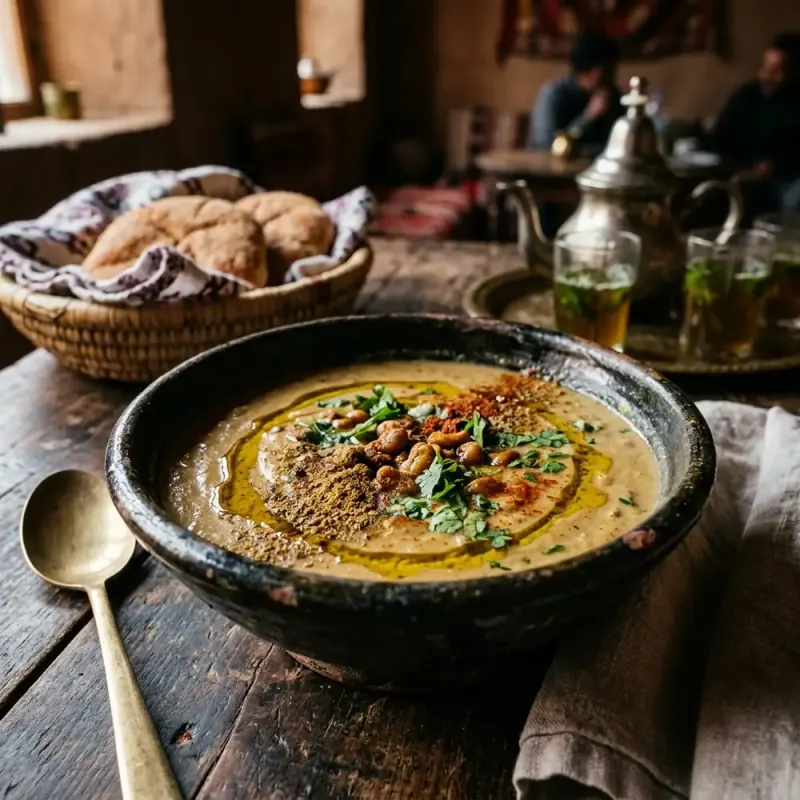
Bissara is a thick, velvety soup made from dried peeled fava beans (foul) or split green peas, simmered with garlic, cumin, and sea salt until completely soft, then pureed into silk. Served piping hot in terracotta bowls, it is submerged under a generous puddle of peppery green olive oil and dusted with roasted ground cumin and cayenne pepper. Paired with a warm loaf of crusty khobz and sweet mint tea, Bissara is the ultimate workingman’s fuel.
The Morning Glass: Atay and Nass-Nass
No Moroccan breakfast is complete without the proper morning drink:
- Atay: A piping pot of fresh gunpowder green tea brewed with spearmint leaves or winter wormwood (chiba), poured from height into clear glasses to awaken the senses.
- Qahwa Nass-Nass: A glass of half strong espresso and half velvety steamed milk, ordered at sidewalk cafés by those watching the morning light wash over medina walls.
Moroccan breakfast is an honor to local craftsmanship, hospitality, and shared plates. It celebrates flour from local mills, oil from hillside groves, and the warmth of family gathered around a shared table.
Frequently Asked Questions
What is the difference between Msemen, Meloui, and Rghaif?
Msemen refers to the square, multi-layered laminated flatbread folded with butter and semolina. Meloui uses the same dough but is rolled into a spiral coil before flattening, resulting in a softer, circular pastry with concentric rings. Rghaif is a broader Moroccan culinary term that encompasses both square and rolled laminated griddle breads.
How do you keep Baghrir spongy and soft?
Baghrir must be cooked on one side only over medium heat without flipping, allowing steam bubbles to burst and form its iconic honeycomb holes. To prevent sticking and keep them tender, cook on a clean non-stick surface, cool them flat on a clean kitchen towel without stacking them hot, and drench in warm melted butter and honey before serving.
What is Moroccan Amlou made of?
Traditional Moroccan Amlou is made from three ingredients: roasted sweet almonds ground into a fine paste, culinary argan oil pressed from roasted argan kernels, and pure honey (such as orange blossom or wildflower honey). It contains no artificial additives, palm oil, or preservatives.
Can Bissara be eaten for breakfast?
Yes. In northern Morocco—especially around Tangier, Chefchaouen, and the Rif mountains—Bissara (fava bean soup) is the quintessential morning meal. It is served steaming hot in clay bowls with olive oil, cumin, cayenne, and crusty bread to provide sustained warmth and energy for the workday.
Experience the true heart of Moroccan heritage through its culinary traditions. Join us in preserving and honoring these ancestral recipes.
What People Are Saying
No comments yet. Be the first — we'd love to hear from you.
The Moroccan Food
Culturally Verified & Fact-CheckedThe Moroccan Food editorial team brings together native culinary researchers, heritage preservationists, and experienced home cooks across Marrakech, Fes, and Casablanca. Every recipe and cultural guide is reviewed against ancestral oral traditions and authentic regional practices.