Traditional Moroccan Desserts: Honey, Almonds, and the Sacred Art of Celebration Sweets

Traditional Moroccan Desserts: Honey, Almonds, and the Sacred Art of Celebration Sweets
Spend an afternoon inside a traditional Moroccan home, and you quickly realize that a tray of pastries is never just food. In our culture, traditional sweets are instruments of hospitality, social honor, and celebration. They carry the collective memory of families, passed down through the hands of mothers and grandmothers who measure by eye, touch, and intuition.
Unlike European baking traditions that feature dairy creams with short shelf lives, Moroccan celebratory confections are born from ancient Mediterranean wisdom. They rely on blanched sweet almonds, mountain honey, aromatic resins, and botanical waters. These ingredients resist spoiling under the sun, allowing a family to prepare dozens of varieties ahead of major celebrations.
The Cultural Role of Sweets: From Henna Nights to Eid Morning
In Morocco, sweet pastries mark life transitions. A home without pastries during a major holiday feels hollow, almost inhospitable.
Weddings and the Bridal Trays
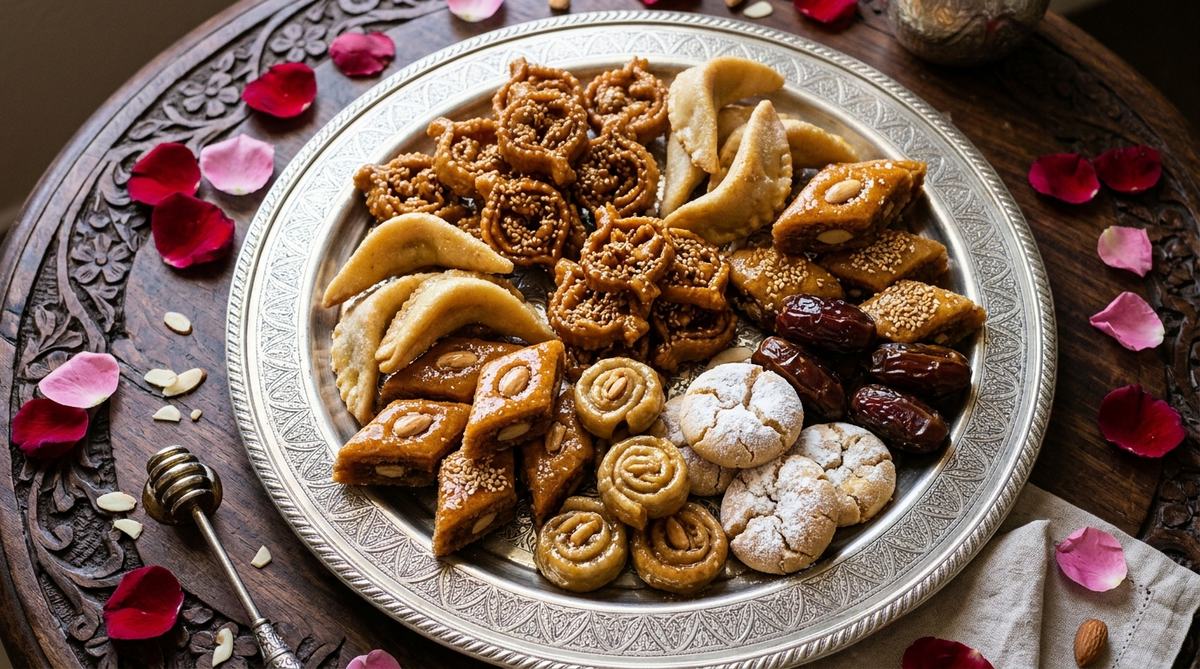
During a traditional Moroccan wedding, sweets take center stage. On the evening of the Henna ceremony, silver trays (tebsil) piled with kaab el ghazal (gazelle horns) and stuffed Medjool dates are carried into the courtyard. The sweetness of dates and the elegance of almond horns symbolize a peaceful beginning for the bride. Offering a gazelle horn to an honored guest is an explicit gesture of respect; it is the most labor-intensive pastry in our repertoire.
The Dawn of Eid al-Fitr
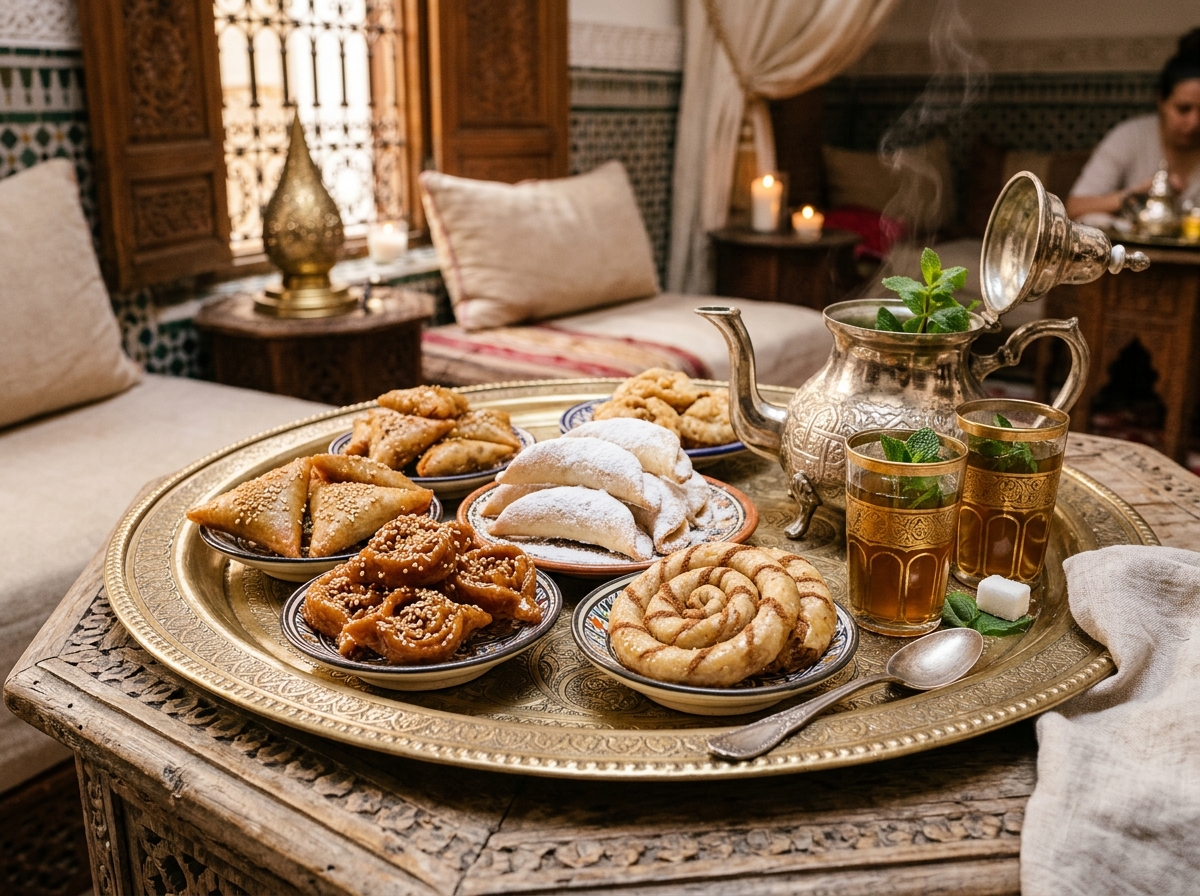
After thirty days of Ramadan fasting, Eid morning begins with sweet hospitality. Before morning prayers end, living rooms are arranged with circular tables. Beside steaming bowls of soup or warm milk flavored with anise, families arrange towers of ghoriba, crisp fekkas, and honey-soaked briouates. Breaking the fast with almond pastries is an expression of gratitude for endurance and family unity.
Naming Ceremonies and Childbirth
When a newborn enters the family, women gather to prepare sellou (also known as sfouf). Made from unbleached flour toasted slowly over embers, crushed roasted almonds, toasted sesame seeds, and pure mountain honey, this unbaked confection is given to the mother to restore strength. It is shared with every neighbor and relative who visits to greet the infant.
The Foundation of Excellence: The Craft of Oqda d’Louz
At the core of almost every traditional Moroccan celebration pastry lies oqda d’louz, the ancestral almond paste. If your almond paste is flawed, no amount of decorative folding or honey will save the pastry. Making it correctly requires strict discipline.
Step 1: Blanching and Hand-Peeling
True Moroccan cooks use sweet local almonds from the Atlas foothills, which contain rich natural oils. The almonds are submerged in boiling water for two minutes. As soon as skins loosen, the nuts are drained and pinched from their skins one by one.
Step 2: The Critical Drying Window
Wet almonds produce gummy paste that ferments quickly. After peeling, almonds must be spread across clean cotton towels in a single layer and left to air-dry for at least twelve hours. When snapped, an almond should break cleanly, dry to the core.
Step 3: The Double Grind
Almonds are ground once on their own into coarse meal, then combined with granulated sugar—strictly at a ratio of two parts almonds to one part sugar (500 grams of sugar per kilogram of almonds)—and ground a second time. This creates an ultra-fine, silky texture without turning into oily nut butter.
Step 4: Kneading and Perfuming
The ground almond mixture is transferred to a wide earthenware bowl (gasaa):
- Mastic Resin (Meska Horra): A few tears of natural mastic are pounded with a pinch of sugar in a brass mortar and folded into the almonds for elasticity and aroma.
- Ground Cinnamon: Only a gentle pinch of sweet cinnamon, enough to warm the paste without darkening its pale tone.
- Softened Butter: Good butter adds suppleness and sheen.
- Bitter Orange Blossom Water (Ma Zhar): Added drop by drop while kneading with the heel of the palm. Use true distilled blossom water, never synthetic flavoring.
Knead with firm pressure until smooth and pliable like clay. When rolled into a thin rope between your palms, it must bend into a circle without cracking.
Why Wild Thyme Honey Rules the Soaking Pot
Walk into a medina kitchen while honey pastries are being finished, and the scent is unmistakable. We do not glaze our celebration pastries with corn syrup or artificial substitutes.
Traditional cooks insist on raw mountain honey, particularly wild thyme honey (asal z’aitra) gathered in the arid slopes of the Middle and High Atlas. Wild thyme honey has an herbal undertone and dark amber color. When warmed gently with orange blossom water, this honey forms a light glaze that coats hot pastry leaves without turning them soft or sticky.
The natural acidity and enzymes of pure honey act as preservatives. When fried almond briouates or chebakia steep in warm thyme honey, the syrup penetrates every fold, preventing the nuts from spoiling and keeping sweets fresh at room temperature for weeks.
The Presentation: Silver Towers and Table Etiquette
In Moroccan hospitality, how you present food matters just as much as how you cook it:
The Silver Tebsil
Pastries are never presented on flat plates. They are built into geometric pyramids on heavy silver-plated platters (tebsil). The base is lined with wider cookies like ghoriba bahla, followed by folded pastries, with delicate crescent-shaped kaab el ghazal forming the crown.
Order of Service
The host presents the platter with both hands, offering it first to elders and guests of honor seated in the corner of the salon (el qon). Guests take a single pastry with their right hand, placing it onto their napkin. Refusing an offered pastry is considered impolite, as it suggests the host’s hospitality is unwelcome.
The Hand-Washing Ritual
Before and after tea service, the host carries the tass—a traditional brass or silver washbasin—around the room. Warm water scented with orange blossom water is poured over the guest’s hands from a slender ewer, followed by an embroidered linen towel.
Troubleshooting Your Almond Paste
Even seasoned home cooks run into trouble when working with oqda d’louz. Here is how to fix common problems:
Problem 1: The Paste Leaks Oil While Kneading
- The Cause: Overworking almonds or letting them overheat during grinding releases nut oils.
- The Fix: Splash a tablespoon of ice-cold orange blossom water into the bowl and knead firmly with open palms. The cold liquid emulsifies the oil back into the paste, restoring its smooth texture.
Problem 2: The Paste Dries Out and Crumbles
- The Cause: Insufficient moisture or leaving paste exposed to dry air.
- The Fix: Work in a spoonful of softened butter and a few drops of orange blossom water. Keep the paste wrapped in plastic wrap while shaping pastries.
Problem 3: Pastry Skins Burst in the Oven
- The Cause: Trapped air expanding inside the pastry during baking.
- The Fix: Prick kaab el ghazal three times with a fine needle before baking. Also, let shaped pastries rest uncovered at room temperature for eight to twelve hours before baking; this dries the outer wrapper into a firm shell that holds its shape.
Frequently Asked Questions
What is the ideal ratio of almonds to sugar for traditional Moroccan almond paste?
The traditional golden ratio is 2:1—two parts blanched, dried almonds to one part granulated sugar. For instance, 1 kilogram of almonds requires 500 grams of sugar. Using more sugar makes the paste cloying, while using less makes it brittle and difficult to shape.
Can I substitute orange blossom water with rose water in almond pastries?
While orange blossom water (ma zhar) is standard for Moroccan almond sweets, rose water (ma ward) can be used in specific regional recipes, particularly in the south near the Dades Valley. Rose water has a sharper perfume, so use half the amount specified to avoid overpowering the almonds.
Why do some Moroccan almond pastries turn rock hard after baking?
Almond pastries turn hard when overbaked. Almond paste should never cook through like a cake; it only needs enough heat to cook the thin pastry skin. For kaab el ghazal, bake at a moderate temperature (160°C or 325°F) for ten to twelve minutes until pale ivory.
How do I store Moroccan celebration pastries two weeks before an event?
Store dry almond pastries like kaab el ghazal in an airtight tin lined with greaseproof paper in a cool, dark room. For honey-soaked pastries like briouates, store them in sealed containers with parchment between layers. Both freeze well for up to three months.
Experience the true heart of Moroccan heritage through its culinary traditions. Join us in preserving and honoring these ancestral recipes.
What People Are Saying
No comments yet. Be the first — we'd love to hear from you.
The Moroccan Food
Culturally Verified & Fact-CheckedThe Moroccan Food editorial team brings together native culinary researchers, heritage preservationists, and experienced home cooks across Marrakech, Fes, and Casablanca. Every recipe and cultural guide is reviewed against ancestral oral traditions and authentic regional practices.