sharing the Sweet Secrets of the Medina: The Best Moroccan Desserts & Pastries (Beyond Gazelle Horns)
sharing the Sweet Secrets of the Medina: The Best Moroccan Desserts & Pastries (Beyond Gazelle Horns)
Marhaba bi-kum—welcome to my table. If you were sitting with me right now in the courtyard of a traditional riad or in my own lively kitchen in Fes, the first thing I would do is pour you a glass of steaming, frothy mint tea. But tea in Morocco never arrives alone. It is always accompanied by a generous platter of sweets, a gesture of hospitality so deeply ingrained in our culture that it feels like second nature.
When most people outside of Morocco think of our pastries, one iconic treat usually comes to mind: Kaab el Ghazal, or Gazelle Horns. And rightly so! These delicate, crescent-shaped parcels of almond paste, scented with a whisper of orange blossom water and encased in a paper-thin pastry, are a triumph of culinary craftsmanship. But to think that Moroccan baking starts and ends with Gazelle Horns is like visiting Paris and only seeing the Eiffel Tower.
Our pastry tradition is a vast, sticky, crumbly, and fragrant landscape shaped by centuries of Berber, Arab, Andalusian, and French influences. Today, I want to take you beyond the familiar and introduce you to the real best Moroccan desserts and pastries—the ones we crave with our afternoon tea, the ones we painstakingly fold for weddings, and the ones that evoke the very essence of my childhood.
The Holy Trinity of Moroccan Baking: Almonds, Honey, and Orange Blossom
Before we get into specific pastries, you must understand the foundation. If French baking relies on butter, flour, and sugar, Moroccan baking relies on what I call our "holy trinity": almonds, honey, and orange blossom water (or rose water, depending on the region).
We don't use just any almonds; we favor the local Beldi almonds, which have an intense, almost marzipan-like bitterness that cuts through the sweetness. The honey is often dark and robust, sometimes sourced from eucalyptus or thyme flowers. And the orange blossom water (ma zhar) is distilled from the bitter orange tree. When you walk through the medina in the spring, you can smell the orange blossoms being distilled in copper alembics. It’s a scent that instantly means "celebration" to any Moroccan.
Everyday Delights: What We Actually Eat with Afternoon Tea
While the elaborate almond-paste masterpieces are reserved for special occasions, our everyday teatime requires something robust, comforting, and perfect for dunking.
Ghriba: The Crumbly, Chewy Cookie of My Childhood
If there is one cookie that defines a Moroccan home, it is Ghriba (also spelled Ghoriba). The name translates roughly to "stranger" or "exotic," but to me, it is the most familiar taste in the world.
A proper Ghriba is a study in textural contrasts. It should have a slightly crisp exterior that gives way to a chewy, dense center. But the hallmark of a perfect Ghriba is the "smile"—the deep cracks that form on the surface during baking. If your Ghriba doesn't crack, my grandmother would say you didn't mix it with enough love.
There are many variations. Ghriba Bahla (the "silly" ghriba) is made with toasted sesame seeds and almonds, yielding a sandy, melt-in-your-mouth texture similar to shortbread, but infinitely more complex. Then there is the Ghriba dyal Gouz (walnut ghriba), dark and chewy, and the coconut and semolina ghriba, which is brightened with lemon zest. Every family has their secret ratio, and yes, we judge each other's Ghribas fiercely.
Fekkas: The Moroccan Biscotti
Walk past any local furan (communal oven) in the morning, and you’ll likely smell the aniseed and toasted sesame of Fekkas baking. Often compared to Italian biscotti, Fekkas are twice-baked cookies, but they are uniquely Moroccan in their flavor profile.
They are studded with whole almonds (which must be soaked in orange blossom water overnight so they slice cleanly), toasted sesame seeds, fennel seeds, and anise. The dough is shaped into logs, baked until firm, sliced on a bias, and then baked again until golden and impossibly crunchy. A glass of hot mint tea is mandatory here; a Fekkas without tea is a missed opportunity for the most satisfying dunk you’ll ever experience.
Festive Showstoppers: Sweets for Weddings, Eid, and Ramadan
When the holy month of Ramadan approaches, or a wedding is announced, the women of the family gather. This is when baking becomes a communal sport, an assembly line of rolling, folding, frying, and soaking.
Chebakia (Mkharka): The Sticky, Spiced Crown Jewel of Ramadan
I cannot think of Ramadan without thinking of Chebakia. It is the undisputed queen of the iftar (break-fast) table, traditionally eaten alongside a steaming bowl of savory, tomato-and-lentil Harira soup. The combination of the sweet, sticky pastry and the savory soup sounds strange to the uninitiated, but it is culinary magic.
Making Chebakia is an art form. The dough is enriched with ground toasted sesame, anise, cinnamon, saffron, and a splash of vinegar (which gives it a bubbly texture when fried). It is rolled out thinly, cut into rectangles with a fluted pastry wheel, and then intricately folded into a flower-like shape. It is deep-fried until deeply browned, then immediately plunged into a bath of warm honey flavored with orange blossom water. The result is sticky, intensely spiced, slightly chewy, and absolutely intoxicating.
Sellou (Sfouf): The Nutritious, Unbaked Powerhouse
Sellou is entirely unique; it’s not baked, it’s not a cookie, and it’s not a pastry. It is a rich, sandy, unbaked sweet made from a base of browned flour (toasted carefully in the oven until it smells like roasted nuts), ground toasted almonds, toasted sesame seeds, anise, cinnamon, nutmeg, and mastic gum. This dry mixture is then rubbed with clarified butter and honey until it resembles damp, fragrant sand.
It is highly nutritious and calorie-dense, which is why it is historically served to nursing mothers after childbirth to restore their energy, and during Ramadan to sustain fasting bodies. We serve it molded into a dome, decorated with whole fried almonds, and guests scoop it up with small spoons. It is earthy, nutty, and profoundly comforting.
M'hanncha: The Almond Snake Pastry
For sheer visual drama at a dinner party or a wedding, nothing beats M'hanncha, which literally translates to "the snake."
Imagine a massive coil of golden, flaky pastry resting on a copper platter. The casing is made from warka—the legendary Moroccan pastry leaf that is thinner than filo and made by dabbing a wet dough onto a hot copper griddle. Inside this crisp shell is a rich, moist filling of ground almonds, sugar, cinnamon, and, of course, orange blossom water.
Once baked to a crisp perfection, it is brushed with honey and heavily dusted with powdered sugar and lines of ground cinnamon. Guests literally break off pieces of the "snake" starting from the outside in. It’s a beautifully communal dessert that forces everyone to share and interact.
Briouat bil Louz: The Sweet Triangles
If M'hanncha is the large, communal showpiece, Briouat bil Louz are its bite-sized cousins. Using the same precious warka pastry and a similar almond paste filling (often with a hint of mastic gum added for a subtle piney flavor), these are folded into precise little triangles.
They are quickly deep-fried until blistered and golden, then submerged in hot honey. The contrast between the shattering crunch of the exterior, the sticky honey coating, and the soft, fragrant almond paste inside is, in my professional opinion, one of the greatest bites in global gastronomy.
The Art of the Moroccan Mint Tea Ceremony
I would be remiss as a Moroccan host to talk about all these sweets without briefly mentioning their liquid counterpart. You do not eat a rich plate of Moroccan pastries with coffee, and you certainly don't eat it with milk. You eat it with Atay B'nana (Mint Tea).
Our tea is brewed with Chinese gunpowder green tea, an egregious amount of fresh spearmint (stems and all), and a generous hand of sugar. The sugar isn't just for sweetness; it balances the bitterness of the green tea and the intense tannins. The tea is poured from high above the glass to aerate it and create a thick layer of foam, or "turban," on top. The hot, sweet, astringent tea cuts through the rich oils of the almonds and the heavy stickiness of the honey in the pastries, cleansing your palate and preparing you for the next bite. It is a perfect symbiosis.
Bringing the Medina to Your Kitchen
Moroccan baking can seem intimidating. The folding of the Chebakia, the stretching of the warka, the perfect cracking of the Ghriba—these take practice. But the soul of Moroccan baking isn't in perfection; it's in the generosity of the act. It’s about filling your home with the scent of toasted sesame and orange blossom, and sharing something sweet with people you love.
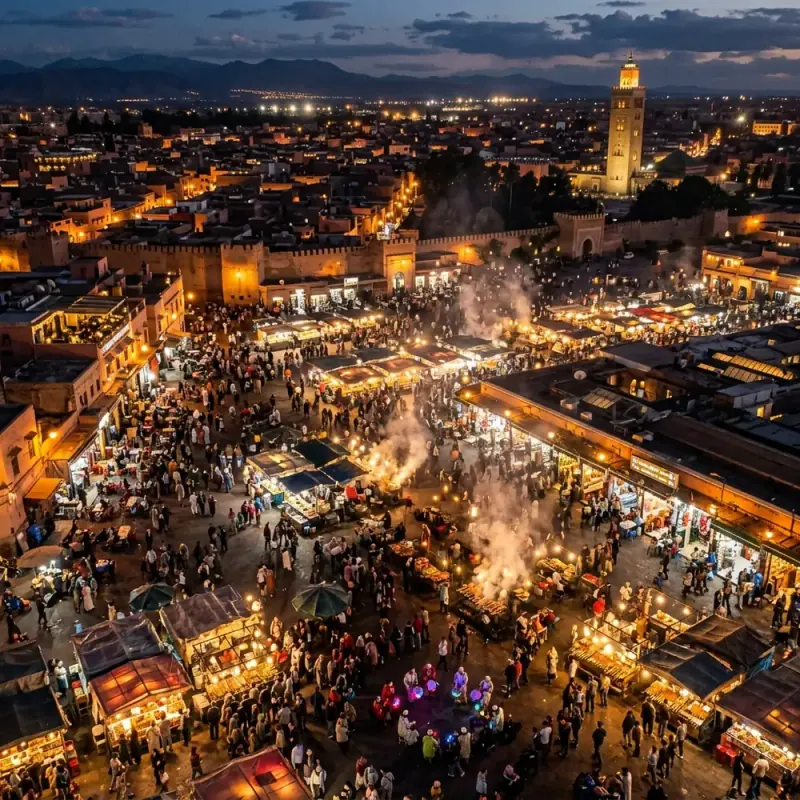
So, the next time you have a craving for something sweet, look beyond the Gazelle Horns. Try baking a simple batch of Ghriba, brew a pot of fresh mint tea, and transport yourself to the sunny courtyards of Marrakech. Bsha w raha—to your health and comfort!
Frequently Asked Questions (FAQ) about Moroccan Desserts
Are Moroccan pastries very sweet?
Yes and no. The pastries that are soaked in honey (like Chebakia or Briouat) are undeniably sweet and are meant to be eaten in small quantities. However, our everyday cookies like Ghriba or Fekkas are surprisingly moderately sweet, relying more on the deep flavors of toasted nuts and spices rather than sheer sugar.
What is the difference between filo dough and Moroccan warka?
While they are often used interchangeably in modern kitchens out of convenience, they are quite different. Filo is a dough that is rolled out extremely thin. Warka (which means "leaf") is a highly hydrated, sticky dough that a skilled artisan "dabs" onto a hot, flat griddle, creating a micro-thin, crepe-like leaf. Warka is generally crispier, less flaky, and holds up better to deep-frying and honey-soaking than filo.
Can I make Moroccan sweets ahead of time?
Absolutely! In fact, most Moroccan sweets are designed to last. Historically, without refrigeration, pastries needed to be shelf-stable. Cookies like Fekkas and Ghriba can last for weeks in an airtight container. Honey-soaked pastries like Chebakia will happily keep at room temperature for a month or more—the honey acts as a natural preservative.
Where can I buy authentic Moroccan orange blossom water?
Look for it in Middle Eastern, North African, or Mediterranean specialty grocers. Avoid anything labeled "orange extract" or products where the first ingredient is a chemical compound or alcohol. Authentic ma zhar should ideally list just water and bitter orange blossoms. French and Lebanese brands are widely available and of excellent quality if you cannot find a Moroccan brand.
Visualizing the Sweet Feast: Image Prompts
For the photographers and visual artists, here is how you capture the soul of Moroccan sweets (no sterile, bright-white studio shots here!):
Image Prompt 1: The Artisan's Hands Subject: A close-up, top-down shot of older, flour-dusted hands intricately folding a piece of Chebakia dough on a rustic wooden table. Vibe: Warm, intimate, generational knowledge. Style: Moody, natural window light spilling in from the side, rich earthy tones (terracotta, warm browns). Focus on the texture of the dough and the hands. Format: 16:9 cinematic.
Image Prompt 2: The Afternoon Tea Spread Subject: A low-angle shot of a traditional hammered silver tray. On the tray: a silver Moroccan teapot pouring tea from high above into a small, ornately painted glass, creating foam. Next to it, a slightly mismatched ceramic plate piled high with cracked walnut Ghriba and Fekkas biscotti. Vibe: Welcoming, relaxed, sensory. Style: Golden hour lighting, capturing the steam from the tea and the warm, golden hues of the cookies. Shallow depth of field keeping the pouring tea in sharp focus. Format: 4:3 lifestyle.
Image Prompt 3: The Golden Snake Subject: A grand M'hanncha (almond snake pastry) resting on a large, aged copper platter. The pastry is heavily dusted with powdered sugar and geometric lines of cinnamon, with a few stray rose petals scattered nearby. Vibe: Festive, abundant, regal. Style: Overhead flat-lay, rich and opulent lighting (chiaroscuro effect). The background should be a dark, traditional Moroccan zellige tile surface to contrast the golden pastry. Format: 1:1 square.
Image Prompt 4: The Honey Plunge Subject: A slotted spoon lifting a batch of golden, freshly fried Briouat (triangular pastries) out of a bubbling pot of dark, amber honey. Thick strands of honey are dripping from the pastries. Vibe: Mouth-watering, sticky, kinetic. Style: Macro photography, high contrast. Capture the glossy, reflective surface of the honey and the blistered, crispy texture of the pastry. Warm, golden lighting. Format: 9:16 vertical.
Image Prompt 5: The Ingredient Still Life Subject: A raw, beautiful still life of the "Holy Trinity": A small burlap sack spilling over with raw Beldi almonds, a rustic clay jar of dark honey with a wooden dipper, and an antique glass bottle of orange blossom water with an Arabic label. Vibe: Rustic, authentic, foundational. Style: Dutch master still life style, side-lit with soft, diffused natural light to emphasize the textures of the burlap, clay, and glass. Format: 3:2 standard.
Experience the true heart of Moroccan heritage through its culinary traditions. Join us in preserving and honoring these ancestral recipes.
What People Are Saying
No comments yet. Be the first — we'd love to hear from you.
Youssef Amazigh
Culturally Verified & Fact-CheckedThe Moroccan Food editorial team brings together native culinary researchers, heritage preservationists, and experienced home cooks across Marrakech, Fes, and Casablanca. Every recipe and cultural guide is reviewed against ancestral oral traditions and authentic regional practices.