Zaâzaâ: The Decadent Northern Moroccan Street Smoothie That Broke the Rules
Zaâzaâ: The Decadent Northern Moroccan Street Smoothie That Broke the Rules
If you walk into a traditional juice bar in Casablanca or Marrakech and ask for fruit juice, you will receive a clean glass of freshly squeezed orange or carrot. But walk into a neighborhood dairy bar in Tangier, Tetouan, or Chefchaouen and whisper the word Zaâzaâ, and the blender operator will smile, roll up his sleeves, and prepare to construct an edible skyscraper.
Zaâzaâ is not a drink. It is a rebellion against beverage modesty.
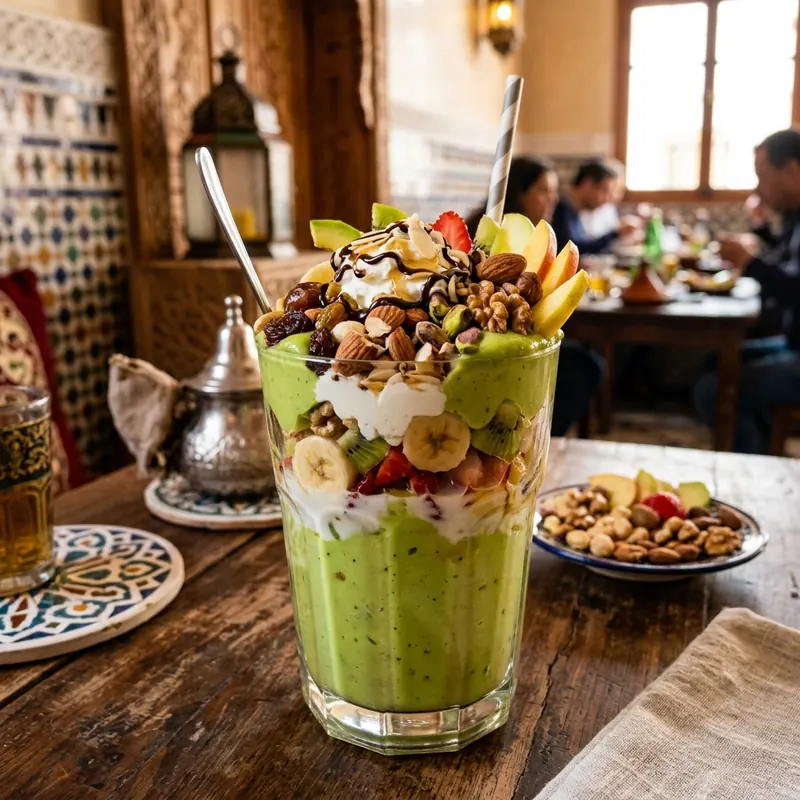
Served in massive glass beer steins or sundae goblets, this northern Moroccan street creation piles sweet avocado smoothie, an entire unmolded caramel flan, diced seasonal fruits, whipped cream, toasted nuts, dried mountain fruits, chocolate wafers, and sweet syrups into a single glass. It is thick enough that no standard straw can conquer it, decadent enough to make visiting pastry chefs blush, and substantial enough to replace both lunch and dinner.
To understand Zaâzaâ is to understand the creative street spirit of northern Morocco—a region where Spanish culinary quirks merged with Moroccan medina traditions to create something wild and unforgettable.
What Does ‘Zaâzaâ’ Mean? The Linguistics of Disruption
The name itself tells you everything you need to know about the drink’s explosive personality.
In Moroccan Darija, the verb za’za’ means to shake violently, to rattle, to cause an earthquake, or to disturb the established order. When Moroccans say a person or an event za’za’ l-makan, they mean it shook the room to its foundation.
The drink earned this title in the late 1990s in the juice bars and creameries (laiteries) of Tetouan and Tangier. Young patrons coming from university lectures, dock shifts at Tanger-Ville port, or late-night study sessions demanded a drink that provided maximum fuel on a modest budget.
Ambitious juice bar owners began competing to see who could build the tallest, most outrageous creation. They tossed aside the concept of a light beverage and began layering puddings, dairy, and confectionery. When customers took their first look at this towering glass crowned with chocolate biscuits and roasted almonds, they exclaimed that the drink would rattle your senses: “Hada zaâzaâ!” (This is an earthquake!)
Within a decade, the northern craze spread south across the country, landing on menus from Rabat to Agadir.
The Northern Andalusian Heritage: The Secret of the Flan
To appreciate why Zaâzaâ was born in northern Morocco rather than in Fes or Marrakech, one must look at the unique culinary history of the Rif and the Chamal region.
For decades during the twentieth century, northern Morocco was governed as a Spanish protectorate. While southern Morocco absorbed French habits like the morning café au lait, northern cities like Tetouan and Tangier absorbed Spanish daily rituals.
Chief among these was the Spanish obsession with flan—the silky egg custard baked with dark caramel syrup. In every northern household and neighborhood dairy bar, flan became as everyday as mint tea. Local home cooks perfected the art of turning fresh milk, eggs, sugar, and vanilla into glossy golden puddings.
When northern mahlaba owners conceived Zaâzaâ, they looked at chilled display cases holding rows of freshly made caramel flans and had a stroke of genius: why not slide an entire unmolded flan directly into the center of a rich avocado milkshake?
That single decision changed Moroccan street food forever. The silky custard created a soft textural core that prevented the thick avocado shake from feeling monotonous, giving each spoonful an alternating wave of cool green velvet and rich golden vanilla.
The Architecture of the Glass: Engineering the Layers
Building a proper Zaâzaâ is an act of culinary architecture. If the density of each stratum is not calibrated correctly, the entire structure collapses into a murky puddle. A seasoned mahlaba artisan constructs the glass through five distinct stages:
Stage 1: The Heavy Emerald Foundation
The base of the glass is filled with a dense, chilled avocado smoothie. Blended with whole milk, banana for body, and a dash of sugar, this layer is kept thick so it can bear the weight of what comes next.
Stage 2: The Caramel Flan Core
The vendor takes a chilled mold holding a single-portion caramel flan (flan royal), loosens the edge with a knife, and inverts it with a flick of the wrist onto the avocado layer. The flan settles into the green cream, sending amber caramel syrup trickling down the inside of the glass.
Stage 3: The Fresh Fruit Stratum
A colorful ring of finely diced fruits is packed around the flan. The artisan selects fruits with pleasant acidity to balance the rich pudding: crisp green apples, strawberries, ripe bananas, and tart kiwi.
Stage 4: The Cream and Berry Crown
A swirl of sweetened whipped cream (chantilly) or thick mountain yogurt is piped over the fruit, creating a snowy platform.
Stage 5: The Sweet Avalanche
The vendor reaches into his jars and blankets the cream with toasted Atlas almonds, chopped walnuts, plump raisins, and sliced Medjool dates. Finally, two chocolate wafer sticks, a broken KitKat bar, or Oreo cookies are plunged into the summit at an angle, finished with ribbons of chocolate sauce and caramel drizzle.
When the glass lands on your counter, it looks like an eruption of sweets. You are handed two utensils: an extra-wide straw and a long sundae spoon. The straw is useless at first; you must eat your way through the biscuits, nuts, cream, and flan before reaching the rich green smoothie waiting below.
Street Fuel: The University and Worker Ritual
In Moroccan medinas, Zaâzaâ is not viewed merely as dessert. It is practical high-octane fuel for working-class youth.
Priced between fifteen and twenty-five dirhams (roughly $1.50 to $2.50 USD), a single glass delivers an immense payload of healthy fats, clean carbohydrates, protein, and sugar.
Step into a mahlaba near the University in Tetouan at four in the afternoon, and half the tables are covered in open notebooks, laptops, and giant glasses of Zaâzaâ. Students split a glass between two spoons as study sustenance. At nine in the evening, dock workers, taxi drivers, and evening strollers take their place on stools, enjoying a sweet reward after hours of physical labor.
It is accessible luxury in its purest form. You do not need a reservation at a luxury hotel to indulge; you simply pull up a plastic stool on a medina corner, hand over twenty dirhams, and feast like an emperor.
Grandmother Wisdom: The Old School Perspective
Traditional Moroccan grandmothers regard Zaâzaâ with fond amusement and gentle skepticism. To a grandmother raised on classic almond briouats, steamed couscous, and slow-cooked tagines, the wild excess of Zaâzaâ represents the impatient creativity of the younger generation.
“In our time, if you wanted sweets, you waited for Eid to eat gazelle horns, or you dipped warm bread in honey and argan oil,” grandmothers laugh when their grandchildren order a giant Zaâzaâ on weekend walks. “Now the young people want the entire pastry shop and dairy farm inside one glass!”
Yet even grandmothers concede the genius of the combination. The wholesome richness of avocado, milk, and almonds reflects traditional staples Moroccan women have fed families for generations. Zaâzaâ simply reorganized those beloved ingredients with modern street swagger, turning ancient pantry staples into an unforgettable medina celebration.
Frequently Asked Questions
What ingredients are in an authentic northern Moroccan Zaâzaâ?
An authentic Zaâzaâ begins with a thick avocado-milk smoothie base, topped with a whole Spanish-style caramel flan, diced seasonal fruits (kiwi, strawberry, banana, apple), whipped cream, toasted almonds, walnuts, dates, and chocolate wafer cookies, finished with chocolate or caramel syrup.
Where did the Zaâzaâ smoothie originate?
Zaâzaâ originated in northern Morocco during the late 1990s, specifically in the coastal cities of Tetouan and Tangier. It emerged from neighborhood dairy shops (mahlabas) where local owners combined Spanish culinary influences (caramel flan) with traditional Moroccan fruit shakes to create an energy-dense street snack for youth.
Can you customize the sweetness and toppings of a Zaâzaâ?
Yes, juice bar operators make each Zaâzaâ to order right in front of you. You can ask for less sugar in the avocado base (nqs s-sokkar), skip the whipped cream, request extra roasted almonds, or select specific fresh fruits depending on your personal taste and dietary preferences.
How much does a Zaâzaâ cost in Morocco?
At traditional neighborhood juice bars across northern and central Morocco, a standard Zaâzaâ costs between 15 and 20 dirhams (about $1.50 to $2.00 USD). Large specialty versions loaded with imported biscuits, extra nuts, and honey typically range from 25 to 35 dirhams.
Experience the true heart of Moroccan heritage through its culinary traditions. Join us in preserving and honoring these ancestral recipes.
What People Are Saying
No comments yet. Be the first — we'd love to hear from you.
The Moroccan Food
Culturally Verified & Fact-CheckedThe Moroccan Food editorial team brings together native culinary researchers, heritage preservationists, and experienced home cooks across Marrakech, Fes, and Casablanca. Every recipe and cultural guide is reviewed against ancestral oral traditions and authentic regional practices.