Zellige: How Morocco's Geometric Tilework Is Cut and Why It Takes Ten Years to Learn
Zellige: The Tile-Cutting Craft That Cannot Be Fully Mechanized and Has Not Been
I have watched a Maâlem (master craftsman) cut zellige tiles for a combined total of probably forty hours across various visits to workshops in Fes, and the thing that still arrests me every time is the speed and the silence of it. The chisel strikes the tile and the tile splits exactly where it is supposed to split in a motion that takes perhaps one second, and the Maâlem moves to the next tile immediately with an expression of complete neutrality, as if nothing has happened. He has made this cut ten thousand times. The tile splits because he knows — in the specific, non-verbal way that manual knowledge works — exactly where and with what force to strike.
There is no template for the cut on an individual tile. The tile, a square of fired clay with a single-color glaze on one face, sits on a sandbag. The chisel is placed against its edge at a specific angle and depth by eye. The mallet strikes. The tile splits. If the Maâlem’s eye and hand are right — and after ten years of training, they reliably are — the split produces the specific geometric shape needed for the pattern’s current position. If they are wrong, the tile is discarded and another is cut.
The discard rate at the beginning of an apprentice’s training is, by all accounts I have received, alarming. By the end of a mature apprenticeship, it is very low. The difference is ten years.
What Are the Geometric Patterns and Where Did They Come From?
Zellige patterns are based on geometric systems derived from Islamic mathematical and artistic traditions that were developed in the 9th through 13th centuries in the cultural centers of the Islamic world — Baghdad, Córdoba, Cairo, Fes — and that spread and elaborated across the Islamic world through a combination of trade, scholarship, and the movement of craftsmen.
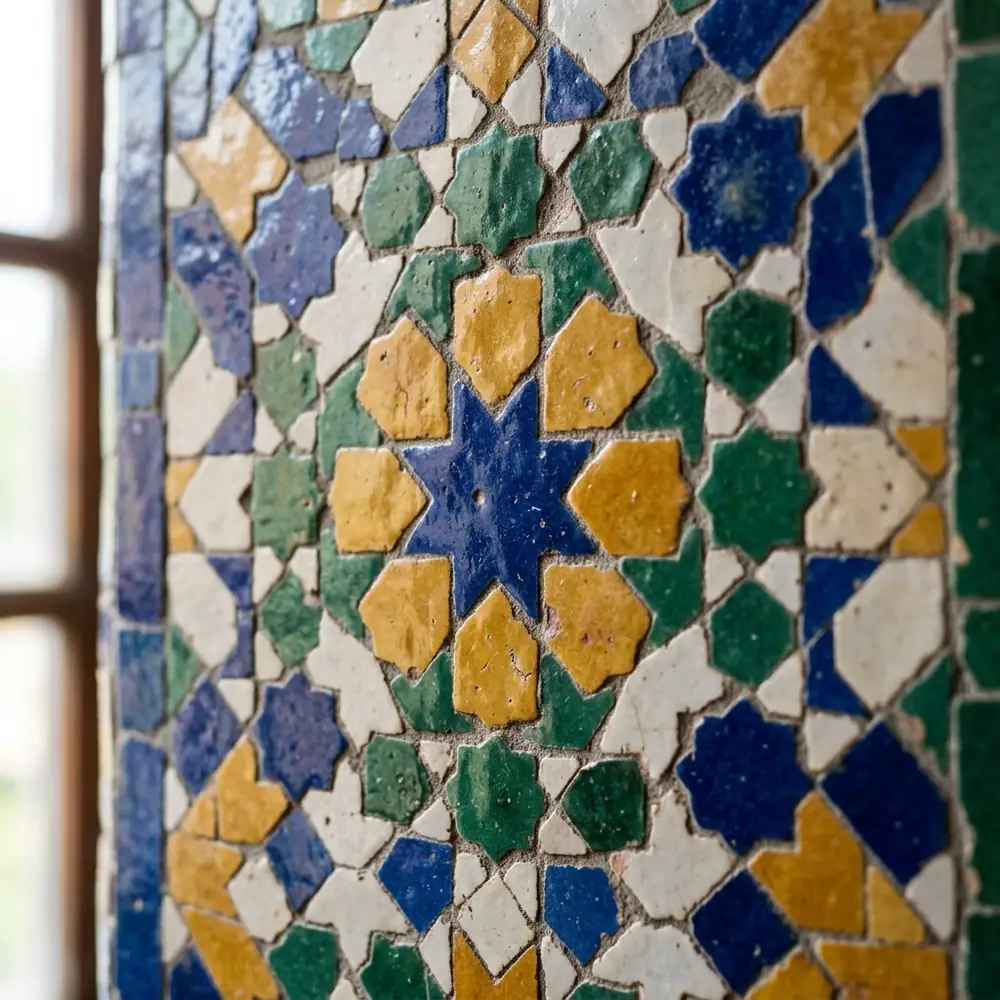
The mathematical basis of zellige patterns is the geometry of regular polygons and their combinations: arrangements of squares, triangles, hexagons, octagons, and twelve-pointed stars, combined through a set of geometric rules that produce infinite non-repeating or regularly repeating patterns of extraordinary visual complexity. The patterns have rotational and reflective symmetry — you can find the center of a good zellige panel and rotate it 60 or 90 degrees and it will look identical — and this symmetry gives the work its characteristic visual completeness, the sense that the pattern could extend infinitely in every direction and remain coherent.
The Andalusian influence on Moroccan zellige is significant and direct. When the craftsmen and scholars of Islamic Spain arrived in Morocco in the 15th century, they brought with them the specific geometric vocabulary that had developed in the Umayyad and Nasrid courts of Córdoba and Granada — a vocabulary already sophisticated after five centuries of development. What Morocco received was not the beginning of the zellige tradition but an already mature branch of it, which was then combined with existing North African traditions and developed further over the subsequent centuries.
The patterns that appear in the Ben Youssef Madrasa in Marrakech, the Bou Inania in Fes, the Al-Attarine in Fes — these are all 14th-century Marinid productions using a design vocabulary that traces directly to Andalusian mathematical geometry. The craftsmen cutting tiles in Fes workshops today are working from the same pattern systems.
How Is a Zellige Panel Actually Made From Cut Tiles to Finished Wall?
The completed zellige panel is built face-down. This is the aspect of the process most people find counterintuitive.
The Maâlem cuts the individual tiles and assembles them pattern-side down on a flat surface — a board, a large tile, or directly on the floor — fitting the pieces together like a puzzle until the design is complete and every space is filled. At this stage the surface you are looking at is the plain, unglazed backs of the tiles. The geometric pattern is invisible, face-down against the surface.
A cement mixture — traditionally lime-based, now often cement-based in commercial production — is spread over the tile backs, binding them together. Once cured, the assembly can be lifted and turned face-up, revealing the completed pattern in its glazed colors for the first time as a unified whole.
For installation on a wall, this face-down panel assembly method is adapted: the tiles are pressed directly into wet mortar applied to the wall surface, again face-down first and then adjusted for position, with the pattern built up across the wall section by section. The Maâlem works from a full-scale drawing (for complex or new patterns) or from the pattern held entirely in his head (for standard patterns he has installed hundreds of times).
The grout that fills the gaps between tiles in traditional zellige is also lime-based and is applied after installation, worked into the gaps by hand, and polished when semi-cured to produce the smooth, slightly recessed grout lines visible in finished zellige. The color of the grout — usually white or very pale grey — is part of the visual effect: it provides contrast that makes the geometric relationships between tile shapes legible from a distance.
What Colors Are Traditional Zellige and What Do They Mean?
Traditional Moroccan zellige uses a relatively constrained color palette: white, black, ochre-yellow, green (from copper oxide in the glaze), blue (from cobalt), turquoise, and a range of earth reds and terracottas. These colors are not arbitrary — they correspond to the colorants available from natural mineral sources that Moroccan glaze-makers have traditionally used, and they produce a specific harmonic quality as a combination that the high-saturation synthetic colors of modern commercial zellige don’t replicate.
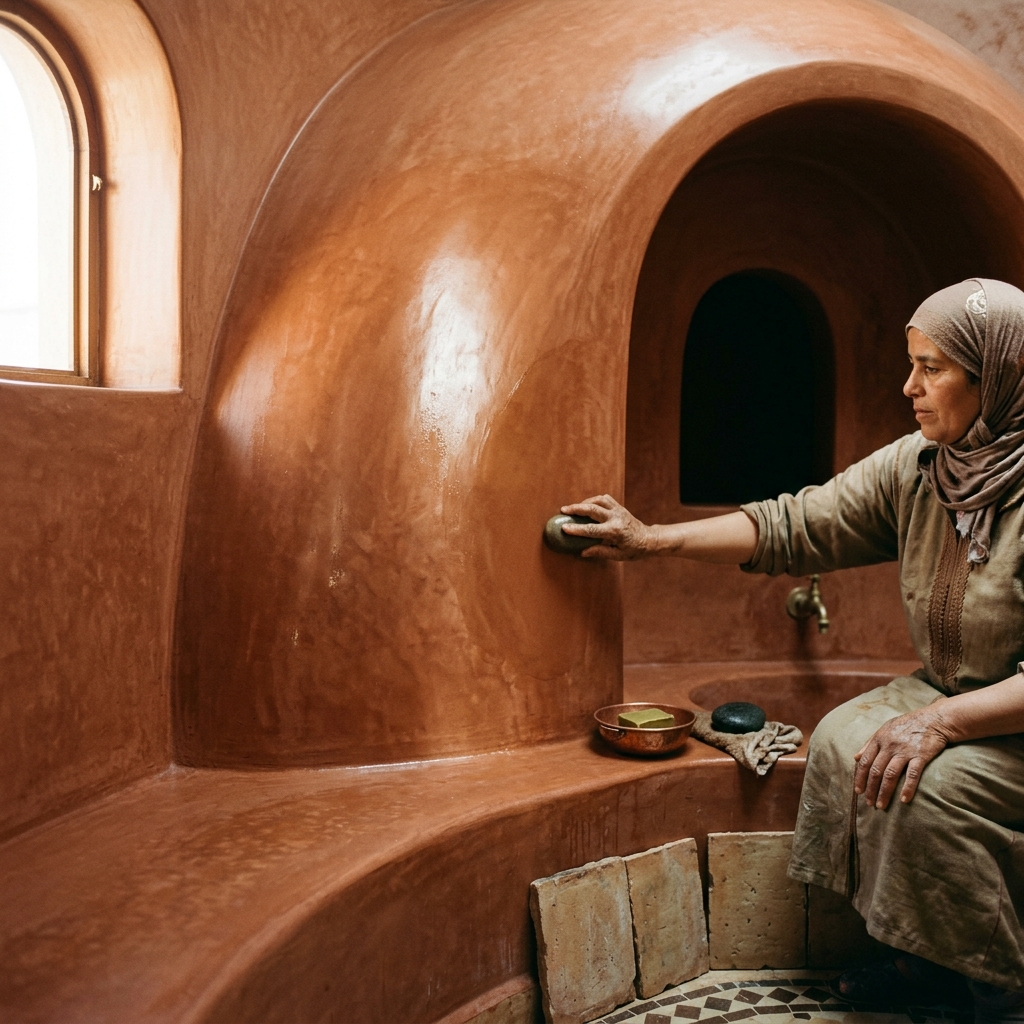
The green-and-white combination — used extensively in special architecture — carries specific symbolic associations in Moroccan Islamic visual culture. The turquoise-and-white combination appears frequently in the imperial city contexts of Fes and Meknes. The all-white zellige of interior hammam and domestic contexts is understated in a different way from the multi-color exterior zellige of mosques and public spaces — the pattern visible only in the relief of the tile edges and the grout lines.
Color in zellige is also regional: the green roofs of Fes’s mosques and the white-and-green tile combinations inside them are a visual signature of the city distinct from Marrakech’s warmer earth-tone palette or Tetouan’s blue-and-white Andalusian legacy.
The Invisible Invitation
Find the zellige workshop street in Fes el-Bali — the Ain Nokbi neighborhood, where the craft has been practiced continuously since the 14th century. Walk slowly past the open workshop doors. In each one, one or two craftsmen are seated on low stools with sandbags in front of them, cutting. The sound is rhythmic and specific: chisel strike, tile splits, next tile. The floor around each craftsman is covered in small geometric offcuts — the negative space of the patterns, discarded. A good workshop smells of fired clay and lime dust and something I cannot name, which is the smell of this specific craft. Sit in the doorway if no one objects. Watch for twenty minutes. Count the cuts. Estimate how many he has made in his career. The number is large enough that it changes how you look at the panel he is building.
SEO Meta Description: How is Moroccan zellige tilework made? The geometric pattern origins, face-down panel assembly technique, ten-year apprenticeship, and the traditional color palette explained.
Experience the true heart of Moroccan heritage through its traditions. Join us in preserving these ancestral rituals.
What People Are Saying
No comments yet. Be the first — we'd love to hear from you.
Youssef Amazigh
A Moroccan cultural writer dedicated to documenting the authentic voice, history, and heritage of the Kingdom. Writing from within — to share what truly makes Morocco extraordinary.
Our Mission →