Boulfaf: The Ancient Chemistry of Lamb Liver Wrapped in Caul Fat
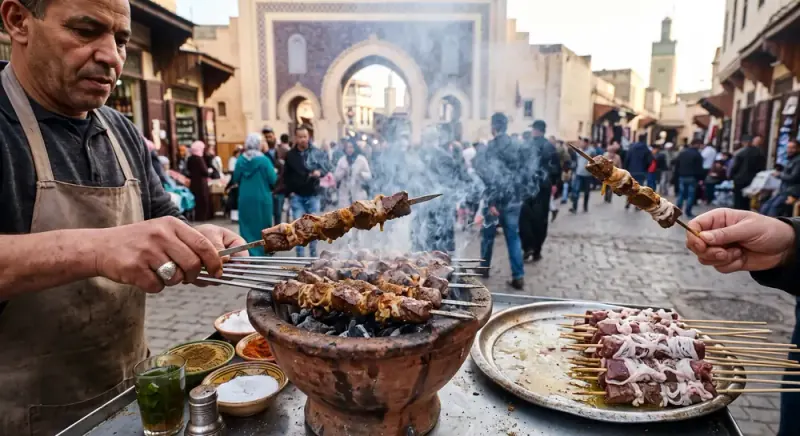
On the morning of Eid al-Adha in Morocco, an invisible clock governs every household from the cliffs of Tangier down to the red walls of Taroudant. Long before midday prayers conclude, rooftop terraces (stah) are scrubbed clean, charcoal braziers (kanoun) are stoked with wood embers, and families gather in anticipation.
There is an unbroken national custom: no matter how magnificent the feast planned for later—be it slow-simmered mrouzia or steam-roasted lamb shoulder—the holiday does not officially begin until the very first skewers of Boulfaf hit the fire.
Step out onto any street corner at eleven in the morning on Eid, and look upward. Plumes of white smoke rise from thousands of rooftops, carrying an unmistakable perfume: fresh lamb liver searing over coals, pungent cumin, sweet paprika, and melting caul fat.
In Moroccan Darija, Boulfaf derives from the root laffa, meaning “to wrap” or “to swaddle.” It is an edible masterpiece of anatomical ingenuity: tender lamb liver swaddled in a delicate jacket of lacy animal fat that bastes the meat from within.
The Anatomy of R’da: The Miracle of Caul Fat
To understand why Boulfaf achieves such tenderness, one must first appreciate its signature element: r’da (also called chhem el-mndil), known in cooking as caul fat.
This is not the hard tallow found around kidneys. The omentum is a thin, translucent membrane resembling fine lace, threaded with delicate pockets of fat. In nature, it surrounds the stomach and organs of the sheep.
Preparing r’da requires patience and gentle hands, an art passed down from Moroccan mothers:
- The Cold Salt Rinse: Immediately after butchering, the caul fat is submerged in cold spring water salted with coarse sea salt to remove excess blood while tightening delicate veins.
- The Air-Drying Breeze: The wet membrane is draped across clean reed mats or clotheslines on the sunny rooftop. Morning breezes dry the surface within twenty minutes, transforming the fat into a pliable sheet that can be sliced into ribbons without tearing.
Without this gossamer membrane, Boulfaf cannot exist. It serves as both a natural cooking casing and a self-basting engine.
The Two-Stage Cooking Method: The Ancestral Secret
The biggest mistake made by novice cooks is trying to cube raw lamb liver, wrap it in caul fat, and place it directly on coals. Moroccan grandmothers will immediately intervene.
Raw liver is composed of high moisture levels and delicate proteins. If you wrap raw liver in fatty membrane, trapped moisture steams inside the fat jacket. The result is a rubbery cube that boils in its own liquid.
Authentic Boulfaf demands an unyielding two-stage cooking technique refined over centuries.
Stage One: The Flash Par-Grill
The liver must first be grilled whole or cut into thick slabs. It is placed directly onto hot charcoal embers without any spices, salt, or oil. The interior must remain completely raw, soft, and ruby-red.
The slabs remain on the grill for barely two minutes per side. This quick burst of direct heat sears the outer surface, sealing in meat juices, and firms up the internal protein matrix so the meat can be sliced cleanly into sharp cubes without collapsing.
The Medina Spice Rub
Once the par-grilled liver rests for two minutes, the cook slices it into two-centimeter cubes. These warm cubes are transferred to a wide earthenware bowl (gsa’a) and tossed in a fragrant dry spice blend:
- Freshly ground mountain cumin seeds (kamoun beldi), pungent and digestive
- Sweet sun-dried paprika (tahmira), lending color and earthy sweetness
- Coarse Atlantic sea salt
- A pinch of sharp black pepper and a whisper of cayenne
- Finely chopped fresh coriander leaves (qasbour), which cut through the organ richness
Because the cubes are warm from their initial sear, the spices bloom upon contact, clinging tightly to the firm meat surfaces.
Stage Two: The Swaddling and the Second Fire
The dried caul fat is sliced into strips three fingers wide. The cook places a spiced liver cube onto the edge of a fat ribbon, rolls it forward once or twice until encased, and slices the tail cleanly with a knife.
These swaddled packages are threaded onto flat steel skewers (qteb), pushed closely together so they support one another on the grill. The skewers then return to the hot charcoal bed for the final sear.
The Chemistry of Heat: Why Boulfaf Never Dries Out
Liver is naturally one of the leanest cuts in butchery, making it vulnerable to overcooking. Left unprotected over charcoal, liver proteins tighten rapidly, squeezing out moisture until the meat becomes dry and mealy.
Caul fat solves this dilemma through thermal insulation. When the swaddled skewer hits red-hot embers, the lacy fat acts as a shield against direct flame. As the temperature rises, the fat slowly liquefies, penetrating the outer spice rub and soaking deep into the porous liver tissue.
Simultaneously, rendered fat drips onto glowing coals below, sending up clouds of white smoke that encase the skewers. The outer layer of fat crisps into golden crackling edges, while the spiced liver inside gently poaches in rendered mutton essence. When you bite through the crisp fat exterior, the liver inside remains tender, pink, and juicy.
The Rooftop Ritual: Khobz, Tea, and Generational Pride
Eating Boulfaf on Eid morning is an intimate family ceremony. Everyone gathers around low wooden tables on the terrace. The grill master lifts the skewers directly from the coals, their fat jackets still bubbling and hissing.
Freshly baked semolina flatbread (khobz ed-dar) is sliced into quarters. Using the bread as a glove, family members grip the sizzling cubes through the crust and pull the skewer free.
The rendered juices and spiced fat soak into the soft bread crumb. Beside each diner sits a small terracotta saucer of coarse sea salt mixed with cumin. You dip the corner of the sandwich into the cumin-salt, take a mouthful, and savor the contrast: the salty crunch of browned fat, the melting richness of liver, and the warm earthiness of cumin.
No Boulfaf feast is complete without the tea tray (siniya). A silver teapot pours steaming gunpowder green tea from high above, thick with amber foam. On Eid, the tea is brewed with fresh spearmint and wild wormwood (chiba), whose pleasant bitterness cuts effortlessly through rich animal fats, cleansing the palate and preparing the stomach for celebrations ahead.
Grandmother’s Rules for Perfect Boulfaf
To recreate authentic Eid Boulfaf at home, follow four rules from Moroccan grandmothers:
- Never Skip the First Sear: Never attempt to cube or wrap raw liver. Searing the whole liver on the grill first seals in moisture and makes slicing into neat cubes effortless.
- Dry the Caul Fat Completely: If your caul fat is wet when wrapping, it will steam rather than crisp. Stretch it in the sun until the surface feels dry to the touch.
- Keep the Interior Pink: Liver overcooks in seconds. The second grilling stage over charcoal should take no longer than four minutes. The center of the liver must remain soft and rosy.
- Serve Immediately: Boulfaf waits for no one. The moment skewers leave the fire, the rendered fat begins to cool. Eat them piping hot straight from the embers.
Frequently Asked Questions
Why must liver be partially grilled before cutting and wrapping in caul fat?
Raw liver contains high moisture and a fragile structure. Slicing raw liver results in torn pieces and juice loss. Par-grilling the liver whole for two minutes firms meat proteins, locking in juices and allowing clean cubing that holds its shape inside the fat wrapper.
How do you clean and prepare fresh lamb caul fat (r’da)?
Fresh caul fat should be soaked in cold water mixed with coarse salt to remove residual blood. Afterward, gently unfold the membrane and hang it across a line in a breezy spot for twenty minutes until dry to the touch. Once dry, slice into long ribbons ready for swaddling.
Can you prepare Boulfaf using beef or calf liver instead of lamb?
While lamb liver is the tradition of Eid al-Adha, young calf liver (kebda dial l-bjel) makes an exceptional everyday substitute. Calf liver is mild, sweet, and tender. However, you must still wrap it in lamb or sheep caul fat, as beef caul fat is too thick and tough to render properly over charcoal.
What spices are essential for an authentic Moroccan Boulfaf rub?
Authentic Boulfaf relies on a pure spice blend: freshly ground cumin seeds (kamoun beldi), sweet paprika (tahmira), coarse sea salt, and a handful of freshly chopped coriander. Never add garlic, onion puree, or ginger to Boulfaf; these compete with the clean flavor of fresh liver and delicate caul fat.
Experience the true heart of Moroccan heritage through its culinary traditions. Join us in preserving and honoring these ancestral recipes.
What People Are Saying
No comments yet. Be the first — we'd love to hear from you.
The Moroccan Food
Culturally Verified & Fact-CheckedThe Moroccan Food editorial team brings together native culinary researchers, heritage preservationists, and experienced home cooks across Marrakech, Fes, and Casablanca. Every recipe and cultural guide is reviewed against ancestral oral traditions and authentic regional practices.