Hiking Morocco’s Lesser-Known Trails: From the Anti-Atlas to the Eastern Sahara
Hiking Morocco’s Lesser-Known Trails: From the Anti-Atlas to the Eastern Sahara
I was leading a small group through the Jbel Saghro range in late November. We hadn’t seen another hiking party in three days. We were navigating through a landscape of black volcanic spires that looked like something out of a science fiction novel, camping near small nomadic encampments where the only sound was the wind and the occasional bleat of a goat. One of the hikers, a veteran of the Alps and the Andes, turned to me and said, ‘Why isn’t everyone here?’
The answer is simple: because everyone is at Mount Toubkal.
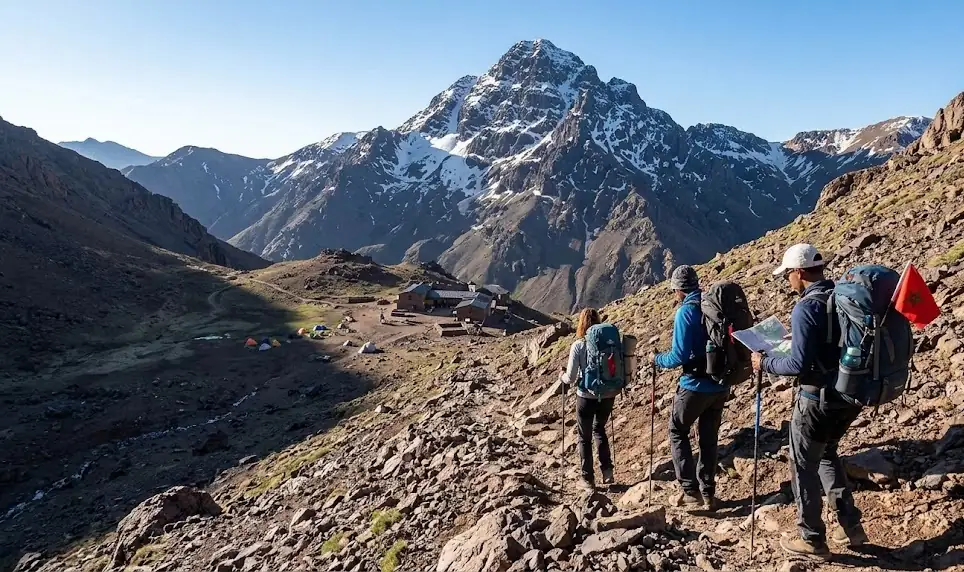
Toubkal (4,167m) is magnificent, but its accessibility from Marrakech means the main trails resemble a highway during the peak spring and autumn seasons. If you want genuine wilderness, if you want to experience the deep, uninterrupted silence of the Moroccan interior, you have to look elsewhere.
Here are the three lesser-known regions that offer the best hiking in Morocco.
1. Jbel Saghro: The Volcanic Desert Range
The Jbel Saghro sits between the High Atlas and the Sahara Desert. It is a harsh, arid, and staggeringly beautiful range composed of volcanic rock, characterized by massive basalt pillars, deep gorges, and flat-topped mesas.
Because it lies further south and at a lower elevation than the High Atlas (its highest peak, Amalou n’Mansour, is 2,712m), Saghro is the perfect winter hiking destination. When Toubkal is buried under meters of snow and requires ice axes and crampons, Saghro offers clear, crisp days and cold, starry nights.
The Trek: A standard crossing of the Jbel Saghro takes 4 to 6 days. You typically start from the village of Tagdilt, hike over the Tizi n’Ouarg pass, and traverse through the Bab n’Ali — a breathtaking formation of twin rock towers rising hundreds of meters into the sky.
The Culture: This is the traditional winter grazing ground of the Aït Atta, one of the most powerful and fiercely independent Amazigh (Berber) nomadic tribes. You will encounter their black goat-hair tents. The interaction is usually limited but very respectful.
Best Time to Go: October to April. Do not attempt this in summer; the heat is lethal.
2. The Anti-Atlas and Jbel Sirwa: The Saffron Mountain
South of Marrakech, acting as a bridge between the High Atlas and the Anti-Atlas, is Jbel Sirwa (3,304m). This is an ancient, extinct volcano, and the hiking here is characterized by vast, open plateaus, deep valleys cut by seasonal rivers, and isolated stone villages built smoothly into the mountainsides.
The Sirwa region is famous for two agricultural products that define the local economy and the landscape: saffron (the ‘red gold’ harvested in autumn around Taliouine) and the high-quality wool used to weave the renowned Ouzguita carpets.
The Trek: The ascent of Jbel Sirwa is challenging but non-technical, usually taking 5 to 7 days for a full circuit. The landscape is softer and more pastoral than the jagged High Atlas, with alpine meadows (in spring) giving way to rocky, volcanic scree near the summit. The view from the top offers a panoramic sweep of the entire High Atlas range to the north.
The Culture: The villages here are incredibly remote. Many are inaccessible by road, meaning goods are still transported by mule. The hospitality is overwhelming; it is entirely common to be invited into a home for tea simply because you are walking past.
Best Time to Go: March to May (for the spring flowers) and September to November (the saffron harvest occurs in late October/early November, which is a spectacular time to be in the region).
3. The Eastern High Atlas: M’Goun Massif
If you want the scale and altitude of Toubkal without the crowds, you go east to the M’Goun Massif. Ighil M’Goun (4,071m) is Morocco’s third-highest peak, but the region is far less developed for tourism.
The M’Goun region is defined by water. While the western High Atlas can be dry and stony, the M’Goun is carved by rivers that have created deep, dramatic gorges and lush, green valleys terraced with agriculture.
The Trek: The classic M’Goun trek involves summiting the long, ridge-like peak (which often feels like walking on the roof of the world for several kilometers) and descending through the Achabou Gorges.
Walking the Achabou Gorges is one of the great adventures in Moroccan hiking. For a full day, the trail is the river. You wade through the Oued M’Goun, sometimes ankle-deep, sometimes waist-deep, between sheer rock walls that rise hundreds of meters on either side, blocking out the sun.
The Culture: The Ait Bougmez Valley (often called the ‘Happy Valley’), which serves as the northern gateway to M’Goun, is one of the most fertile and beautiful valleys in the country. The architecture here — towering tighremts (fortified houses) made of rammed earth — is spectacular.
Best Time to Go: May to September. The river walking in the gorges requires the water to be relatively warm and low, which rules out the spring melt season.
The Practicalities of Off-the-Beaten-Path Hiking
You Need a Guide: I cannot stress this enough. While you can navigate Toubkal independently if you are experienced, regions like Saghro and Sirwa require a licensed Moroccan mountain guide. Trails are unmarked, water sources are scarce and seasonal, and navigating the cultural etiquette with remote nomadic communities requires local knowledge.
Logistics are Tougher: You won’t find comfortable gîtes (guesthouses) every night. You will be camping in the wild, relying on mules to carry the tents and food.
The Reward: The reward is the absolute privilege of seeing a landscape before it has been packaged and smoothed out for mass consumption. You will earn every kilometer, and you will remember every view.
Experience the true heart of Moroccan heritage through its culinary traditions. Join us in preserving and honoring these ancestral recipes.
What People Are Saying
No comments yet. Be the first — we'd love to hear from you.
Hamid Ouazzane
Culturally Verified & Fact-CheckedThe Moroccan Food editorial team brings together native culinary researchers, heritage preservationists, and experienced home cooks across Marrakech, Fes, and Casablanca. Every recipe and cultural guide is reviewed against ancestral oral traditions and authentic regional practices.