Mhancha: The Royal Serpent Pastry of Fez and Its Medina Street Legacy
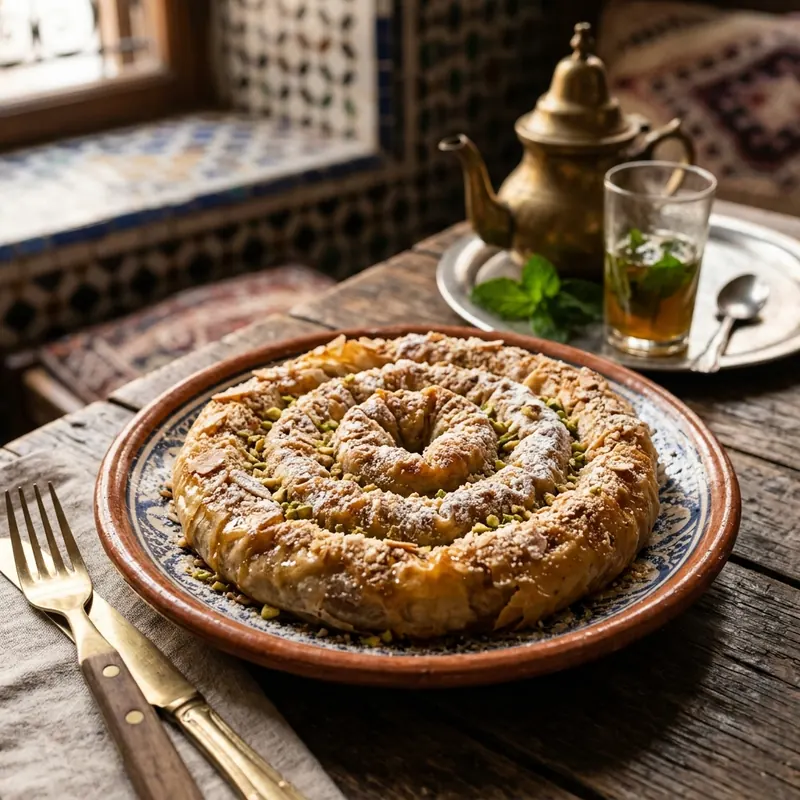
Of all the treasures created by Moroccan pastry chefs over the centuries, none possesses the regal architectural drama of Mhancha (محنشة).
Its name translates literally to “the coiled snake” or “the serpent,” describing the magnificent spiral of delicate pastry wrapped around an aromatic core of almond paste. While Mhancha first graced the banquets of sultans and imperial weddings in Fez, Rabat, and Tetouan, it has also earned a proud, daily place in the medina: sliced into golden, bite-sized spirals and sold from pastry vitrines beside steaming glasses of mint tea.
Imperial Fez and the Andalusian Heritage
To understand Mhancha is to step into the historic riads of Fez el-Bali. Following the fall of Granada in 1492, thousands of Andalusian families brought their refined sweet-making traditions to Morocco. In the imperial capital, Andalusian confectioners encountered the local culinary geniuses, blending Spanish almond cultivation, Persian sugar techniques, and native Moroccan floral waters.
The genius of Mhancha lies in its geometry. In traditional Moroccan culture, circular and coiled foods carry profound symbolic weight. Just as the round communal tagine and the spherical couscous grain symbolize completeness and unity, the unbroken spiral of Mhancha represents eternity, renewal, and continuous prosperity. Serving a large, golden Mhancha at a wedding or celebration was a host’s way of wishing the new couple an unbroken journey of sweetness and joy.
The Three Pillar Elements of Authentic Mhancha
Creating an authentic Mhancha requires patience, delicate touch, and generational knowledge:
1. The Paper-Thin Warqa
Unlike Greek phyllo or French puff pastry, traditional Moroccan warqa is created by tapping a ball of elastic, high-hydration dough against a scorching copper dome (tassa). The resulting leaves are whisper-thin, translucent, and incredibly flexible. For Mhancha, several long strips of warqa are brushed with melted clarified butter and overlappingly joined into a continuous ribbon that stretches across the table.
2. The Almond Paste (Oqda d’Louz)
The soul of Mhancha is its almond filling:
- Blanched Atlas almonds: Boiled briefly, peeled by hand, and dried completely overnight so no water dilutes the paste.
- Double stone-grinding: Ground once on their own, then ground a second time with granulated sugar until a smooth, malleable marzipan forms.
- The Royal Perfumes: Kneaded with pure orange blossom water (ma zhar), crushed Moroccan gum arabic (meska horra) ground with a pinch of sugar, Ceylon cinnamon, and softened smen or unsalted butter.
3. The Coiling and Baking Alchemy
The almond paste is rolled by hand into long, uniform serpents roughly the thickness of a thumb. The warqa ribbon is folded snugly over the almond snake, forming a long encased tube.
With immense care and greased fingertips, the baker begins coiling the tube from the center outward, forming an unbroken spiral that resembles a sleeping snake. The surface is brushed generously with melted butter and baked in a gentle oven until uniformly golden and crisp.
4. The Hot Honey Soak and Lattice Decoration
The moment the hot Mhancha emerges from the oven, warm orange blossom honey infused with a touch of mastic is ladled over the entire spiral. The pastry drinks the honey, turning translucent and crackling.
Once cooled, the maâlema decorates the spiral using powdered sugar and toasted cinnamon, drawing radiating geometric lines that accent the natural ridges of the coiled serpent, often garnishing the rim with toasted slivered almonds or chopped green pistachios.
The Street Medina Culture: Mini-Mhanchas
While grand banquet Mhanchas can span two feet in diameter, medina pastry shops pioneered individual mini-spirals known as Mhanchat sghirat.
Walk through the Habous quarter in Casablanca or the spice alleys of Marrakech, and you will see glass cases filled with these golden palm-sized spirals. Workers stop for an afternoon respite, pairing a warm, crisp mini-Mhancha with a glass of gunpowder green tea steeped with wild mountain sage or fresh mint. The contrast between the crackling outer warqa, the melting honey, and the nutty almond core makes it one of the most rewarding pastries in the world.
Frequently Asked Questions
What is the difference between Mhancha and Briouates?
Both pastries utilize the classic Moroccan almond paste (oqda d’louz) and paper-thin warqa. However, Briouates are individually folded into small triangles and deep-fried, resulting in a blistered, crunchy shell. Mhancha is rolled into continuous coiled tubes and baked in the oven, producing a more delicate, stratified, and golden texture.
Can I make Mhancha using store-bought phyllo dough?
Yes! While authentic homemade warqa produces the most authentic crispness, good quality store-bought phyllo dough works very well. Keep unused sheets covered with a damp cloth to prevent drying, brush each layer generously with melted butter, and double-wrap the almond snake to prevent tears during coiling.
How should authentic Mhancha be stored?
Because it is soaked in pure honey, Mhancha keeps exceptionally well. Store it in an airtight container at room temperature for up to two weeks. Avoid refrigerating, as humidity can soften the crisp pastry layers.
Experience the true heart of Moroccan heritage through its culinary traditions. Join us in preserving and honoring these ancestral recipes.
What People Are Saying
No comments yet. Be the first — we'd love to hear from you.
The Moroccan Food
Culturally Verified & Fact-CheckedThe Moroccan Food editorial team brings together native culinary researchers, heritage preservationists, and experienced home cooks across Marrakech, Fes, and Casablanca. Every recipe and cultural guide is reviewed against ancestral oral traditions and authentic regional practices.