The Sacred Ritual of Chwa: Inside Morocco's Charcoal Brochette Culture
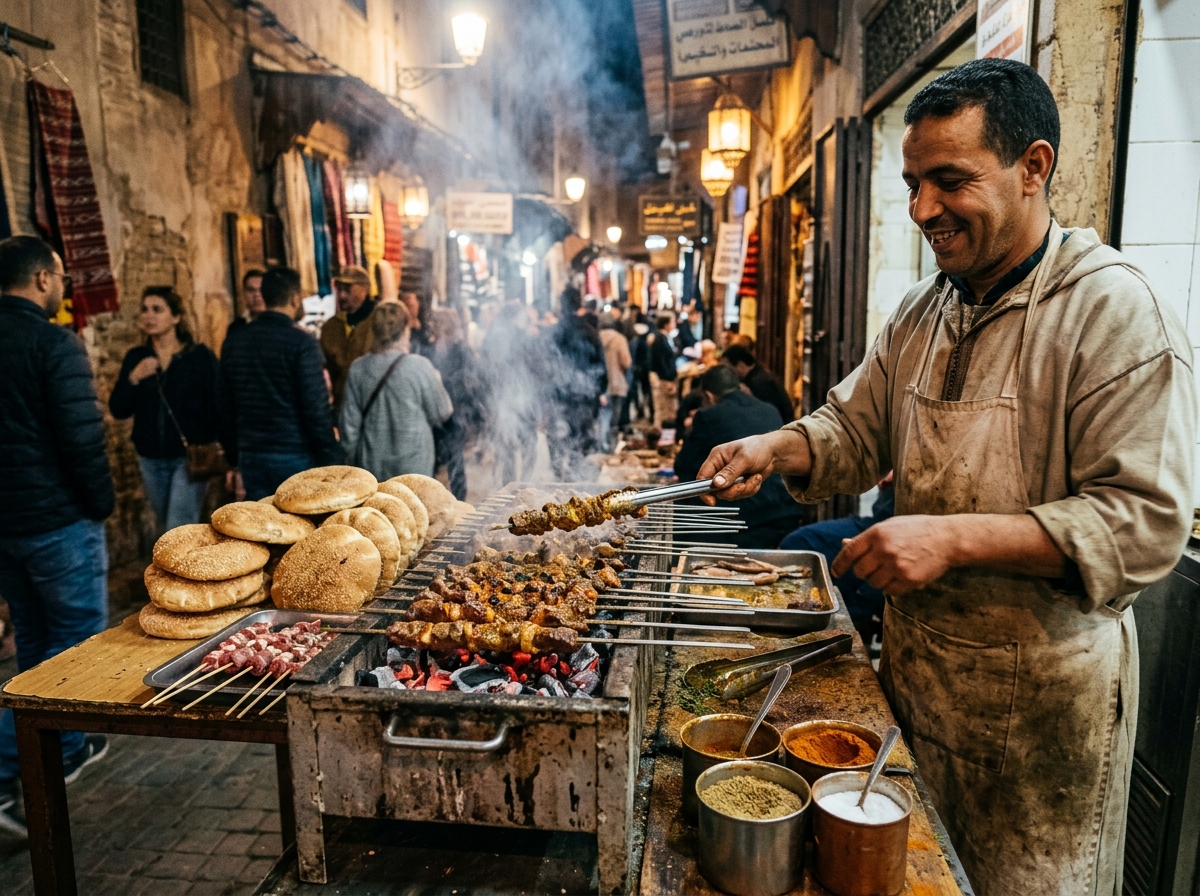
Step into any Moroccan market town around one o’clock in the afternoon, and your senses guide you long before you see a single storefront. A thin veil of pale blue smoke drifts through the alleyways, carrying an unmistakable aroma: rendered lamb fat dripping onto glowing oak embers, sweet paprika blooming in heat, toasted cumin, and clean woodsmoke.
This is the world of Chwa—the sacred, daily ritual of Moroccan charcoal brochettes.
From the roadside stalls of the Middle Atlas mountains in Immouzzer and Zaida to the deep alleys of Bab Boujeloud in Fes and Rahba Kedima in Marrakech, chwa is far more than fast food. It is an unhurried communion between customer, butcher, and grill master, unchanged for generations. Here, meat is honored in its purest form: cut fresh before your eyes, lightly spiced, kissed by fire, and pulled straight into warm, crusty bread.
The Souk Ecosystem: From Butcher Block to Red Coals
To understand authentic Moroccan chwa, you must leave behind fixed menus. True grill culture lives inside a partnership between two neighboring tradesmen: the butcher (el-gazzar) and the grill master (moul chwa).
Walk down the butcher row in any medina souk. Carcasses of grass-fed mountain lamb, young beef, and milk-fed veal hang behind glass or on iron hooks, framed by white ceramic tiles. You do not order “three skewers.” Instead, you approach the butcher block, greet him with a respectful “Salamu Alaykum,” and tell him how many grams or quarter-kilos of meat your table desires.
“A-khoya, give us half a kilo of tender lamb shoulder, and add some heart and liver,” a regular customer instructs.
The butcher reaches for his heavy cleaver. On a massive round block of olive wood, worn smooth by decades of chopping, he trims the meat with rhythmic precision into neat cubes. Alongside muscle cuts, he selects rich organ meat—firm lamb heart (l-qalb) with its deep mineral sweetness, or silky liver (kebda).
Crucially, the butcher never discards the fat. He slices thin squares of clean kidney suet (chhem dial l-kela), the true soul of the skewer. Once weighed on the brass scale, the butcher hands the meat across to the grill master next door, or wraps it in brown paper for you to carry over yourself.
The Marinade Secret: Onion Juice and Mountain Herbs
Moroccan cooks understand an unspoken rule: never drown quality cuts in heavy sauces. Great chwa relies on an artful, light marinade known as t’tebila that tenderizes without masking the flavor of pasture-fed livestock.
The secret of authentic Moroccan brochettes is grated onion juice. Seasoned cooks never toss chunky chopped onions into meat destined for skewers. Chopped onion bits burn black on hot coals before the meat cooks through, leaving an unpleasant bitter taste.
Instead, the cook grates yellow onions and squeezes the pulp through cheesecloth directly over the meat. Onion juice contains natural sulfur compounds and gentle enzymes that soften meat fibers while infusing every piece with savory moisture.
To this aromatic onion base, the cook adds:
- Finely minced flat-leaf parsley and coriander (qasbour w ma’adnous)
- Sweet paprika (tahmira), which lends warmth and brick-red color
- Freshly ground cumin seeds (kamoun beldi), earthy and pungent
- A gentle touch of sea salt and freshly cracked black pepper
- A light thread of olive oil to coat the cubes and lock in the spices
No garlic, vinegar, or citrus is used. Garlic chars over coals, while acid tightens raw meat. The meat rests in this gentle bath for just twenty minutes—long enough to absorb the herbs and spices.
The Architecture of the Skewer and Suet Smoke
Threading the skewer (qteb) is an engineering art solved generations ago. A skewer made entirely of lean meat dries out within minutes over hot charcoal.
The golden rule is alternating geometry: two cubes of lean meat, one thin square of firm kidney suet fat, two cubes of lean meat, another sliver of fat.
When this skewer meets the heat, culinary chemistry occurs. The suet melts quickly, basting adjacent meat cubes from the outside in. As droplets of rendered fat drip onto glowing coals below, they vaporize into aromatic white smoke. That smoke curls back up around the meat, depositing a delicate charcoal perfume that cannot be duplicated by any kitchen pan.
The Master of the Embers: The Kanoun and the Marouaha
Watch the grill master work his station. He stands before a long, narrow iron trough known as the kanoun or mijmar, packed with glowing lump charcoal (fâkher) made from oak, olive wood, or citrus branches. No briquettes with chemical binders are ever allowed.
The coals glow an even, ash-dusted cherry red. The master lays dozens of long stainless-steel skewers across the narrow lips of the trough. The fat hits the heat: shhh-tzzz. White smoke rises toward the chimney hood.
In his right hand, the grill master holds his most essential instrument: the marouaha, a hand fan woven from dried dwarf palm fronds (doum). With rhythmic strokes of his wrist, he directs air currents across specific sections of the coals. If flames threaten to char the meat, he lifts the skewers briefly, taps the ash, and fans gently to maintain steady heat without burning. Within seven minutes, the brochettes develop rich caramelized edges while the center remains juicy and tender.
The Bread Clamp Ritual: Eating Like a Medina Insider
You do not eat Moroccan chwa off the skewer with your teeth like an amateur. That is a quick way to burn your lips on scorching metal. Nor do you pull the meat onto a plate with a fork.
The proper way to eat chwa is the Bread Clamp technique:
- Take a fresh, warm round of Moroccan semolina bread (khobz) and tear it into a clean quarter.
- Open the bread like a pocket, exposing the soft, steamy crumb (l-baba).
- Take the sizzling skewer straight from the grill master’s tongs.
- Enclose the meat inside the bread pocket, gripping firmly through the crust.
- With your other hand, pull the skewer backward in one smooth, confident tug.
The skewer slides out clean, leaving the hot meat cubes nestled inside the bread. Rendered juices, seasoned fat, and spices soak directly into the crumb, turning every bite into an aromatic delight.
On the table sits a small clay dish of coarse sea salt and freshly ground cumin, along with sliced sweet onions and ripe tomatoes. You dip each bite into the cumin-salt, take a sip of hot mint tea poured from high above, and understand why Moroccans consider chwa one of life’s greatest comforts.
Grandmother’s Rules for Home Brochettes
If you grill chwa at home, keep these four ancestral rules close:
- Grate the Onion: Squeeze fresh onion juice over your meat. Chopped pieces char into bitter flecks, while onion juice tenderizes deeply.
- Never Skip the Suet: Lean cuts require fat to survive open fire. Threading small squares of kidney suet between meat keeps everything succulent.
- Wait for White Coals: Never lay meat over active flames. Let charcoal burn down until coated in powdery white ash for even heat.
- Salt at the End: Keep salt minimal until just before grilling, or sprinkle coarse sea salt immediately after skewers leave the fire to preserve juiciness.
Frequently Asked Questions
What cuts of meat make the most authentic Moroccan brochettes?
Boneless lamb leg or shoulder is the traditional choice, prized for natural tenderness and grass-fed flavor. Beef sirloin is equally popular for everyday meals. Moroccan souks also value skewers of lamb liver (kebda) and heart (l-qalb), which offer a rich flavor when paired with cumin.
Why do Moroccan grill masters use onion juice instead of sliced onions?
Raw onion pieces char and burn when exposed to direct charcoal heat, imparting an acrid crust. Squeezing grated onion juice over the cubes avoids this problem. The juice coats meat evenly, tenderizing muscle fibers while natural sugars caramelize cleanly on the grill.
How do you prevent lean skewers from drying out on the grill?
The secret lies in the fat-to-meat ratio and fast cooking. Interspersing squares of fresh kidney suet fat between lean meat cubes continuously bastes the brochettes as they cook. Additionally, keep charcoal very hot and avoid overcooking; six to eight minutes is plenty to seal in moisture.
What is the purpose of dipping chwa into cumin and salt at the table?
In Moroccan cooking, cumin loses its bright aromatic oils when exposed to prolonged heat. By keeping spices gentle during marination and serving freshly ground cumin and sea salt on the table, diners can customize each bite, letting the spice bloom against hot meat.
Experience the true heart of Moroccan heritage through its culinary traditions. Join us in preserving and honoring these ancestral recipes.
What People Are Saying
No comments yet. Be the first — we'd love to hear from you.
The Moroccan Food
Culturally Verified & Fact-CheckedThe Moroccan Food editorial team brings together native culinary researchers, heritage preservationists, and experienced home cooks across Marrakech, Fes, and Casablanca. Every recipe and cultural guide is reviewed against ancestral oral traditions and authentic regional practices.