The Probiotic Secret: Why Preserved Lemons and Smen Are the Gut Health Foods of Tomorrow
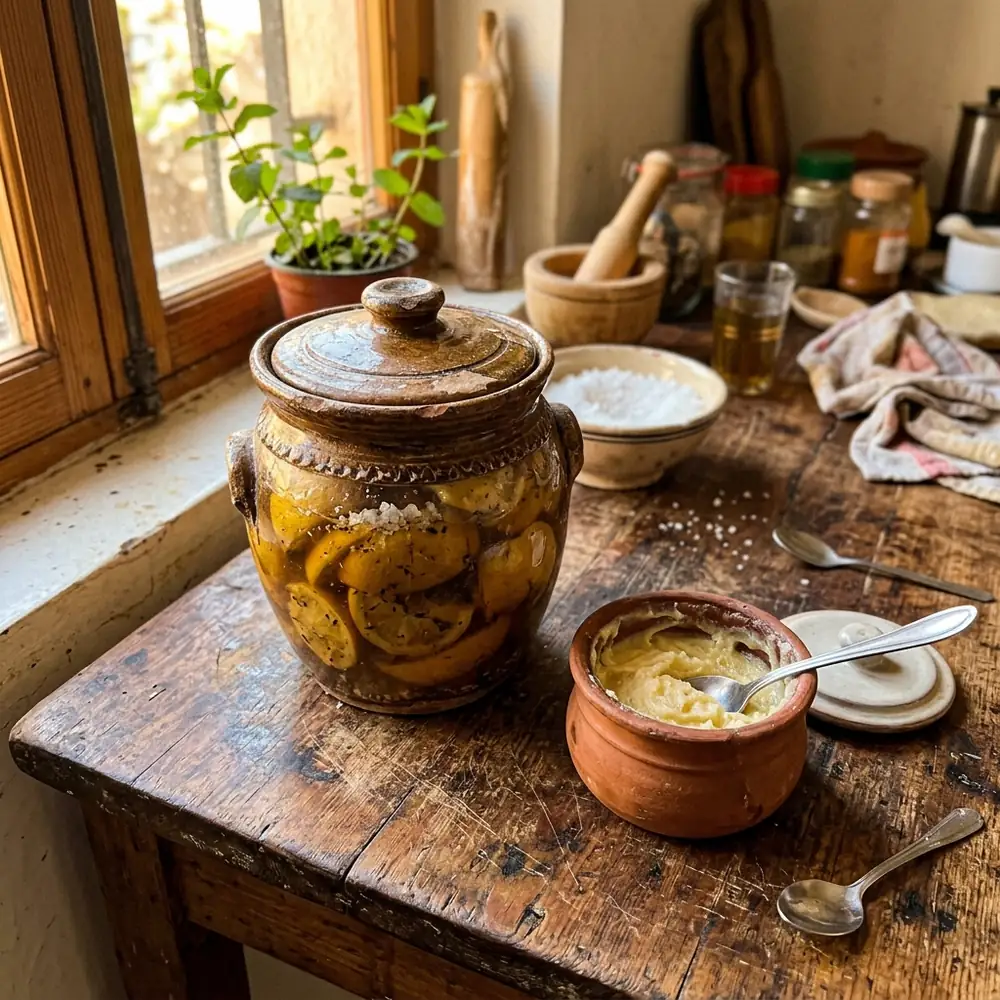
The Probiotic Secret Hidden in Every Moroccan Kitchen
I grew up watching my mother press lemons into salt with her bare hands. A gesture so ordinary I never thought to ask why. It was just something she did, every autumn, in the big clay jar that lived on the bottom shelf of the kitchen. The jar that was never in the fridge. The jar that sat, fermenting, in its own brine for a minimum of thirty days before she'd let anyone touch it.
She wasn't thinking about lactobacillus. She wasn't optimizing her microbiome. She was doing what her mother did, and what her mother's mother did, in an unbroken chain that goes back centuries before anyone had a word for probiotics.
And yet — the science, when you look at it, is extraordinary.
What Actually Happens Inside a Jar of Preserved Lemons?
The moment salt makes contact with the lemon's skin, something begins. The salt draws out moisture from the fruit. That moisture dissolves the salt into brine. The brine, acidic from the lemon juice and rich in the sugars leaking out of the rind, becomes the perfect environment for a specific group of bacteria — the lactic acid bacteria — that were already living on the lemon's surface.
These bacteria, primarily Lactobacillus species, begin to ferment the sugars in the brine. They produce lactic acid as a by-product. The lactic acid acidifies the environment further, which kills off competing bacteria that can't survive in acid. Within two to four weeks, you have a living, stable fermented food dominated by beneficial bacteria and hostile to pathogens.
This is, chemically, exactly what happens with kimchi, with sauerkraut, with traditional pickles, with real lacto-fermented vegetables of any kind. The Moroccan kitchen reached this technique independently — or inherited it from an even older Mediterranean preservation tradition — and has been using it with precision ever since.
What Does Science Say About Eating Fermented Foods and Gut Health?
The evidence has accumulated considerably in the last decade. A 2021 Stanford study published in Cell found that a high-fermented-food diet increased microbiome diversity and reduced markers of inflammation — and the effects were measurable within weeks. Not months. Weeks.
The mechanism is not fully understood, and anyone who tells you it is is simplifying. But the working model is that fermented foods introduce live microbial strains that interact with the gut's existing bacterial community, that the short-chain fatty acids produced by microbial fermentation have anti-inflammatory effects on the gut lining, and that the diversity of bacterial strains in a healthy microbiome is itself protective against dysbiosis.
Preserved lemons tick multiple boxes here. They're lacto-fermented, meaning they contain live lactic acid bacteria if eaten without excessive heat. They're high in polyphenols from the lemon rind — and polyphenols are prebiotic, meaning they feed beneficial bacteria rather than being directly absorbed by the body. And the fermentation process actually increases the bioavailability of certain nutrients in the fruit.
And Smen? What Exactly Is This Aged Butter and Why Does It Matter?
Smen is one of the most misunderstood ingredients in North African cooking. From the outside, it looks like a mistake — butter that has been allowed to ferment and age, developing a sharp, funky, intensely complex flavor that strikes most first-timers as somewhere between blue cheese and something that has gone very wrong.
It hasn't gone wrong. It has gone exactly right.
Traditional smen is made from fresh butter — ideally from sheep's or goat's milk, which has a different fatty acid profile than cow's milk — worked with salt and sometimes herbs, then packed into clay jars and buried or stored for months, sometimes years. The fermentation is driven by naturally occurring microorganisms in the raw butter. The result is a product with a flavor profile of extraordinary depth and a concentration of butyric acid — the same short-chain fatty acid that gut-lining cells use as their primary fuel source.
Old smen, properly made, is also high in fat-soluble vitamins, in conjugated linoleic acid (which has been studied for anti-inflammatory properties), and in the bacterial metabolites produced by long fermentation. Is it the most scientifically optimized gut health food? No. Is it a traditional food with genuine nutritional complexity that modern processed butter has largely abandoned? Absolutely yes.
How to Actually Use These Ingredients in Your Kitchen Today
Start with preserved lemons. They are the easiest and most immediately transformative.
- Don't cook them at high heat if you want the probiotic benefit — add them at the end, as a finishing element
- Use only the rind — scoop out and discard the pulp, rinse the rind under cold water to remove excess salt, then slice or mince finely
- A little goes a long way — a quarter of a preserved lemon adds a flavor complexity that two whole fresh lemons cannot replicate
- They keep indefinitely — properly brined, they last in the fridge for over a year after opening
For smen, start with a small quantity in couscous — a teaspoon stirred into the steamed grain at the final stage. The funk is transformative. Give it time to melt into the couscous before you judge it. It is not butter. It is something older and more interesting than butter.
Making Your Own Preserved Lemons: The Minimum Viable Method
You need: unwaxed lemons (preferably thin-skinned), coarse non-iodized salt, a clean glass jar. That's the list.
Quarter the lemons almost through — keeping the base intact so they open like a flower. Pack the cut surfaces generously with salt. Compress them into the jar, pushing down firmly so they release juice. The juice, combined with the salt, will eventually submerge the lemons entirely. If they're not submerged after 24 hours, add a small amount of fresh lemon juice. Seal. Leave at room temperature, away from direct sunlight, for 30 days minimum.
Open the jar after a month. The smell — bright, fermented, deeply complex — will tell you something has happened. The lemon rinds will have softened and turned translucent. The brine will have clouded slightly. All of this is correct. All of this is what thirty days of lacto-fermentation looks like.
Taste a small piece of the rind. It should be salty, intensely lemony, with a fermented depth that fresh lemon doesn't have. If it tastes like that, you have succeeded at something your grandmother did intuitively, and that the wellness industry is now charging considerable amounts of money to explain.
Experience the true heart of Moroccan heritage through its culinary traditions. Join us in preserving and honoring these ancestral recipes.
What People Are Saying
No comments yet. Be the first — we'd love to hear from you.
Nadia Berrada
Culturally Verified & Fact-CheckedThe Moroccan Food editorial team brings together native culinary researchers, heritage preservationists, and experienced home cooks across Marrakech, Fes, and Casablanca. Every recipe and cultural guide is reviewed against ancestral oral traditions and authentic regional practices.