Ras M'bawkher: The Art and Delicacy of Steamed Sheep's Head in the Medina
Ras M’bawkher: The Art and Delicacy of Steamed Sheep’s Head in the Medina
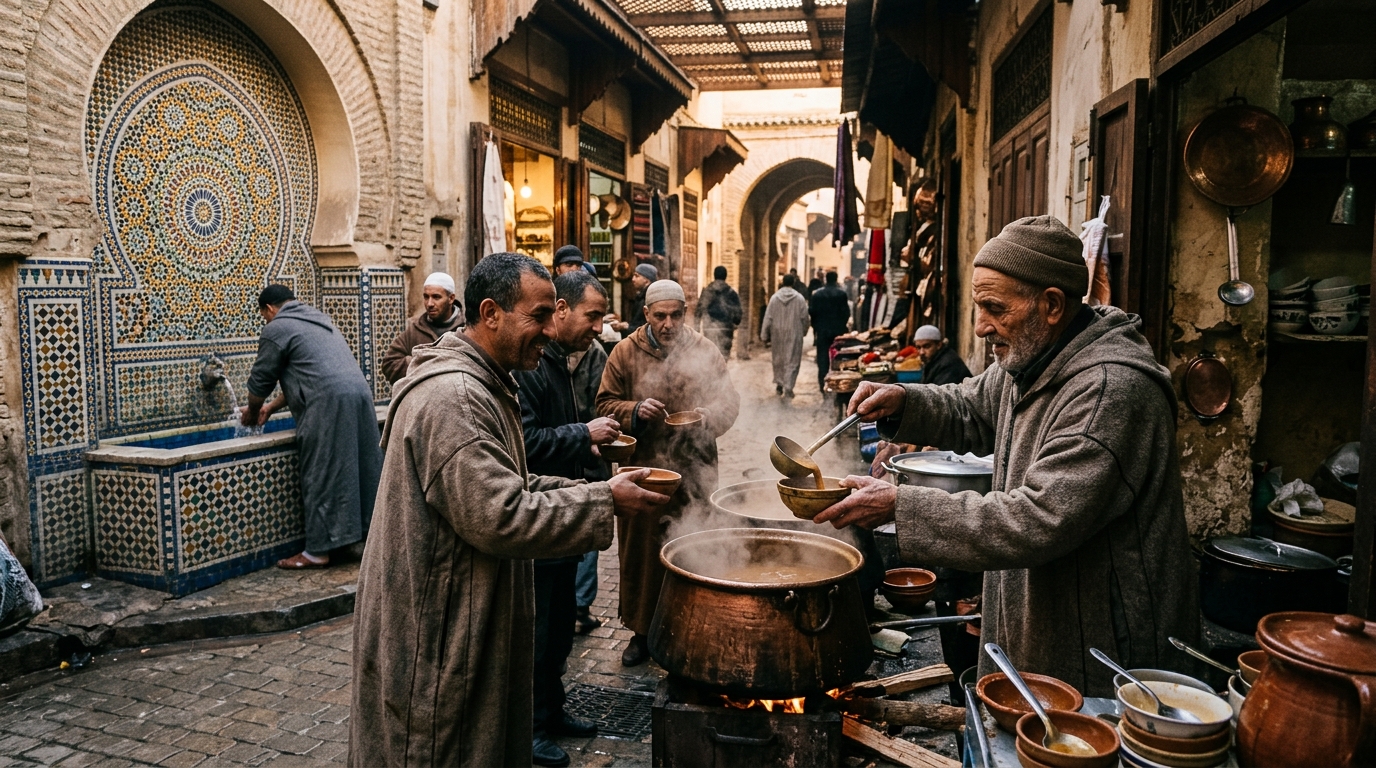
Step into Bab Doukkala in Marrakech or the ancient butcher alleys of Fes el-Bali on a crisp morning, and a distinct aroma stops you in your tracks. It begins with the sweet smokiness of singed wool and crackling embers, quickly overtaken by the deep perfume of freshly toasted cumin seeds and gentle steam escaping from colossal metal pots.
This is the sanctuary of Ras M’bawkher—steamed sheep’s head—one of the most revered culinary traditions in Moroccan gastronomy.
While uninitiated travelers might hesitate at the sight of split skulls displayed on butcher counters, medina locals recognize this dish as pure culinary royalty. The meat is not boiled into stringy submission; it is coaxed into tender perfection through three to four hours of patient, enclosed steam. When prepared by seasoned masters, the cheeks dissolve like confit, the tongue slices like butter, and the savory gelatin clings to your fingers in a badge of authentic indulgence.
The Post-Eid Morning Ritual and Medina Specialists
In Moroccan family life, Ras M’bawkher is forever linked to Eid al-Adha, the Feast of the Sacrifice. While sizzling skewers of liver (boulfaf) dominate the grills on the opening day, the sheep’s head belongs to the second morning. It is an unhurried meal that gathers generations around the table after a day of labor and celebration.
Yet this delicacy is far too cherished to stay confined to once a year. In every imperial city, dedicated medina artisans known as chouwaya and m’bawkher masters operate year-round stalls. These craftsmen have inherited their copper pots, butcher blocks, and precise steaming techniques through family lines stretching back generations.
Walking past their shops at mid-morning, you see them tending to towering two-piece steamers, checking the seal of wet cloth wrapped around the seam, waiting patiently for the steam to complete its transformation. By noon, neighborhood workers, shopkeepers, and elders fill every stool, eager to claim their favorite cut before the day’s batch sells out.
Fire, Ash, and Wire: The Demanding Art of Preparation
Preparing a sheep’s head demands hard physical labor, absolute cleanliness, and complete attention to detail. No Moroccan mother or medina cook will tolerate a stray hair or speck of unwashed soot.
The preparation unfolds through three rigorous stages:
1. Singeing over Open Embers (Tashwat)
Directly following slaughter, the head is placed over a bed of glowing olive wood coals or gas flames. The artisan rotates the skull constantly, charring the wool until the exterior turns carbonized and jet-black. This step strips the wool, caramelizes the skin beneath, and imparts an irreplaceable woodsmoke foundation that defines the dish.
2. Scraping and Scrubbing
Once charred, the head is plunged into cold water. Armed with steel scrapers and wire brushes, the cook scours every millimeter of the skull. The black carbon flakes away under hard muscle work, uncovering smooth, golden-ivory skin. The teeth are scrubbed thoroughly with coarse sea salt and cut lemons, and the ears are trimmed and scraped clean.
3. The Cleaver Split
The cleaned head is laid flat on a heavy butcher block. With a single strike of an iron cleaver, the butcher splits the skull down the center line from crown to snout. The nasal cavities are scrubbed and rinsed repeatedly under rushing tap water until clean. The brain is either extracted to steam gently on its own, or secured inside the halved skull with clean twine.
The Steaming Craft: The Secrets of the Couscoussier
Moroccans almost never boil a sheep’s head. Boiling leaches the rich natural fats and gelatin directly into the cooking water, leaving the meat bland, gray, and waterlogged. True Moroccan cooks rely entirely on the couscoussier—known in Moroccan Darija as the barma w-kesskass.
The seasoned cook builds flavor from the base up. The bottom pot (barma) is filled with water infused with halved onions, bay leaves, celery sprigs, smashed garlic cloves, and whole cumin seeds. As the water boils, it generates aromatic steam that perfumes the meat without washing away its juices.
Before arranging the split head inside the perforated top steamer (kesskass), the meat receives a generous rub of coarse Atlantic sea salt, freshly toasted cumin (kamoun beldi) ground coarse that morning, cracked coriander seeds, and smashed garlic cloves tucked into the cavities.
Now comes the master’s secret: the qfal. The junction where the steamer rests atop the water pot is wrapped tightly with a strip of wet cotton cloth or thick flour paste. This airtight seal prevents steam from leaking out. Trapped inside the sealed chamber, the gentle steam breaks down tough connective tissues, turning collagen into silky gelatin. The cooking continues over low heat for three to four hours until a light touch causes the meat to slip effortlessly from the jawbone.
On Butcher Paper: The Sensory Feast
When your order is called at a medina stall, there are no china plates. The cook lifts the heavy metal lid, unleashing a cloud of cumin-rich steam. With tongs, he transfers half a steaming head onto brown butcher paper spread across the counter.
Using a short paring knife and his thumb, the artisan rapidly carves the meat into succulent portions:
- The cheek meat (el-khdoud) is dark, intensely juicy, and laced with ribboned fat that melts instantly.
- The tongue (el-lsan) has its rough outer skin peeled away in one smooth motion, revealing pale, tender meat with a velvety texture.
- The eye socket meat and temple muscles offer the sweetest, most delicate bites on the skull.
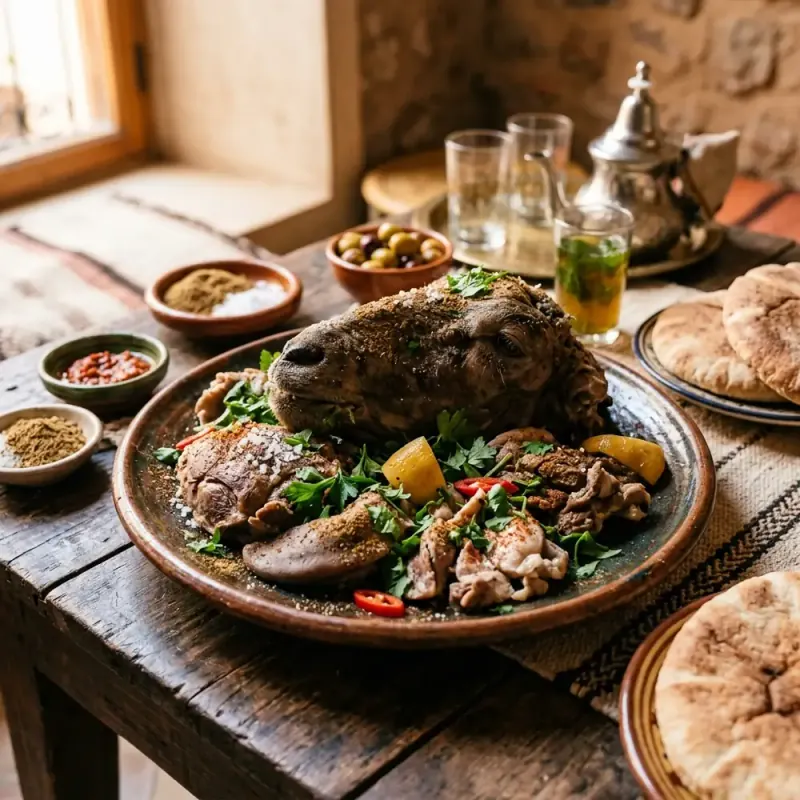
Beside the meat, the vendor places two small terracotta saucers: one filled with coarse grey sea salt, the other with freshly ground cumin. You tear off a warm piece of crusty, round Moroccan bread (khobz), pinch a piece of steaming cheek meat, dip it lightly into the cumin and salt, and bring it to your mouth.
The contrast is unforgettable: the crunchy wheat crust gives way to piping-hot meat that yields without chewing, followed by the smoky warmth of cumin and the sharp crunch of salt crystals.
To wash it down, nothing less than a steaming glass of sweet gunpowder green mint tea will do. In winter months, medina cooks brew the tea with fresh sprigs of wormwood (chiba), whose herbal bitterness cuts straight through the richness of the lamb fat, settling the stomach and refreshing the palate.
Grandmother Wisdom: Nose-to-Tail Respect
To understand Ras M’bawkher, one must understand the philosophy of the traditional Moroccan kitchen. In the eyes of Moroccan grandmothers, wasting any part of a sacrificial animal is an act of disrespect toward both the creature and the Creator.
“Every part of the sheep carries a blessing (baraka),” grandmothers remind their families as they gather around the steaming platter on the second morning of Eid. “The chops are for the impatient; the head is for those who understand patience, craft, and true sustenance.”
Elders in Morocco have long prized sheep’s head for its health-giving properties. The abundant natural gelatin and bone marrow are believed to strengthen joints, lubricate cartilage, and restore energy. It is a dish born of thrift and respect, transformed by patience and spice into one of the most celebrated feasts in North Africa.
Frequently Asked Questions
What does steamed sheep’s head taste like?
Ras M’bawkher tastes remarkably similar to slow-braised lamb shanks or beef short ribs, but with a silkier, melt-in-the-mouth texture due to the high concentration of natural gelatin. It is rich and savory without tasting overly gamey, beautifully balanced by the fragrant earthiness of freshly ground cumin and sea salt.
How do you eat Ras M’bawkher like a local?
You eat it with your right hand using freshly baked round Moroccan bread (khobz). Tear off a piece of crusty bread to form a small pouch between your fingers, pinch a portion of the tender cheek or tongue meat, and dip it lightly into the small saucers of coarse salt and ground cumin provided alongside.
Is the brain included and how is it prepared?
Yes, the brain (el-mokh) is considered a delicacy. It is either gently steamed inside the skull or removed and cooked separately in a small earthenware tagine with olive oil, crushed garlic, cumin, sweet paprika, and occasionally scrambled eggs.
Where can visitors try authentic Ras M’bawkher in Morocco?
The best places are traditional open-air grill stalls and specialized m’bawkher shops inside historic medinas. Look for busy vendors near Bab Doukkala or Mechoui Alley in Marrakech, the Boujloud and R’cif quarters in Fes, and Marché Central in Casablanca. Choose stalls packed with local patrons where steam pots are constantly refilled.
Experience the true heart of Moroccan heritage through its culinary traditions. Join us in preserving and honoring these ancestral recipes.
What People Are Saying
No comments yet. Be the first — we'd love to hear from you.
The Moroccan Food
Culturally Verified & Fact-CheckedThe Moroccan Food editorial team brings together native culinary researchers, heritage preservationists, and experienced home cooks across Marrakech, Fes, and Casablanca. Every recipe and cultural guide is reviewed against ancestral oral traditions and authentic regional practices.