Essaouira Food Guide: The Best Seafood and Local Dishes on Morocco's Atlantic Coast
Essaouira Food Guide: The Best Seafood and Local Dishes on Morocco’s Atlantic Coast
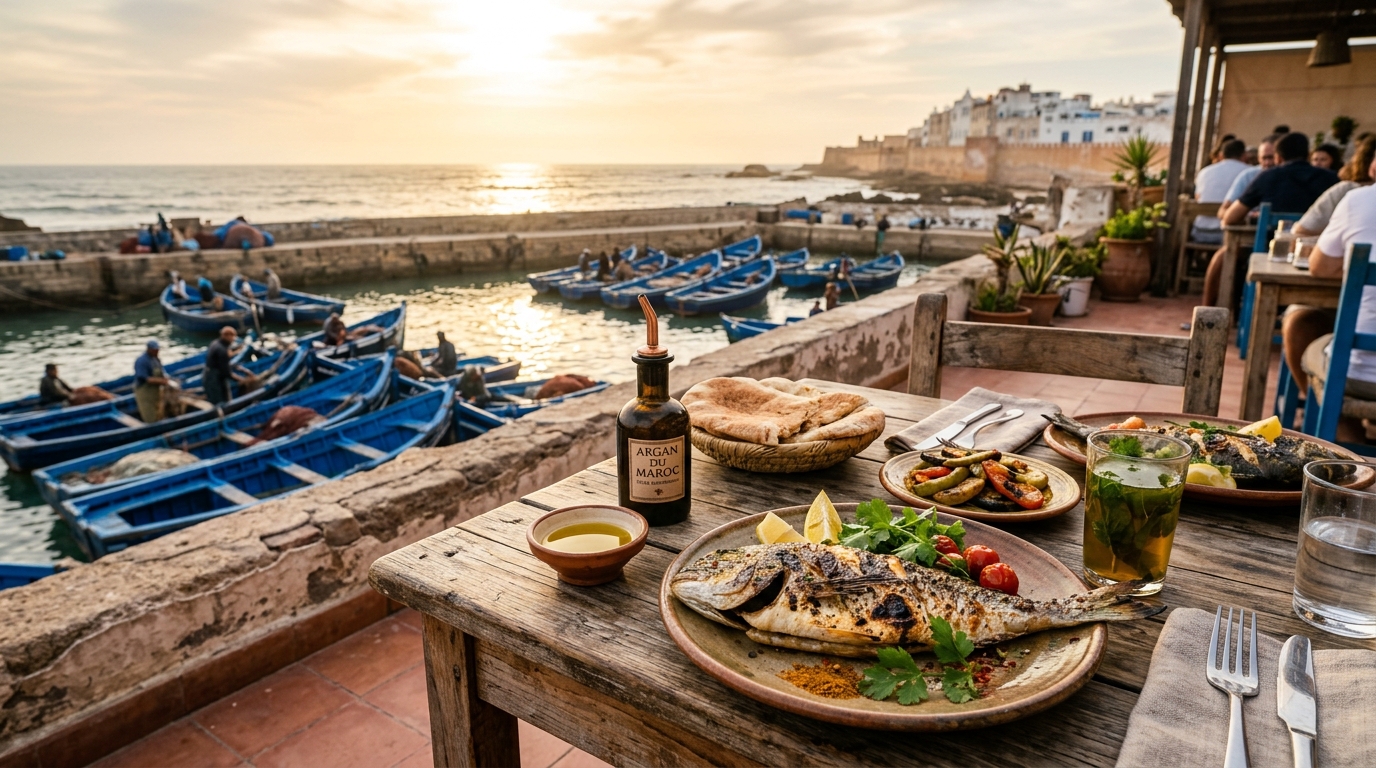
The wind hits you first. That constant, salt-soaked Atlantic breeze that locals call the alizé and that makes Essaouira one of the best kitesurfing spots in the world. But before you reach for your kite, stop. Look to your left. There are men grilling sardines over charcoal right on the port wall, smoke rising into the sea air, and they have been doing it since before you were born. That is where your Essaouira food story begins.
Essaouira — known as Mogador to the Portuguese who built its walls — is a town that many visitors spend only one day in. They walk the ramparts, take a few photos of blue boats in the harbor, and leave. What a shame. Those who stay, who wander past the postcard spots and into the backstreets of the medina, discover one of Morocco’s most honest and underrated food cultures.
Start at the Port: The Grill Stalls That Change Everything
Walk through the blue gate at the southern end of the port area and you enter a row of open-air grill stalls that have no formal name, no website, and no need for either. Fishermen bring their catch in by mid-morning; by noon the grills are going.
Your best move here is to point. Ask the price first — a quick bchhal? will do — and agree before anything hits the grill. For around 40 to 60 dirhams you can get a full plate: two or three fat sardines, grilled over charcoal until the skin is crisp and slightly charred, served with rough slices of white bread, olives, and a wedge of lemon. Add a cup of chermoula — that thick, garlicky, herb-packed sauce made with cilantro, cumin, paprika, and preserved lemon — and you have one of the best cheap meals in Morocco.
Sea bass (loup de mer) is the upgrade. Grilled whole, stuffed with herbs, painted with chermoula before going over the coals. The flesh is white, firm, and sweet from the cold Atlantic water. A whole fish here will cost you 80 to 120 dirhams depending on size and mood. Always worth it.
Shrimp are also worth ordering, especially in late summer and early autumn when they are fattest. The local style is dead simple: grilled in the shell, tossed with coarse salt, eaten with your hands. No ceremony needed.
One honest tip: the stalls right at the entrance closest to Moulay Hassan Square are the ones that have learned to charge tourist prices. Walk deeper into the row, past the first three stalls, and you will find the ones where fishermen sit eating their own lunch. That is where you want to be.
The Souiri Breakfast: Slow Mornings the Right Way
Locals in Essaouira wake up to a breakfast that is completely different from what you get in Marrakech or Fes. The Souiri breakfast is built around the agricultural identity of the surrounding region — specifically the argan forests and the Souss-influenced honey culture.
Find a small makhfiya (a neighborhood café with no sign in English) and order msemen — those flaky, layered square flatbreads griddled on a flat iron — with a pot of miel d’argan. This is honey that bees produce from the flowers of the argan tree. It is darker than commercial honey, slightly bitter at the edges, and deeply aromatic. Drizzled over hot msemen with a scrape of fresh butter, it is the kind of breakfast that makes you cancel your plans.
Add a glass of fresh orange juice squeezed from Moroccan clementines or navels — the vendors outside the medina gates do this in real time — and you are set until lunch.
Amlou: The Spread You Will Try to Recreate at Home
If you have not heard of amlou, you are missing one of the most distinctive ingredients of the Souss-Essaouira region. Made from roasted, ground argan kernels blended with honey and almond paste, it has the consistency of thick peanut butter and a nutty, slightly smoky flavor that is completely its own.
Amlou is traditionally served as a dipping sauce for bread at breakfast, but you will also find it sold in jars at the argan oil cooperatives around town. Buy a jar. It travels well and will outlast your memories of the trip.
The argan cooperatives — women’s cooperatives that press the oil by hand — are worth visiting in their own right. Many of them welcome visitors to watch the process. Some sell directly to the public at fair prices. The cooperatives on the road toward Marrakech (the P8 route) tend to have better prices than the medina shops.
Chez Sam: A Legend with a View
Chez Sam is the most famous restaurant in Essaouira, and it has been for decades. Tucked inside the port walls, right at the water’s edge, it looks like something from a film set — low ceilings, nautical wood decor, fishing nets, and windows that open directly onto the harbor.
The restaurant was started by a Frenchman named Sam in the 1960s, during the era when Essaouira attracted Jimi Hendrix, Cat Stevens, and a rotating cast of musicians and wanderers. It has changed hands since then, but the bones of the place remain. The menu leans toward fish and shellfish — crevettes royales, lobster, sole meunière — at prices that are not cheap by Moroccan standards (expect 150–300 dirhams per dish) but are reasonable for the quality and setting.
Go for lunch rather than dinner. The light through those harbor windows in the afternoon is extraordinary, and the kitchen tends to be sharper earlier in the day. Booking ahead on weekends is wise.
What to Skip (And Why)
The restaurants immediately around Place Moulay Hassan — the main square — are, with a few exceptions, designed entirely for tourists. Menus in five languages, photographs of dishes laminated to the table, persistent hosts who grab your elbow. The food is rarely bad, but it is rarely anything you could not find in a hotel buffet in Agadir either.
One specific trap: the “set menu” deals advertised on chalkboards around the square for 120–150 dirhams. They often promise seafood but deliver frozen fish poorly seasoned. If you are going to spend that kind of money, spend it at Chez Sam or walk into the medina to one of the smaller fish restaurants on Rue Mohammed Ben Masoud.
Best Time to Visit for Food
September and October are the sweet spot. The summer crowds have thinned, the wind is calmer than July and August, and the fishing season is at its peak. Sardines are fat, sea bass is plentiful, and the local produce markets are full of late-summer tomatoes and peppers.
Essaouira also holds a small seafood festival in late summer that draws local vendors and chefs. If you time your visit right, you will find pop-up stalls on the port wall selling things you will not see on any standard restaurant menu — smoked fish preparations, seafood pastilla, local clam dishes that are almost impossible to find otherwise.
FAQ
Is Essaouira seafood expensive compared to other Moroccan cities? At the port grill stalls, it is some of the most affordable seafood you will find anywhere in Morocco. Prices rise significantly in sit-down restaurants with harbor views, but you can eat an excellent grilled fish lunch for well under 80 dirhams if you eat where locals eat.
Can vegetarians eat well in Essaouira? Better than in most Moroccan cities, actually. The argan oil culture means there is a natural emphasis on vegetable-based preparations, amlou, and grain dishes. The medina has a few spots that cater specifically to vegetarian diners, and any decent café will make you a msemen breakfast without any meat.
Is Chez Sam worth the price? For the history and atmosphere, yes. For pure value-per-dirham food quality, the port grill stalls win easily. Think of Chez Sam as a special-occasion lunch rather than an everyday option.
Where can I buy real argan oil without being overcharged? Visit a certified women’s cooperative rather than a medina shop. Look for cooperatives with a sign from UCFA (Union des Coopératives des Femmes de l’Argan). They sell culinary argan oil — the roasted, brown-colored type used for cooking and amlou — as well as the lighter cosmetic oil, and the prices are set by the cooperative, not by a commission-hungry guide.
Experience the true heart of Moroccan heritage through its traditions. Join us in preserving these ancestral rituals.
What People Are Saying
No comments yet. Be the first — we'd love to hear from you.
The Moroccan Food
A Moroccan cultural writer dedicated to documenting the authentic voice, history, and heritage of the Kingdom. Writing from within — to share what truly makes Morocco extraordinary.
Our Mission →