The Fermentation Science of Smen: Why Morocco’s Aged Butter Is the Soul of Medina Cooking
ARTICLE 1: The Fermentation Science of Smen: Why Morocco’s Aged Butter Is the Soul of Medina Cooking
Slug: smen-fermentation-moroccan-aged-butter-science
Category: Food & Cuisine
Excerpt: From terracotta amphoras buried beneath earthen floors to the pungent, blue-cheese complexity in a Friday couscous broth: uncover the microbial heritage and culinary genius of Moroccan smen.
The Fermentation Science of Smen: Why Morocco’s Aged Butter Is the Soul of Medina Cooking
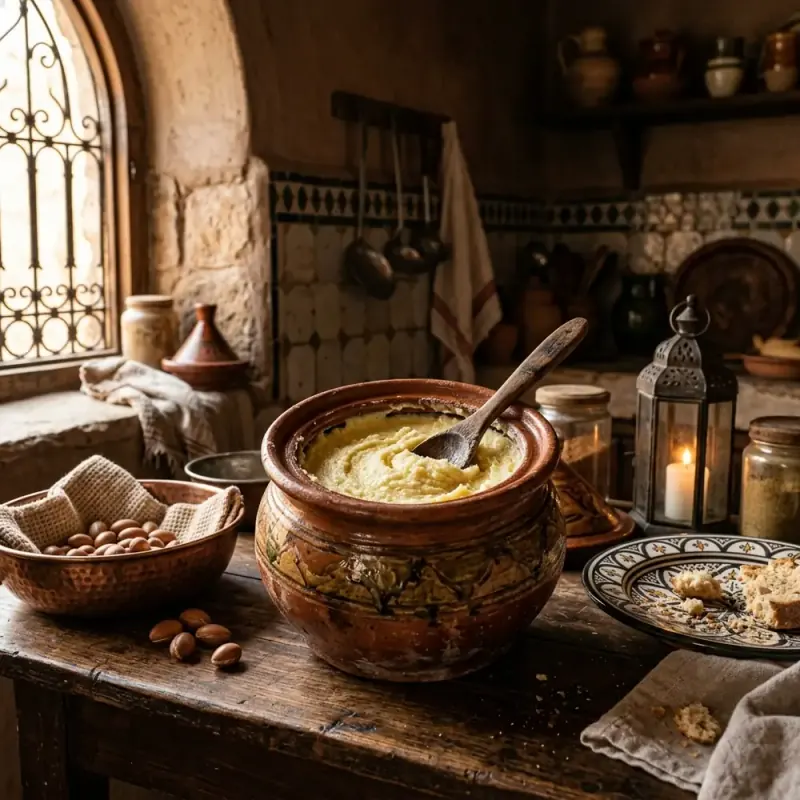
Welcome to my kitchen table. Come closer, pull up a carved wooden stool, and let me untie the linen cloth from this clay vessel resting in the cool shadows of the pantry.
Before you smell the spices of the medina—before the saffron of Taliouine, the sweet paprika of the Tadla plains, or the sharp ginger root ground by mortar—there is another aroma that defines the true culinary architecture of Morocco. It is the deep, primordial scent of smen.
To the uninitiated nose, an open jar of long-aged smen (smen harr) can shock the senses. It breathes with the pungent, unmistakable funk of an aged Roquefort or a cave-ripened Parmigiano-Reggiano, underpinned by the wild, sun-baked herbaceousness of mountain thyme and mineral salt. But to anyone raised within the whitewashed walls of a Moroccan home, that single whiff is home, memory, and heritage distilled into golden fat. A single pea-sized drop melting into a steaming Friday couscous or a bubbling pot of harira does not merely season the broth; it transforms it from simple sustenance into a 1,200-year-old royal feast.
Let us unravel the ancestral science, the living microbiology, and the sacred ritual of Morocco’s fermented preserved butter.
1. The 1,200-Year Ancestry: From Berber Pastoralism to Imperial Fez
Long before refrigeration crossed the Mediterranean, preservation was not merely a culinary technique in North Africa—it was the thin line between survival and starvation. In the high valleys of the Atlas Mountains and the arid plateaus of the pre-Sahara, the Amazigh (Berber) pastoralists lived by the rhythms of their sheep, goats, and cows.
In the lush spring months, when pastures bloomed with wildflowers and mountain herbs, dairy was abundant. Cows and ewes produced rich, golden milk heavy with fat. But winter in the mountains was unforgiving. To capture that fleeting spring bounty, pastoralist women developed a method of churning, washing, purifying, and salting butter, infusing it with wild mountain herbs, and curing it inside sheepskin sacks (guerba) or earthenware pots (khabiya).
   Spring Pastures (Abundant Milk)
                │
                ▼
   Raw Churning in Gourd / Leather (*Guerba*)
                │
                ▼
   Separation of Buttermilk (*Lben*)
                │
                ▼
   Washing & Kneading in Iced Herb Infusions
                │
                ▼
   Salting (8-10%) & Clay Pot Sealing (*Khabiya*)
                │
                ▼
   Subterranean Anaerobic Ageing (Months to Decades)
As Moroccan civilization coalesced around the great imperial capitals—Fez, Marrakech, Meknes, and Rabat—smen evolved from survival rations into high culinary art. In the aristocratic dars and riads of Fez, families kept cellars filled with glazed amphoras. An amphora of smen was sealed on the day a daughter was born, buried in the cool subterranean earth under the tiled courtyard, and unearthed fifteen or twenty years later on her wedding day to perfume the feast's tagines.
Smen was currency, medicine, and status. The older the smen, the higher its value. Historic accounts from caravan routes tell of jars of twenty-year-old smen traded like gold dust across the trans-Saharan tracks.
2. The Alchemy of Separation: Churning, Washing, and Herbal Decoction
To understand smen, one must understand that it is not simply "clarified butter" or Indian ghee. While ghee relies on heat to evaporate water and caramelize milk solids before straining, authentic Moroccan smen is a cold-fermented, raw lipid culture. Heat is rarely used in traditional preparation, preserving the living enzymes and beneficial microbes within the fat matrix.
The transformation begins with raw, unpasteurized milk.
Traditional Smen vs. Ghee vs. Western Cultured Butter:
┌───────────────────┬──────────────────────┬──────────────────────┬──────────────────────┐
│ Attribute         │ Moroccan Smen        │ Indian Ghee          │ Cultured Butter      │
├───────────────────┼──────────────────────┼──────────────────────┼──────────────────────┤
│ Thermal Process   │ Cold/Ambient Raw     │ High-Heat Clarified  │ Light Pasteurized    │
│ Moisture Level    │ Near 0% (Washed out) │ 0% (Evaporated)      │ ~16-18% (Retained)   │
│ Herb Infusion     │ Wild Za'atar Decoction│ None / Occasional    │ None                 │
│ Primary Chemistry │ Lipolysis + Salt Age │ Maillard Browning    │ Lactic Acid only     │
│ Shelf Life        │ Decades (Buried)     │ 1-2 Years            │ Weeks (Refrigerated) │
│ Flavor Profile    │ Pungent, Blue Cheese │ Nutty, Toasted, Sweet│ Clean, Tangy, Milky  │
└───────────────────┴──────────────────────┴──────────────────────┴──────────────────────┘
The Churning of Lben
Fresh raw milk is left in a warm corner to naturally ferment into clabbered milk (rayeb). It is then transferred into a suspended goatskin or a large terracotta vessel and rocked vigorously back and forth. The fat globules collide and consolidate into soft, sweet butter (zebda beldia), leaving behind tangy, naturally probiotic buttermilk (lben).
The Ritual of the Triple Wash
Raw butter contains trapped water and milk proteins (casein and whey). Left alone at ambient temperature, these proteins will rot rather than cure. The maker places the butter in a wide unglazed earthenware dish called a gsa'a.
Cold mountain water is poured over the butter. With the heel of the palm, the artisan presses, folds, smears, and kneads the butter against the clay. The water turns cloudy as it extracts residual whey. The water is drained, replaced with fresh icy water, and kneaded again. This is repeated three, four, or five times until the water remains crystalline clear. Every micro-droplet of buttermilk has been physically expelled.
The Infusion of Za'atar (Origanum elongatum)
Here lies the aromatic soul of Moroccan smen. A concentrated decoction is brewed from wild Moroccan oregano (za'atar), wild thyme (tyme sauvage / origan des montagnes), and coarse unrefined sea salt. In some regional variations (such as the Souss), dried bitter orange leaves, marjoram, or wormwood (sheeh) are included.
The hot herbal tea is strained and chilled completely. It is then poured over the washed butter. The artisan kneads the salted herbal infusion directly into the butter fat. The fat cells absorb the thymol, carvacrol, and mineral salts, imparting natural antibacterial and antioxidant compounds that protect the butter for decades.
3. The Microbiology of Decay Turned Gold: Lipolysis and Anaerobic Aging
What turns fresh, sweet herb-scented butter into the complex, pungent treasure of Moroccan gastronomy? The answer lies in the precise biochemistry of controlled lipolysis.
    [Triacylglycerols (Butter Fat)]
                   │
                   │  + Natural Lipase Enzymes
                   │  + Halotolerant Microbes (LAB, Yeasts)
                   ▼
    [Hydrolysis into Free Fatty Acids (FFAs)]
        ├── Butyric Acid (sharp, pungent, cheese aroma)
        ├── Caproic & Caprylic Acids (earthy, goat-milk notes)
        └── Lauric & Oleic Acids (rich, savory mouthfeel)
                   │
                   │  + Controlled Micro-Oxidation
                   ▼
    [Secondary Volatile Esters & Ketones]
        └── (The signature complex, umami profile of Smen Harr)
1. Water Activity Inhibition ($a_w$)
By removing the water during the kneading phase and introducing coarse salt at a concentration of 8% to 10% by weight, the water activity ($a_w$) drops below the threshold required by pathogenic bacteria (such as Clostridium botulinum and Staphylococcus aureus). Putrefaction is halted dead in its tracks.
2. Enzymatic Lipolysis
Butterfat is composed predominantly of triglycerides. Over months and years in anaerobic conditions, endogenous milk lipases and microbial lipases break the ester bonds linking fatty acids to glycerol. This releases short-chain and medium-chain Free Fatty Acids (FFAs):
- Butyric Acid: Imparts the characteristic sharp, fermented piquancy reminiscent of aged Italian provolone or sharp cheddar.
- Caproic, Caprylic, and Capric Acids: Named after Capra (goat), these yield the earthy, rustic, animalistic complexity prized by connoisseurs.
- Volatile Methyl Ketones and Lactones: Secondary reactions yield nutty, fruity, and deeply savory notes that give medina dishes their lingering flavor depth.
3. The Role of Clay Micro-Porosity
The vessel is critical. Glazed ceramic or unglazed terracotta amphoras (khabiya), sealed with wax and parchment or dense cloth, allow an infinitesimal exchange of gases—similar to an oak cask aging fine balsamic vinegar or wine. The butter never oxidizes rapidly (which would create nasty, cardboard-like rancidity), but undergoes micro-aerobic maturation.
4. The Spectrum of Smen: From Hlou to M'teeq
Not all smen is created equal, nor are all smens used interchangeably. Moroccan culinary grammar distinguishes between stages of aging with rigorous precision.
                  THE SMEN MATURATION CONTINUUM
[1 Month - 3 Months]        [6 Months - 2 Years]        [3 Years - 15+ Years]
“Smen Hlou”                “Smen Moukhamer”              “Smen Harr / M’teeq”
───────────────────        ──────────────────────       ─────────────────────────
Pale butter-yellow.        Deep gold to amber.          Grayish-ochre to antique ivory.
Soft herbal notes,         Pronounced parmesan,         Intense Roquefort punch,
gentle lactic tang.        wild oregano aroma.          earthy, medicinal potency.
For sweets, delicate       For Friday Couscous,         Micro-dosed in Rfissa,
pastries, & morning bread. Tagines, and Harira.         Tanjia Marrakchia, cures.
1. Smen Hlou (Sweet / Young Smen)
Aged for just 30 to 90 days. It has lost its raw milky innocence but retains a bright, creamy, herbal-butter note. This is the smen favored in pastry making—such as delicate Kaab el Ghazal (Gazelle Horns), Briouats, or brushed over steaming hot Msemmen pancakes alongside warm mountain honey.
2. Smen Medyanni / Moukhamer (Cured Smen)
Aged between 6 months and 2 years. This is the workhorse of Moroccan imperial cooking. It possesses a clear yellow-gold color, a granular, crystallized texture, and a rich, cheesy savoriness. A spoonful added to a slow-simmering chicken tagine with preserved lemons and purple olives (Zitoun Meslalla) melts into the onion gravy (daghmira), producing a silkiness and umami depth that chicken broth alone can never achieve.
3. Smen Harr / M'teeq (Ancient / Pungent Smen)
Aged from 3 to 15 years or more. Its color transforms from gold into a pale, gray-ivory or deep beeswax amber. The scent is intoxicatingly potent—medicinal, mineral, intensely fungal, and sharp. In Moroccan folk medicine, a rub of smen m'teeq over the chest was the ancient cure for winter chest chills and joint aches. In the kitchen, it is treated like white truffle or royal saffron: used by the tip of a knife.
5. Smen in the Medina Pot: The Art of the Master Stroke
A common mistake among cooks unfamiliar with Moroccan cuisine is to use smen as a cooking fat for frying. Smen is never a frying medium; it is a finishing essence and an aromatic catalyst.
Because the short-chain fatty acids are volatile, high direct heat will destroy their delicate floral and fungal esters. Instead, it is introduced strategically:
THE SMEN CULINARY TRIAD┌─────────────────────┼─────────────────────┐ │ │ │ ▼ ▼ ▼ [THE COUSCOUS] [THE RFISSA] [THE TANJIA]
Rubbed by hand into Stirred into fenugreek Sealed with garlic, steaming semolina in and lentil broth; cumin, & lemon in the final Gsa’a bridges Ras el Hanout clay jar; slow-cooked aeration step. with Trid pastry. in Hammam ashes.
The Friday Couscous Ritual
When the fine semolina grains have completed their third steam over the fragrant broth in the couscoussier, the mound is emptied into the broad gsa'a. While the semolina is still scorching hot, the cook drops a walnut-sized knob of one-year-old smen into the center. With bare, heat-tempered fingers or a flat wooden ladle, the grains are rolled and aerated.
The smen coats each microscopic grain of durum wheat in a gossamer sheen of fat. It keeps the grains distinct, silky, and prevents them from turning gummy when the vegetable-rich broth is ladled over top.
The Sacred Bowl of Rfissa
In Rfissa—the legendary dish of shredded steamed pastry leaves (trid), chicken, lentils, and fenugreek seeds prepared for women after childbirth—smen is the great harmonizer. Fenugreek can easily turn overly bitter; smen’s rich, lipid-bound butyric notes round off the jagged edges of the spice, binding the fenugreek, saffron, and ginger into a seamless velvet sauce.
The Street Secret of Tanjia Marrakchia
In the labyrinth of Marrakech, unmarried craftsmen filled urn-shaped clay pots (tanjia) with beef shank, garlic cloves, cumin seeds, saffron water, strips of preserved lemon peel, a splash of olive oil, and a generous dollop of aged smen. The jar was tied with parchment and twine, then taken down to the neighborhood bathhouse (hammam).
The farnatchi (furnace master) buried the pot deep inside the smoldering wood ashes beneath the water boiler. Over eight hours of gentle, uniform subterranean heat, the smen emulsified with the collagen melting from the beef shanks, turning the cooking liquid into a gelatinous, glossy, deeply savory glaze without a single drop of added water.
6. Lalla’s Kitchen Secrets: Crafting Your Own Smen at Home
You do not need a centuries-old cellar in Fez to craft authentic smen. You only need patience, immaculate cleanliness, and high-quality raw ingredients.
                              STEP-BY-STEP
                       HOMEMADE SMEN BLUEPRINT
[Phase 1: Raw Material]  ──► Cultured, high-fat unsalted butter (82-84% fat)
[Phase 2: The Wash]      ──► 3 to 4 rounds of ice water kneading (Clear run-off)
[Phase 3: The Infusion]  ──► Boiled & chilled Za’atar + 8% Sea Salt
[Phase 4: The Packing]   ──► Sterilized terracotta or dark glass jar; zero air pockets
[Phase 5: The Cure]      ──► Dark, cool pantry (15°C - 18°C) for 90 days minimum
Secret 1: The Butter Selection
Never use commercial sweet cream butter made with artificial flavorings or excessive water content. Seek out cultured, unsalted butter with a minimum of 82% to 84% butterfat, or better yet, churn raw farm milk. The natural lactic cultures in cultured butter give the fermentation a head start.
Secret 2: Expelling the Last Ghost of Whey
If your smen turns sour-bitter or grows black surface mold, you left water or whey inside. When pressing the butter in your bowl, use a flat silicone spatula or the heel of your hand to smash it into paper-thin ribbons against the side of the bowl under cold water. Repeat until the rinse water tests as clear as spring water.
Secret 3: The Za'atar Temperature Rule
Never pour warm herbal tea over your washed butter! Warm water will melt the delicate crystalline structure of the butterfat, turning it greasy and separating the oils. Let your boiled oregano-salt decoction sit in the refrigerator until it is ice-cold before massaging it into the butter.
Secret 4: The Bubble-Free Pack
When spooning your experienced butter into its aging jar, tamp it down firmly with the back of a spoon after every single tablespoon. Trapped air bubbles are the enemy of anaerobic lipolysis. Any pocket of trapped air can allow aerobic molds to develop. Fill the jar to within a half-inch of the rim, wipe the neck with vinegar, and cover the surface with a parchment circle dipped in salted oregano water before sealing the lid airtight.
7. Frequently Asked Questions About Smen
Is smen the same as Indian ghee?
No. While both are butter-fat preserves, ghee is rendered through high heat to caramelize and strain out milk solids, producing a sweet, nutty, golden oil with zero microbial fermentation. Smen is cold-washed, kneaded raw with herbal infusions and sea salt, and cured via anaerobic bacterial and enzymatic lipolysis over months or years, developing a pungent, cheesy umami profile akin to aged blue cheese.
Can smen make you sick if it sits at room temperature for years?
When prepared correctly, no. The combination of complete whey removal, very low water activity ($a_w < 0.80$), high salt content (8–10%), and the natural antimicrobial terpenes found in wild oregano (thymol and carvacrol) creates an environment where harmful pathogens cannot reproduce. Smen has been safely stored without refrigeration in hot North African climates for over a millennium.
What should I do if a white or greenish film appears on top of my aging smen?
A thin, powdery white film on the top surface is often harmless wild surface yeast (similar to the flor on sherry or the bloom on cheese rind). Simply scrape off the top quarter-inch with a clean, sterilized spoon, wipe the inside glass rim with a cloth dampened in vinegar, and reseal. However, if you see dark black, hairy mold accompanied by a watery, foul rot rather than a clean cheesy funk, the butter was insufficiently washed of whey and must be discarded.
Can lactose-intolerant people consume aged smen?
Yes, in almost all cases. The rigorous mechanical washing removes virtually all the lactose-bearing whey, and what microscopic trace sugars remain are consumed by lactic acid bacteria during the initial weeks of fermentation. Smen is virtually 100% pure butterfat.
What is the best substitute if I cannot find or make authentic smen?
To mimic the complex funk and savory depth of smen in a tagine or couscous broth, combine 3 tablespoons of high-quality room-temperature cultured unsalted butter with 1 teaspoon of melted clarified butter (ghee), a pinch of fine sea salt, a pinch of dried crushed wild oregano (za'atar), and 1/4 teaspoon of finely grated, mature Roquefort, Danish Blue, or aged Pecorino cheese mashed thoroughly into the fat.
8. Curated Visual Prompts for the Smen Masterpiece
Image Prompt 1: The Riad Pantry sharing
- Subject: An antique glazed green-and-ochre Moroccan earthenware amphora (khabiya) sitting on a zellij tile floor in a shaded riad pantry, its linen seal untied, revealing smooth, golden-amber aged smen with a hand-carved olive wood spoon lifting a glistening dollop.
- Vibe: Moody, heritage, artisanal, intimate morning light filtering through cedar mashrabiya lattice.
- Style: Chiaroscuro food photography, high-texture, Hasselblad medium format depth of field.
- Format: 16:9 Landscape.
Image Prompt 2: The Cold Water Kneading Ritual
- Subject: Weathered, gentle hands of an elderly Moroccan woman kneading raw golden butter inside a broad terra cotta gsa'a bowl filled with crystal-clear mountain water and scattered fresh wild oregano sprigs (za'atar).
- Vibe: Generational craftsmanship, authentic grandmotherly wisdom, tactile culinary motion.
- Style: Candid documentary realism, warm earth tones, hyper-focused water droplets and lipid textures.
- Format: 4:3 Portrait.
Image Prompt 3: The Friday Couscous Transformation
- Subject: Steaming, golden grains of fine durum semolina mounded high inside a massive glazed Fez ceramic platter, crowned with tender caramelized squash, carrots, and chickpeas, with a glossy, aromatic broth glistening where a small knob of aged smen has just melted over the peak.
- Vibe: Regal imperial dining, communal warmth, mouthwatering steam, vibrant colors.
- Style: Editorial culinary photography, rich saturation, cinematic overhead 45-degree angle.
- Format: 16:9 Landscape.
Image Prompt 4: The Marrakchi Farnatchi Furnace
- Subject: A traditional terracotta tanjia urn, sealed with brown parchment paper and hemp string, resting deep within the warm gray ashes of the subterranean hammam furnace (farnatchi) in the Marrakech medina, surrounded by glowing embers.
- Vibe: Ancient urban secrets, rustic medina life, intense warmth, smoky atmospheric haze.
- Style: Atmospheric travel documentary, dramatic side lighting, deep embers and ash textures.
- Format: 16:9 Landscape.
Experience the true heart of Moroccan heritage through its culinary traditions. Join us in preserving and honoring these ancestral recipes.
What People Are Saying
No comments yet. Be the first — we'd love to hear from you.
Lalla Fatima & The Medina Culinary Guild
Culturally Verified & Fact-CheckedThe Moroccan Food editorial team brings together native culinary researchers, heritage preservationists, and experienced home cooks across Marrakech, Fes, and Casablanca. Every recipe and cultural guide is reviewed against ancestral oral traditions and authentic regional practices.